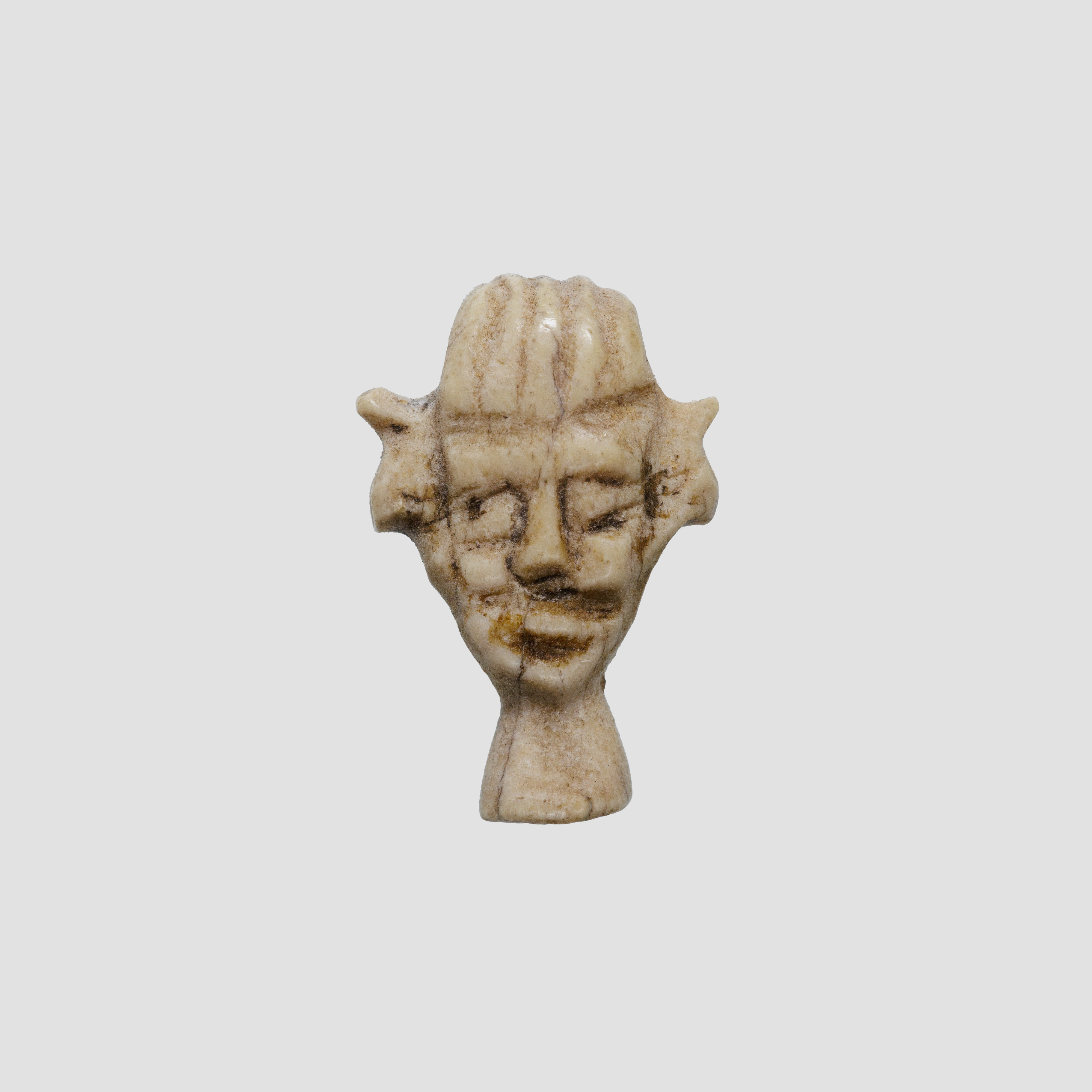
Executive Summary: The Apotropaic Face as Luxury Asset
In the material record of ancient civilizations, few objects carry the strategic density of the amulet in the form of a face. Carved in ivory or bone, these miniature visages functioned simultaneously as protective technology, social marker, and portable shrine. For Katherine Fashion Lab, this artifact class represents more than archaeological curiosity; it is a blueprint for a 2026 luxury strategy built on archaic authority, scarcity, and talismanic desire. This analysis examines the symbolic power, historical adornment logic, and spiritual meaning of the face amulet, then translates those findings into actionable positioning for the high-end market.
Symbolic Power: The Face as Apotropaic Interface
Warding and the Gaze
The carved face amulet was never merely decorative. In ancient contexts, the human countenance was understood as an active threshold between the wearer and unseen forces. The frontal, wide-eyed expression common to ivory and bone face amulets served an apotropaic function: to meet the malevolent gaze before it reached the wearer. This is the logic of sympathetic magic, where the representation of a watchful face substitutes for the watchfulness of a deity, ancestor, or guardian spirit.
Materiality and Metaphysical Value
Ivory and bone were not neutral choices. Both materials derive from living creatures, and in many ancient cosmologies they retained residual life force. Bone, in particular, was associated with ancestry and continuity; ivory, with purity, endurance, and elite access. A face carved in such material therefore condensed biological vitality, ancestral memory, and social prestige into a single object. The amulet did not simply represent protection; it was protection, activated through material and form.
Miniaturization as Power
The small scale of these amulets is strategically significant. Miniaturization concentrates agency. A face that could be held in the palm or worn against the skin operated as a private altar, granting the wearer continuous access to supernatural alliance without the mediation of temple or priest. This democratization of spiritual security made the face amulet a persistent feature of personal adornment across ancient civilizations.
Historical Adornment: Wearability, Status, and Identity
From Burial to Body
Archaeological contexts reveal face amulets in graves, domestic shrines, and personal assemblages. Their perforations, suspension loops, and worn surfaces indicate prolonged bodily contact. They were strung on cord, sewn into garments, or mounted on pins and fibulae. This wearability transformed the amulet into an extension of the self, a second face that spoke to the wearer’s spiritual literacy and social standing.
Gendered and Hierarchical Coding
While distribution varied by culture, face amulets frequently appear in high-status and gendered contexts. In some societies, they accompanied women as guardians of fertility and household continuity; in others, they marked male authority, military protection, or priestly office. The same visual motif could carry different meanings depending on who wore it and how. This semantic flexibility is precisely what makes the face amulet a powerful template for luxury branding: it is universal in form, specific in meaning.
The Amulet as Heirloom Logic
Durability of ivory and bone, combined with the intimacy of wear, encouraged intergenerational transfer. An amulet could outlive its first owner and accumulate biography. This heirloom logic anticipates the modern luxury principle of patina and provenance. The object becomes valuable not only for what it is, but for what it has witnessed.
Spiritual Meaning: The Face Between Worlds
Ancestral Mediation
In many ancient systems, the face was the locus of ancestral presence. A carved face amulet could invoke a specific forebear, a lineage guardian, or a generalized ancestral collective. Wearing it meant carrying the dead with the living, a practice that reinforced lineage identity and moral obligation.
Protection, Healing, and Transition
Face amulets were deployed at liminal moments: childbirth, illness, travel, warfare, and death. Their spiritual function was to stabilize the boundary between the known and the unknown. The face, as the most human of forms, offered recognition and reassurance in contexts of radical uncertainty. This is the emotional core that any luxury interpretation must respect: the amulet answers fear with presence.
2026 Luxury Strategy: From Artifact to Atelier
Positioning: Archaic Modernity
For Katherine Fashion Lab, the face amulet should be positioned within a strategy of archaic modernity: objects that feel simultaneously ancient and inevitable. The 2026 luxury consumer is saturated with digital novelty and seeks tangible, slow, meaning-dense artifacts. The face amulet offers a ready-made narrative of protection, ancestry, and material honesty.
Product Architecture
Recommend a three-tier product architecture:
Tier I — The Talisman: Small-scale face pendants in responsibly sourced bone or alternative ivory, priced for accessible luxury. These serve as entry points and daily-wear guardians.
Tier II — The Heirloom: Larger, hand-carved faces in premium materials, with documented provenance and artisan signature. These are collector pieces designed for intergenerational transfer.
Tier III — The Commission: Bespoke face amulets carved to the client’s own likeness or ancestral line, positioned as private ritual objects with unmatched personalization.
Material Ethics and Narrative
Given contemporary sensitivity around ivory, Katherine Fashion Lab must lead with material substitution and transparency. Vegetable ivory, reclaimed bone, and lab-grown alternatives can carry the same symbolic weight while aligning with 2026 ESG expectations. The narrative should emphasize continuity of meaning, not extraction of species.
Retail and Ritual Experience
The face amulet demands a ritualized retail environment. Consider dimly lit, museum-grade displays; tactile handling stations; and a naming ceremony in which each piece is dedicated to a guardian concept—protection, memory, courage, lineage. This transforms purchase into initiation, increasing perceived value and emotional retention.
Digital Amplification
Use digital channels not to dilute the artifact but to document its journey: archival references, carving process, material sourcing, and wearer stories. Short-form video should treat the face amulet as a character, not a product. The goal is to build a mythology of the gaze that consumers can participate in.
Conclusion: The Strategic Face
The ancient face amulet in ivory or bone is a compressed civilization: protection, status, ancestry, and beauty in a single wearable form. For Katherine Fashion Lab, its value in 2026 lies in its capacity to satisfy a luxury market hungry for meaning, materiality, and mystery. By honoring the artifact’s symbolic power, historical adornment logic, and spiritual function—while translating them through ethical sourcing and ritualized experience—the Lab can claim a rare position: guardian of the archaic, author of the future. The face looks back. The strategy looks forward.