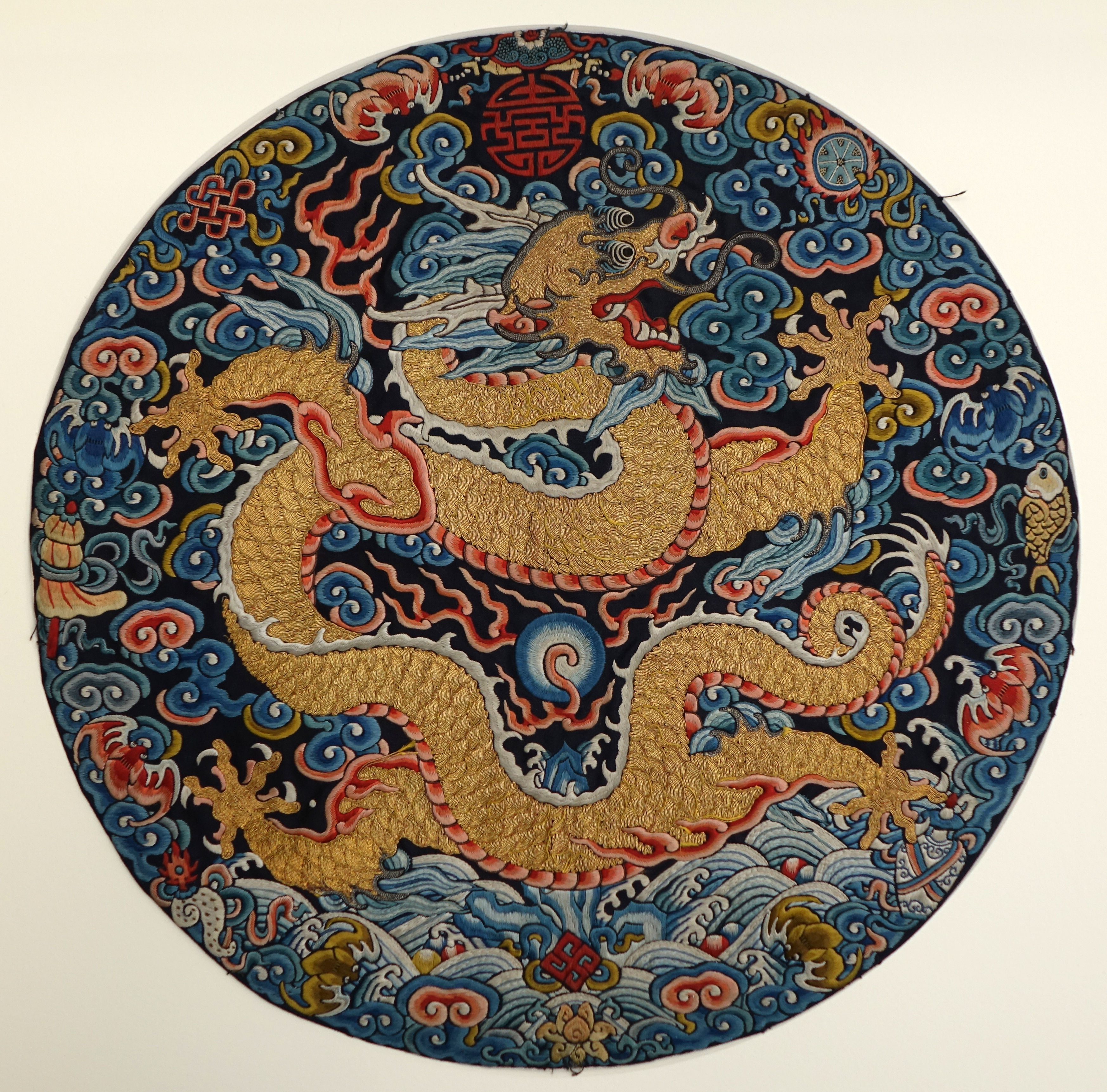
Medallion with Dragon and Auspicious Symbols: A Study in Chinese Silk and Metal Thread Embroidery
The medallion under examination represents a singular and highly refined expression of Chinese textile artistry, executed in silk and metal thread embroidery upon a ground of silk satin. As a standalone study, this piece transcends its immediate function as ornamentation to embody a convergence of technical mastery, cosmological symbolism, and imperial-era aesthetics. Within the context of Katherine Fashion Lab's ongoing investigation into global couture traditions, this medallion offers a compelling case study in how material, motif, and meaning coalesce into an object of enduring cultural significance.
Materiality and Technical Execution
The foundation of the medallion is a silk satin ground, a choice that is far from incidental. Silk satin, with its lustrous face and tightly woven structure, provides not only a physically stable substrate for dense embroidery but also a reflective surface that interacts dynamically with light. This quality is essential when considering the application of metal thread, which in Chinese embroidery traditions—particularly those associated with the Ming and Qing dynasties—often took the form of gold- and silver-wrapped silk, known as pian jin or yinjia xianxiu. The metal thread was typically wound around a silk core, allowing for flexibility while retaining a metallic sheen that catches and diffuses light across the satin surface.
The embroidery technique itself demonstrates a sophisticated command of stitch vocabulary. The dragon's scales, for instance, are likely rendered in scale stitch (linxiu), wherein overlapping rows of metallic thread create a three-dimensional, armor-like texture. The auspicious symbols interspersed around the dragon—possibly including the shou (longevity) character, ruyi clouds, or the bagua trigrams—would have been executed in satin stitch (duanxiu) or couched metallic thread, each stitch laid with precision to maintain the integrity of the motif while maximizing the play of light and shadow.
What distinguishes this medallion from more utilitarian embroideries is the density of coverage and the tonal modulation achieved through the selective use of colored silks alongside metal threads. The artisan has not merely outlined forms but has built up areas of color and texture that give the dragon a sense of coiled energy and the auspicious symbols a jewel-like prominence.
Iconography: The Dragon and Auspicious Symbols
At the center of the medallion is the dragon, a motif that in Chinese visual culture is not merely decorative but deeply cosmological. Unlike the malevolent Western dragon, the Chinese long is a beneficent creature associated with water, rain, and imperial authority. In the context of a medallion, the dragon is often depicted in a circular or coiled posture, symbolizing the eternal cycle of renewal and the centrality of the emperor within the cosmic order. The dragon's five claws—if present—would denote an imperial connection, as five-clawed dragons were reserved for the emperor and his immediate circle during the Qing dynasty.
Surrounding the dragon are auspicious symbols that amplify the medallion's talismanic function. These may include:
The Shou Character: A stylized rendering of the character for longevity, often embroidered in circular or medallion form. Its presence transforms the piece from a mere ornament into a wish for long life, a common aspiration in Chinese art and daily life.
Ruyi Clouds: These stylized cloud forms, often depicted as spiraling or trailing wisps, represent the ruyi scepter—a symbol of power and the fulfillment of wishes. When paired with a dragon, they suggest the dragon's ability to command the heavens and bring rain, and by extension, prosperity.
The Eight Buddhist Emblems or Eight Treasures: Depending on the specific composition, the medallion may incorporate symbols such as the wheel, the conch shell, the lotus, or the endless knot. Each carries layered meanings—spiritual, material, and philosophical—that would have been legible to a contemporary viewer steeped in Chinese cultural literacy.
The interplay between the dragon and these symbols is not haphazard; it follows a hieratic logic in which the dragon acts as the axis mundi, the point of connection between heaven and earth, while the surrounding symbols radiate outward as emanations of its power. This concentric composition is mirrored in the medallion's circular form, reinforcing the idea of wholeness, protection, and cosmic order.
Context and Function: The Standalone Study
As a standalone study, this medallion invites us to consider the original context from which it may have been detached. Chinese embroidered medallions of this type were often components of larger garments—imperial robes, theatrical costumes, or ceremonial hangings—or they may have served as independent talismanic objects, sewn onto clothing or displayed in domestic altars. The fact that this piece is presented in isolation allows for an uninterrupted appreciation of its craftsmanship, but it also raises questions about provenance and the original gestalt in which it functioned.
In the context of Katherine Fashion Lab, this medallion serves as a reminder that couture—whether Western or Eastern—is never merely about adornment. It is a technology of meaning, a way of encoding values, beliefs, and aspirations into material form. The anonymous artisan who embroidered this medallion was not simply following a pattern; they were participating in a centuries-old visual language, one in which every stitch, every color choice, and every motif carried weight.
Conclusion: A Legacy in Thread
The Medallion with Dragon and Auspicious Symbols stands as a testament to the sophistication of Chinese silk and metal thread embroidery. Its materiality—silk satin ground, metallic threads, colored silks—speaks to a deep understanding of how texture and light can be manipulated to create visual drama. Its iconography—dragon, longevity characters, ruyi clouds—reveals a cosmology in which the human, the natural, and the divine are interwoven. And its status as a standalone study invites us to look closely, to appreciate the labor, skill, and intentionality embedded in every square centimeter of its surface.
For the contemporary observer, whether a couture historian, a collector, or a designer, this medallion offers more than aesthetic pleasure. It offers a lesson in how objects can carry meaning across time, how tradition can be both preserved and transformed, and how the finest embroidery is, in essence, a form of writing in thread—a language that speaks of power, protection, and the enduring human desire to make beauty that lasts.