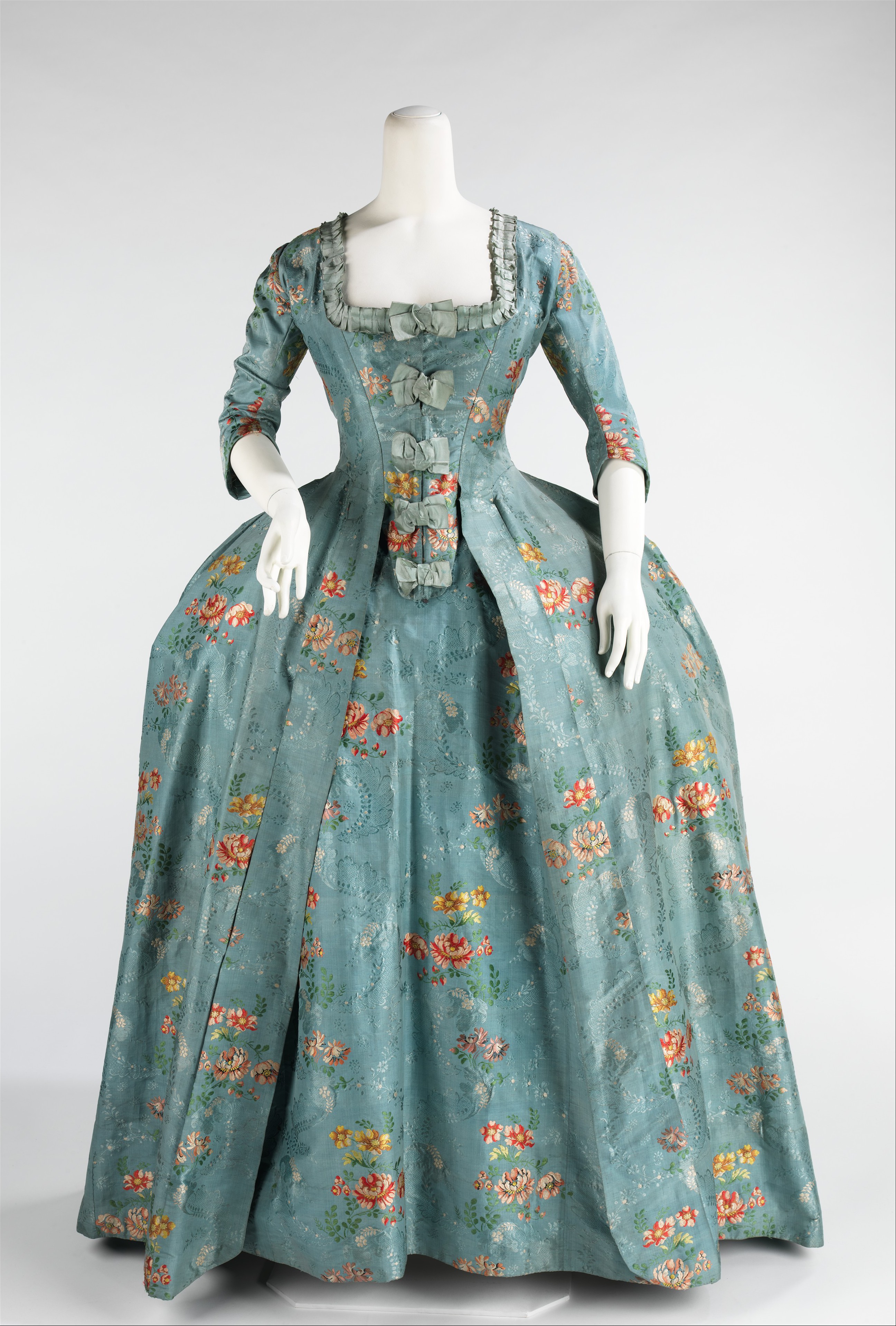
Robe à la française: The Architecture of Eighteenth-Century French Couture
The robe à la française stands as one of the most consequential garments in the history of Western dress—a sartorial invention that codified the relationship between textile, body, and social performance in eighteenth-century France. More than a gown, it was a structural system: a carefully engineered assemblage of silk and cotton that transformed the female silhouette into a canvas for the display of wealth, taste, and hierarchical position. For the contemporary analyst, the robe à la française offers a case study in how couture functions as both aesthetic object and instrument of cultural power.
Origins and the Logic of the French Court
Emerging in the early eighteenth century and reaching its apogee in the decades before the Revolution, the robe à la française—often called the sack-back gown in English—was the dominant formal garment of the French court and, by extension, of European aristocratic fashion. Its defining feature was the plis Watteau, or Watteau pleats: loose, unbroken folds of fabric falling from the shoulders down the back, named after the painter Antoine Watteau, whose canvases immortalized the garment's fluid rear silhouette. These pleats were not merely decorative; they represented a deliberate rejection of the fitted bodice in favor of a construction that privileged the movement and volume of the textile itself.
The garment's origin is inseparable from the ritualized environment of Versailles. Under the regulatory gaze of court etiquette, dress became a form of governance. The robe à la française was worn for formal occasions—presentations, receptions, and ceremonial gatherings—where appearance signaled proximity to the monarch. Its cost was prohibitive, its maintenance labor-intensive, and its silhouette unmistakable. In this sense, the gown functioned as a wearable credential, an assertion of membership in a closed elite.
Materiality: Silk, Cotton, and the Economics of Surface
The robe à la française was fundamentally a textile-driven garment. Silk was the prestige material par excellence, and the French silk industry—centered in Lyon—supplied the elaborate brocades, damasks, and satins that defined the gown's visual character. These fabrics were often woven with metallic threads and complex floral or geometric patterns, their production requiring months of specialized labor. A single gown could consume many meters of hand-woven silk, making the garment a direct translation of manufacturing cost into social capital.
Cotton played a more ambivalent role. Initially a lesser material in the formal hierarchy, cotton gained prominence through the eighteenth-century craze for indiennes—printed and painted cottons imported from India or produced in French manufactories such as those at Jouy. While the most formal robes à la française remained silk, cotton versions emerged for less ceremonial contexts and for warmer climates. The cotton question also carried political weight: French protectionist policies repeatedly restricted Indian cotton imports to shield the domestic silk and wool industries, making the material composition of a gown a matter of mercantilist policy as much as personal taste.
The interplay between silk and cotton therefore reflects a broader tension in ancien régime fashion: between the ceremonial demand for silk's luminosity and the practical, increasingly fashionable appeal of cotton's printability and relative affordability. The robe à la française sat at the intersection of these material economies.
Construction and the Engineering of the Silhouette
Technically, the robe à la française was a triumph of dressmaking as engineering. The gown consisted of a fitted bodice front and a back panel of loose pleats, worn over a conical corset and a pannier—a hooped understructure that extended the hips laterally. The pannier's width varied by period and occasion, from modest to nearly a meter on each side, and it dictated the wearer's movement through space. Doorways, carriages, and seating arrangements were all negotiated around the garment's dimensions.
The trained skirt added further complexity. Trains of considerable length trailed behind the wearer, their management requiring either a servant or practiced choreography. This was deliberate: the gown's impracticality was its point. To wear a robe à la française was to demonstrate that one did not need to work, walk unassisted, or move through the world efficiently. The garment encoded leisure as a visible value.
Symbolism and the Politics of Display
The robe à la française was never neutral. Its ornamentation—ribbons, lace engageantes, stomachers, and embroidered petticoats—invited close reading. Color carried meaning; certain fabrics were reserved by sumptuary convention for specific ranks or occasions. The gown also participated in the era's culture of parure, the coordinated ensemble in which dress, jewelry, and accessories formed a unified statement.
By the late eighteenth century, the garment's dominance began to erode. The rise of neoclassicism, the influence of Rousseau's critiques of artifice, and the political upheavals of the Revolution all contributed to a rejection of the panniered silhouette in favor of simpler, more "natural" forms. The robe à la française became, in retrospect, an emblem of the ancien régime itself—magnificent, exclusionary, and ultimately unsustainable.
Legacy and Contemporary Relevance
For Katherine Fashion Lab, the robe à la française is more than a historical artifact. It is a lesson in how couture constructs meaning through material, structure, and context. The garment demonstrates that fashion is never merely clothing; it is a system of signs. Its silk and cotton, its pleats and panniers, its trains and trimmings all participated in a grammar of social distinction that continues to inform luxury fashion today.
Contemporary designers who reference the robe à la française—whether through Watteau pleats, exaggerated volume, or historical textile quotation—engage with this legacy. The gown's enduring fascination lies in its dual identity: a feat of craftsmanship and a document of inequality. To study it is to understand how dress has historically mediated power, and how the politics of fabric and form remain central to the analysis of couture.