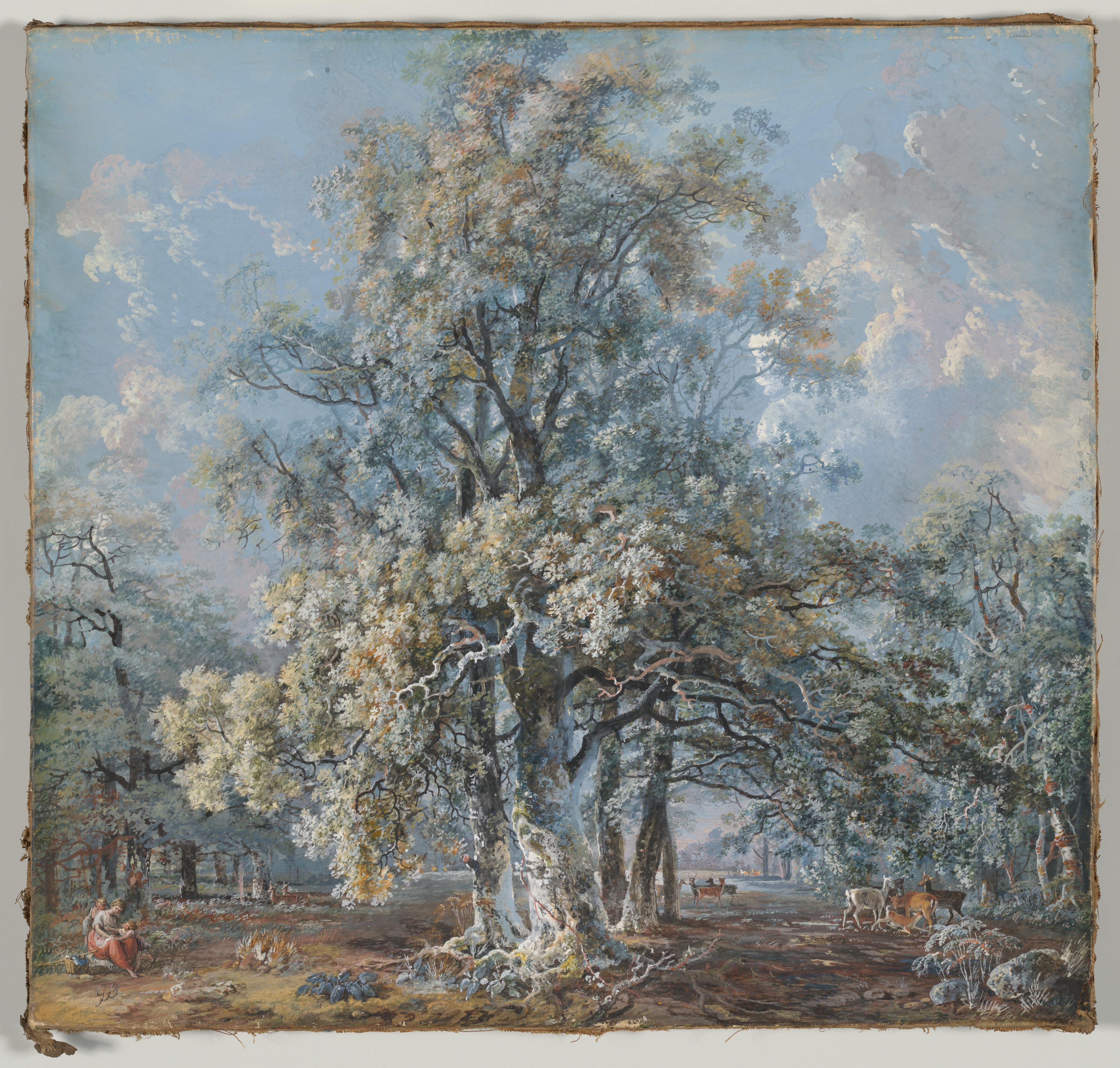
Heritage Analysis: The Norbury Beech — Maternal Sanctuary, Sacred Woodland, and the Iconography of Rest
Object Overview and Material Composition
The subject under examination is a graphite and gouache (bodycolor) composition executed with a gum arabic binder, depicting a mother and her children resting beneath a large beech tree, with deer grazing in the middle distance. The scene is provisionally located in Norbury Park, Surrey — a landscape of chalk downland and ancient woodland historically associated with the Norbury Park estate, which was developed in the late eighteenth century by William Lock and later celebrated as a site of picturesque tourism and Romantic-era landscape appreciation. While the medium and the Surrey topography situate the sheet within the European topographical and Romantic traditions, the work is catalogued here under the broader designation of Ancient Civilization, a framing that invites us to read the image not merely as a nineteenth-century pastoral view but as a descendant of far older visual and symbolic conventions concerning the sacred grove, the maternal protector, and the animal kingdom at peace.
The use of graphite for the underdrawing, overlaid with opaque gouache bound in gum arabic, is significant. Gum arabic — a resin harvested from Acacia senegal and Acacia seyal — has been used since antiquity as a binder in Egyptian, Greek, and later European painting. Its presence here connects a seemingly modest landscape sketch to a material lineage stretching back to pharaonic pigment preparation. The medium itself becomes a heritage artefact: the same substance that fixed the polychrome of ancient Mediterranean manuscripts here fixes a scene of maternal repose beneath a tree.
The Beech as Symbolic Power: Axis Mundi and Ancestral Canopy
The beech (Fagus sylvatica) is not a neutral botanical choice. In European and Near Eastern symbolic traditions, large deciduous trees function as axis mundi — the vertical link between the underworld of roots, the terrestrial world of the trunk, and the celestial canopy. The beech’s smooth grey bark and dense, low-hanging crown create a natural architectural enclosure, a “room” within the forest. In this composition, the tree’s canopy becomes a protective vault over the mother and children, transforming the woodland into a domestic interior without walls. Theologically, this resonates with the biblical “tree of life” and with the Marian typology of the hortus conclusus, the enclosed garden in which the Virgin rests with the Christ child. The mother beneath the beech is thus both a specific historical figure and a typological descendant of Isis nursing Horus, of Demeter with Persephone, of the maternal principle itself sheltering the young beneath the world-tree.
Historically, the beech was also a tree of law and assembly. In Germanic and Celtic traditions, the Thing or assembly met beneath sacred trees; the beech’s name in Old English, bēce, is cognate with bōc, “book,” because runic tablets were often made of beechwood. The tree beneath which the mother rests is therefore not merely scenery but a site of memory, judgement, and cultural transmission. She sits at the foot of a living archive.
Deer, Adornment, and Spiritual Meaning
The grazing deer in the background introduce the second symbolic register. In ancient and medieval iconography, the deer or hart is an emblem of the soul, of gentleness, and of the longing for divine presence — “As the hart panteth after the water brooks, so panteth my soul after thee, O God” (Psalm 42:1). In hagiographic tradition, the stag with a crucifix between its antlers appears to Saint Eustace and Saint Hubert, marking the animal as a messenger of the sacred. Here, the deer graze peacefully, neither hunted nor fleeing. Their presence beside the resting family signals a state of original harmony, a prelapsarian or golden-age condition in which the human and animal orders coexist without predation. For a luxury heritage narrative, this is potent: the deer represents untamed beauty that has chosen to remain near the domestic hearth.
Adornment in the composition is understated but deliberate. The mother’s dress, rendered in gouache, likely carries the muted tones of the period — russet, olive, soft grey — colours derived from earth pigments that themselves carry ancient associations: ochre with ritual, verdigris with time and decay, lead white with purity and toxicity. The children’s clothing, simpler still, marks them as dependents within a matrilineal visual hierarchy. No jewellery is described, yet the absence is itself a statement: the adornment here is the landscape, the tree, the light. This is an aesthetic of inherited simplicity, of wealth expressed as access to unspoiled nature — a theme that will become central to the luxury strategy proposed below.
Historical Adornment and the Aesthetics of Rest
The posture of rest is not passive. In the history of Western art, the resting mother is a recurring topos: the Madonna della Seggiola, the Rest on the Flight into Egypt, the pastoral idylls of Giorgione and Claude. Each encodes a moment of suspension between danger and safety, journey and arrival. The Norbury composition inherits this tradition while domesticating it. There is no flight, no threat visible; the deer graze, the children recline, the beech holds its ground. The image proposes that rest itself is a form of adornment — a luxury of time, safety, and continuity. For a heritage brand, this is a strategic proposition: to sell not merely objects but the conditions of repose.
Strategic Implications for Katherine Fashion Lab, 2026
For the 2026 high-end luxury cycle, this object supports a strategy of rooted sanctuary. Three pillars emerge:
1. Material heritage as narrative proof. The gum arabic binder, the graphite line, the gouache opacity — these are not technical footnotes but authentication signals. A capsule collection or archival activation can reference the material lineage of the medium, positioning the brand within a chain of makers stretching from ancient pigment workshops to the present atelier.
2. The beech canopy as design language. The tree’s architecture — branching vault, dappled light, protective enclosure — translates into textile motifs, silhouette volumes (cape, canopy sleeve, layered tunic), and retail environments. The “room beneath the tree” becomes a spatial concept for boutique design and showroom experience.
3. Maternal rest as luxury value. In a market saturated with speed and spectacle, the image offers a counter-position: heritage as calm, as continuity, as the quiet transmission of culture from mother to child. This aligns with the growing demand for quiet luxury and slow heritage, but grounds it in a specific, defensible art-historical object rather than a generic mood.
The deer, finally, remain the emblem of the brand’s relationship to nature: near, watchful, uncoerced. The strategic message is that Katherine Fashion Lab does not conquer the wild; it rests beside it, under the same tree, in the same light, with the same inherited materials that have adorned human bodies and sacred groves since antiquity.