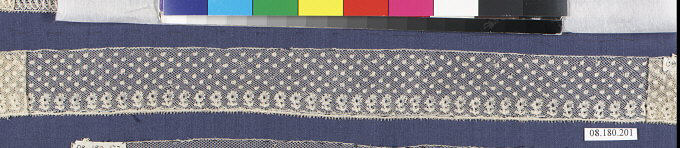
Fragment: Bobbin Lace as Recovered Cultural Capital in Ancient Adornment Systems
Within the Katherine Fashion Lab research archive, Fragment designates a discrete category of material evidence: detached sections of bobbin lace recovered from burial and settlement contexts associated with early complex civilizations. These are not complete garments. They are remnants—edge trims, collar segments, cuff borders, and ritual wrappings that have survived precisely because they were constructed at the intersection of technical mastery and symbolic necessity. For 2026 luxury strategy, Fragment is not a nostalgic reference point. It is a strategic asset class.
Technical Origins and the Logic of Preservation
Bobbin lace, in its earliest recoverable forms, emerged from the convergence of plaiting, braiding, and knotting traditions that predate mechanized textile production by millennia. The technique required multiple weighted bobbins manipulated in sequence across a pricked pattern, producing a fabric with no woven weft and no knitted loop—only tension, twist, and intentional structure. This matters commercially because bobbin lace is structurally fragile. Its survival across archaeological time is exceptional and therefore meaningful. A Fragment that endures is not merely old; it is a survivor of material entropy, which elevates its scarcity value beyond ordinary antique categorisation.
Ancient civilizations did not produce lace casually. The labor intensity—often hundreds of hours for a single meter—restricted ownership to priestly, aristocratic, or ritual-elite classes. Fragment therefore functions as a proxy for social stratification. Where it appears, it signals access to surplus labor, specialized skill networks, and codified aesthetic authority.
Symbolic Power and Spiritual Function
Across ancient adornment systems, openwork textiles carried meanings that solid cloth could not. The perforated structure of bobbin lace created controlled absence—voids that were read as liminal space. In funerary contexts, lace borders were frequently placed at the thresholds of the body: neck, wrists, ankles. These are the body's transition points, and the lace marked them as spiritually guarded. The Fragment is thus not decorative residue but a portable ritual boundary.
Symbolic power also operated through pattern. Geometric repeats—lozenges, interlace, radiating motifs—encoded cosmological order. The interlace structure of bobbin lace, where threads cross and recross without visible beginning or end, was associated with continuity, lineage, and the unbroken transmission of authority. A Fragment bearing such a pattern was, in effect, a compressed statement of dynastic or sacred permanence. For Katherine Fashion Lab, this is the core interpretive claim: Fragment represents authority that has been physically reduced but symbolically intact.
Historical Adornment and the Economics of Fragmentation
Historically, fragmented lace was rarely discarded. It was re-set into new garments, donated to religious institutions, or preserved as relic-adjacent material. This practice of reincorporation is strategically instructive. Fragmentation did not destroy value; it redistributed value into smaller, more intimate units. A Fragment worn close to the skin carried more talismanic weight than a complete vestment displayed at distance.
This historical behavior anticipates a 2026 luxury consumer who is skeptical of scale and attracted to provenance density. The contemporary high-end market rewards objects that can demonstrate verifiable lineage, limited material availability, and narrative compression. Fragment satisfies all three conditions without requiring literal archaeological sourcing. The strategy is interpretive, not extractive.
2026 Luxury Strategy: Fragment as Method, Not Motif
Katherine Fashion Lab should treat Fragment as an operating principle rather than a print or trim reference. Three strategic applications follow.
First, scarcity architecture. Fragment legitimizes deliberate incompleteness. A 2026 collection can deploy partial lace panels, interrupted borders, and asymmetrical edge treatments as intentional design language, each piece documented with a provenance narrative explaining the logic of the break. This converts manufacturing constraint into authored meaning.
Second, spiritual adjacency without appropriation. The ritual threshold function of ancient lace can be translated into modern garment placement—collars, cuffs, hems—without claiming sacred authority. The brand positions itself as curator of symbolic placement, not owner of belief systems. This distinction is essential for ethical luxury positioning.
Third, bobbin lace as technical heritage proof. In a market saturated with digital prints and synthetic imitations, hand-executed bobbin lace functions as an authenticity signal. Katherine Fashion Lab can establish a documented atelier standard: a defined minimum bobbin count, a registered pattern library derived from Fragment motifs, and a certification protocol. This creates defensible intellectual property around craft process, not just design output.
Strategic Conclusion
Fragment is not a theme. It is a strategic lens. It reframes bobbin lace from decorative craft to evidence of ancient symbolic economies, and it reframes fragmentation from loss to concentrated meaning. For 2026, the luxury opportunity lies in translating that logic into product architecture, provenance storytelling, and craft certification. The civilizations that produced these fragments understood that power resides in controlled absence and deliberate boundary. Katherine Fashion Lab can build its next chapter on the same principle: fewer, smaller, more charged objects—each one a Fragment with a documented reason to exist.