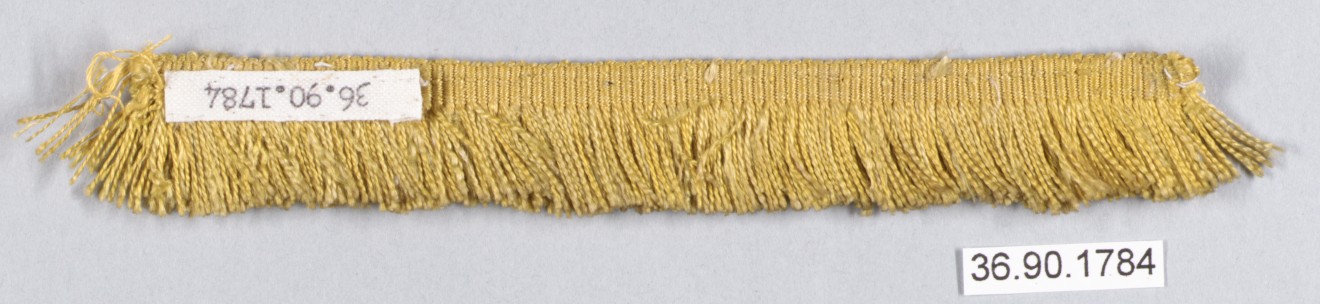
Fringe: A Global Heritage Materialized in Silk
Fringe occupies a singular position within the couture canon. It is at once ornament and architecture, movement and mass, a surface treatment that carries the weight of millennia. Unlike embroidery, which sits upon cloth, or beading, which punctuates it, fringe extends from the garment into space itself, creating a kinetic boundary between body and air. When executed in silk, this boundary becomes something rarer still: a study in how a single material can translate the rituals, hierarchies, and craftsmanship of disparate cultures into a unified language of luxury. This standalone study examines fringe not as a seasonal trend but as a global heritage technique, interrogated through the specific properties of silk.
Origins: A Cartography of Movement
The history of fringe is a history of convergence. In Mesopotamia, twisted wool and flax cords adorned ceremonial garments as early as 3000 BCE, their motion believed to ward off malevolent forces. In the Andes, pre-Columbian weavers incorporated fringe into textiles that recorded lineage and status, each knot a deliberate act of memory. Along the Silk Road, the technique traveled—absorbed, adapted, and reborn—until fringe became a shared vocabulary among cultures that otherwise shared little. The Ottoman Empire refined it into metallic cascades for royal caftans; West African weaving traditions integrated it into wrappers and adire cloth as markers of rank; and in the American Southwest, Pueblo and Navajo artisans developed a distinct fringed aesthetic rooted in spiritual practice and territorial identity.
What unites these traditions is not a single origin point but a shared intuition: that cloth, when extended into strands, acquires a life of its own. Fringe animates the static. It converts the garment from a container into a performer. For the couturier, this inheritance is both a gift and an obligation—a reminder that any use of fringe enters a global conversation already centuries in progress.
Silk: The Material Logic of Fringe
Not every fiber is suited to fringe. Wool is heavy and holds a sculptural line; cotton is democratic but lacks luminosity; synthetics offer durability at the cost of soul. Silk, by contrast, possesses a rare combination of properties that make it the ideal medium for fringed couture. Its tensile strength allows for the finest possible strands without compromising structural integrity. Its natural sheen captures light along the length of each cord, so that a fringed hem becomes a moving gradient rather than a static edge. Its drape—fluid, responsive, almost liquid—means that silk fringe does not hang so much as it flows.
Consider the technical demands. A single silk fringe panel may require hundreds of individually cut strands, each hand-knotted or twisted to prevent raveling. Because silk filament is continuous, unlike staple fibers, the fringe retains a smooth, unbroken surface that resists the frizzing common to shorter fibers. This smoothness is not merely aesthetic; it affects how the fringe behaves in motion. Silk strands separate and recombine with a precision that reads as intentional, even when the wearer is simply walking. In a couture atelier, this predictability is invaluable. The designer can choreograph movement with near-mathematical confidence.
Yet silk is also unforgiving. It shows every irregularity in cutting, every inconsistency in tension. A poorly executed silk fringe does not merely look flawed—it unravels, both literally and metaphorically. This is why the material demands a level of artisanal skill that few workshops still possess. The global heritage of fringe, in other words, is not preserved through nostalgia but through the continued training of hands capable of working with such exacting material.
Global Heritage, Contemporary Interpretation
To analyze fringe in silk today is to confront a paradox. The technique is ancient and geographically dispersed, yet its contemporary expression is often reduced to a single visual trope: the flapper dress, the Western jacket, the bohemian shawl. These references are not invalid, but they are incomplete. A more rigorous approach treats fringe as a structural device with which to interrogate silhouette itself. When silk fringe is applied not as trim but as the primary fabric of a garment—layered, braided, or left to fall in uninterrupted columns—it challenges the boundary between textile and sculpture.
This is where the global heritage becomes most relevant. Andean weavers understood fringe as a form of writing; Ottoman artisans understood it as a display of imperial reach; West African traditions understood it as a conduit between the visible and the spiritual. A contemporary couturier who engages with these histories does not merely borrow motifs. They enter into a dialogue about what cloth can signify. Silk, with its associations of trade, refinement, and cross-cultural exchange, is the appropriate medium for that dialogue. It is a fiber that has always moved between worlds.
The Discipline of the Strand
Ultimately, fringe in silk is a lesson in restraint. Because the material is so expressive, excess is fatal. A single well-placed panel of hand-knotted silk fringe can carry an entire garment; an overabundance collapses into noise. The couturier must therefore think like an editor, deciding not only where fringe appears but where it does not. The negative space around a fringed edge is as important as the fringe itself.
This discipline reflects the broader ethic of couture: that luxury is not accumulation but precision. The global heritage of fringe—Mesopotamian, Andean, Ottoman, West African, and beyond—offers a deep archive of techniques and meanings. Silk offers the material conditions for translating that archive into something wearable. The task of the contemporary atelier is to honor both without reducing either to decoration. Fringe, at its best, is not an embellishment. It is a statement about how cloth can move, how heritage can travel, and how a single strand of silk can hold the weight of centuries.