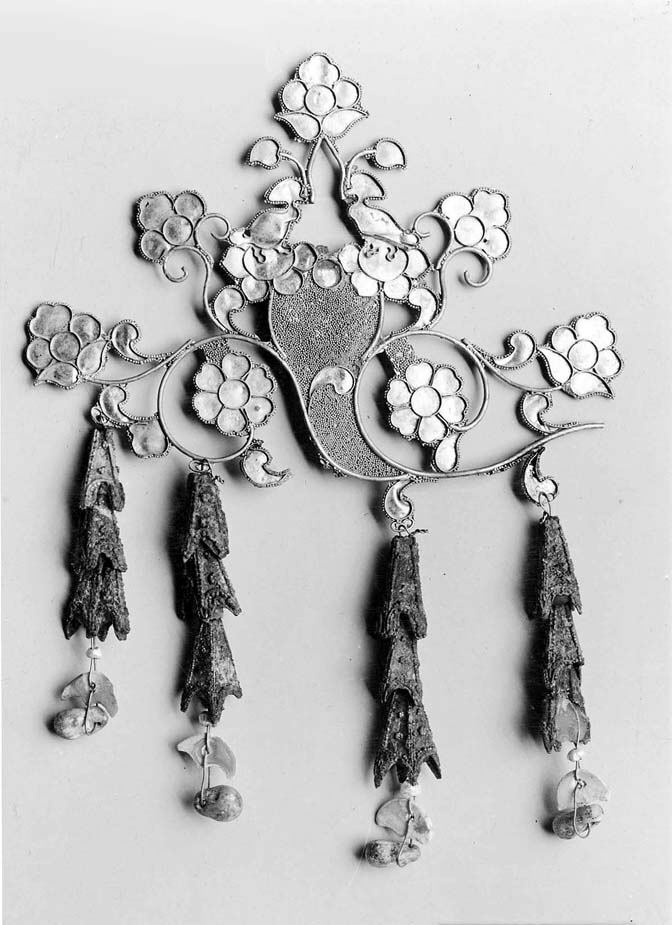
Side Ornament: Gold Adornment in Chinese Funerary and Ritual Tradition
The side ornament in Chinese goldwork represents one of the most sophisticated intersections of material wealth, spiritual cosmology, and personal adornment in East Asian history. Unlike central pectoral or crown ornaments that serve overt displays of rank, side ornaments—worn at the temples, ears, or suspended from belts—operate in a register of intimate proximity. They are seen in profile, glimpsed in motion, and often buried with the deceased as personal rather than institutional property. This distinction matters for Katherine Fashion Lab because it establishes a heritage category rooted in individual spiritual agency rather than collective ceremonial display.
Materiality and the Metaphysics of Gold
In Chinese funerary and ritual practice, gold carried a dual semantic load. It signified imperishability—resisting the corrosion that claimed bronze and iron—and therefore became a vehicle for the soul's continuity beyond death. Side ornaments fashioned from hammered gold sheet, often less than 0.2 millimeters thick, were frequently embellished with granulation, filigree, and repoussé work depicting botanical and avian motifs. The choice of gold was not merely aesthetic; it was theological. A gold side ornament placed at the temple of the deceased was understood to anchor the spirit's return, a material promise that the wearer's identity would survive decomposition.
This resonates directly with the research context we have established through our study of the Mirror with Split-Leaf motif—one face a polished silver mirror bearing gold-inlaid palm fronds, the other a cold stone sarcophagus panel narrating life in relief. Both objects operate on the same principle: the obverse is for the living, the reverse for the dead. The side ornament participates in this dialectic. Worn in life as a marker of beauty and status, it becomes in death a passport, a small golden argument against oblivion.
Symbolic Power: Botanical and Avian Motifs
Surviving examples from the Tang and Song dynasties reveal a consistent iconographic vocabulary. Palm or palm-like fronds—those same 纷繁棕叶纹 that appear in our mirror study—curl around the edges of side ornaments in rhythmic repetition. In Chinese symbolism, such fronds are not merely decorative. They evoke the lingzhi fungus of immortality, the tree of life, and the feathered wings of the fenghuang (phoenix). When rendered in gold, these motifs acquire an additional layer: the metal's incorruptibility transfers to the symbol itself, making the promise of renewal permanent.
Avian motifs—particularly paired birds facing one another—appear frequently on side ornaments intended for married women. The symmetry encodes marital fidelity, while the gold ensures that fidelity survives the grave. This is symbolic power operating at the level of the intimate: not a public proclamation of dynasty, but a private covenant between wearer and cosmos.
Spiritual Meaning: The Side Ornament as Psychopomp
In Daoist and later Buddhist-inflected funerary practice, the soul was understood to require guidance. Side ornaments, particularly those with suspended bells or jade beads, served an acoustic function. The soft chime produced by movement—whether in life or in the imagined afterlife—was believed to attract benevolent spirits and repel malevolent ones. The gold surface, polished to a mirror finish on some examples, also served as a reflective surface. Like the silver mirror in our comparative study, the gold side ornament could be turned inward, allowing the deceased to see their own refined soul rather than the decay of the body.
This is the spiritual core that Katherine Fashion Lab must understand: the side ornament is not merely jewelry. It is a technological interface between the living and the dead, a wearable prayer, a small golden argument that identity persists.
2026 High-End Luxury Strategy: From Heritage to Wearable Continuity
For the 2026 luxury market, the side ornament offers a strategic counter-narrative to the maximalist, logo-driven aesthetics of the previous decade. The contemporary consumer of high jewelry is increasingly interested in objects that carry metaphysical weight—pieces that can be worn in life and imagined as heirlooms that accompany the wearer into memory. The side ornament's inherent duality—intimate scale, spiritual function, material permanence—positions it perfectly for a luxury strategy built on continuity rather than novelty.
Katherine Fashion Lab should consider three strategic pillars:
1. The Obverse/Reverse Design Principle. Each piece should have a public face (polished gold, botanical inlay) and a private face (engraved narrative, perhaps a relief of the wearer's life). This mirrors the Mirror with Split-Leaf logic and creates a wearable object that is also a personal archive.
2. Acoustic and Kinetic Engagement. Reintroduce suspended elements—gold beads, tiny bells—that produce sound with movement. In a luxury context, this transforms the wearer into a participant in an ancient sensory ritual, not merely a consumer of static beauty.
3. Gold as Spiritual Technology. Position gold not as a symbol of wealth but as a material agent of continuity. Marketing language should emphasize incorruptibility, the anchoring of identity, and the side ornament's historical role as a psychopomp. This resonates with the 2026 luxury consumer's search for meaning beyond status.
Conclusion
The Chinese gold side ornament is a heritage object of extraordinary density. It carries botanical symbolism, avian fidelity codes, Daoist funerary function, and a material theology of gold as soul-anchor. For Katherine Fashion Lab, it offers a strategic opportunity: to create high jewelry that is not merely worn but inhabited—pieces that speak to the living and prepare for the dead, exactly as their Tang and Song predecessors did. In a market saturated with ephemeral luxury, the side ornament reminds us that the most powerful adornment is the one that promises to survive us.