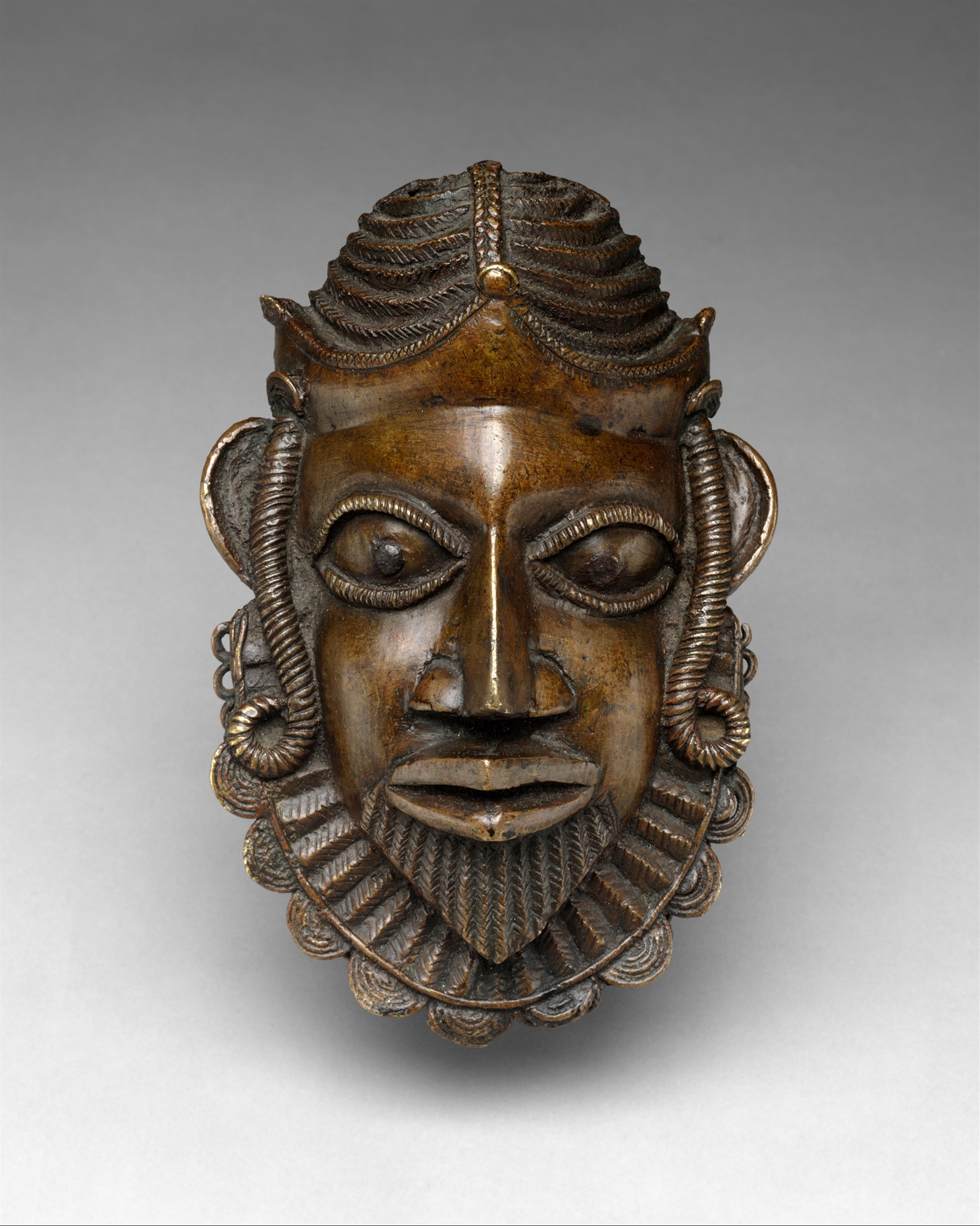
An Edo Brass Hip Ornament: Deconstructing Power, Prestige, and Transcultural Dialogue
Within the curated silence of the Katherine Fashion Lab, a singular object commands attention: a hip ornament (ukhurhe) from the Edo peoples of the Benin Kingdom, crafted from brass and iron. This is not merely an accessory; it is a dense, non-verbal treatise on sovereignty, spiritual protection, and the sophisticated aesthetic language of a West African empire at its zenith. As a standalone study, this piece invites us to move beyond superficial appreciation and engage in a deep material and semiotic analysis, revealing how couture—in its most profound sense—functions as an instrument of statecraft and identity.
Materiality as a Language of Hierarchy and Alchemy
The primary material, brass, is a deliberate and politically charged selection. In the Benin Kingdom, brass was not a mere decorative metal; it was the prerogative of the Oba (king) and the royal court, its use strictly controlled through guild systems. The casting of this ornament using the lost-wax technique speaks to the exceptional skill of the Igbesanmwan guild, whose artistry was dedicated to the glorification of divine kingship. The very substance of the piece, therefore, immediately communicates elite status and connection to centralized power. Its golden hue, achieved through specific alloys, would have caught the light dynamically during ceremonial dances, transforming the wearer into a luminous, awe-inspiring figure.
The incorporation of iron is equally significant. Iron, worked by the blacksmiths of the Igun Eronmwon guild, symbolized strength, endurance, and the ability to conquer chaos. Its presence within a predominantly brass ornament creates a potent material synergy. This combination can be read as an alchemical statement: the unyielding strength of iron (military and spiritual fortitude) is seamlessly integrated with the radiant, prestige-conferring quality of brass (royal authority and prosperity). The material dialogue itself becomes a metaphor for the ideal Edo ruler—both formidable and splendid.
The "Portuguese Head" Motif: Recontextualizing the Foreign
The most striking formal element is the depicted "Portuguese head." This common motif in 16th-18th century Benin art is frequently misinterpreted through a colonial lens. A deeper, more accurate analysis reveals a sophisticated process of transcultural appropriation and symbolic neutralization. The Portuguese, arriving by sea in the late 15th century, were initially perceived by the Edo as spirits from the realm of Olokun, the god of the sea and wealth. They represented novel technology, trade opportunities (especially in the brass manillas used for casting), and potential allies.
However, the Benin court did not simply replicate foreign features; it subsumed them into its own existing iconographic system. The stylized, almost mask-like rendering of the European face—with its prominent beard, long hair, and distinctive hat—transforms the specific individual into a generalized symbol. This "Portuguese head" came to represent the foreign, the exotic, and the source of overseas wealth and power, which the Oba had the unique authority to manage and control. By wearing this motif on a hip ornament, the elite individual literally girded themselves with a symbol of the kingdom’s far-reaching influence and its sovereign ability to engage with and master external forces.
Anatomies of Power: The Hip as a Locus of Significance
The choice of the hip as the site for this ornament is profoundly intentional. In Edo cosmology and physiology, the hip and waist are associated with mobility, agility, and generative power. Regalia worn here accentuates the movement of the body in ritual dance, a key component of court ceremony. The sway and jangle of such pieces would create a multisensory spectacle of sound and motion, marking the presence and vitality of the wearer.
Furthermore, the hip is structurally central, connecting the upper and lower body. An ornament of this placement and weight signifies balance, stability, and the anchoring of spiritual forces. It acts as a protective amulet, guarding a vulnerable yet powerful junction of the body. When viewed through the lens of couture, this transforms the garment or belt from which it hung into more than attire; it becomes an architectural exoskeleton, designed to project authority and provide metaphysical armor. The craftsmanship ensures that every movement is accompanied by the audible and visual proclamation of status.
Standalone Study: Towards a Universal Couture Philosophy
Examining this piece in isolation, as a standalone study, allows the Katherine Fashion Lab to distill universal principles of high adornment. This Edo hip ornament demonstrates that true couture—whether from 16th-century Benin or 21st-century Paris—operates on multiple synchronous levels:
1. Technical Mastery: The flawless lost-wax casting and intricate detailing set an uncompromising standard for craftsmanship, the very foundation of any luxury object.
2. Narrative Depth: Every element, from material to motif, is a loaded signifier, embedding complex cultural, political, and spiritual narratives into the wearable form.
3. Corporeal Architecture: It is designed in profound dialogue with the human body, enhancing, protecting, and redefining the silhouette and movement of the wearer.
4. Exclusive Symbolism: Its meaning and potency are contingent on a specific cultural context and hierarchy; its power is diluted outside of that understood system of values.
This analysis ultimately challenges parochial definitions of fashion history. The Edo brass hip ornament stands as a peer to the most elaborate European court regalia. It reminds us that the drive to use adornment as a tool for communicating power, identity, and belief is a human constant. For the contemporary designer, this piece offers a masterclass in how to imbue material with meaning, how to transform foreign influences into personal iconography, and how to craft objects that are not just worn but performed. It is a testament to the fact that the most enduring fashion is that which successfully garments ideology.