Introduction: The Cylinder Seal as a Neo-Sumerian Masterwork
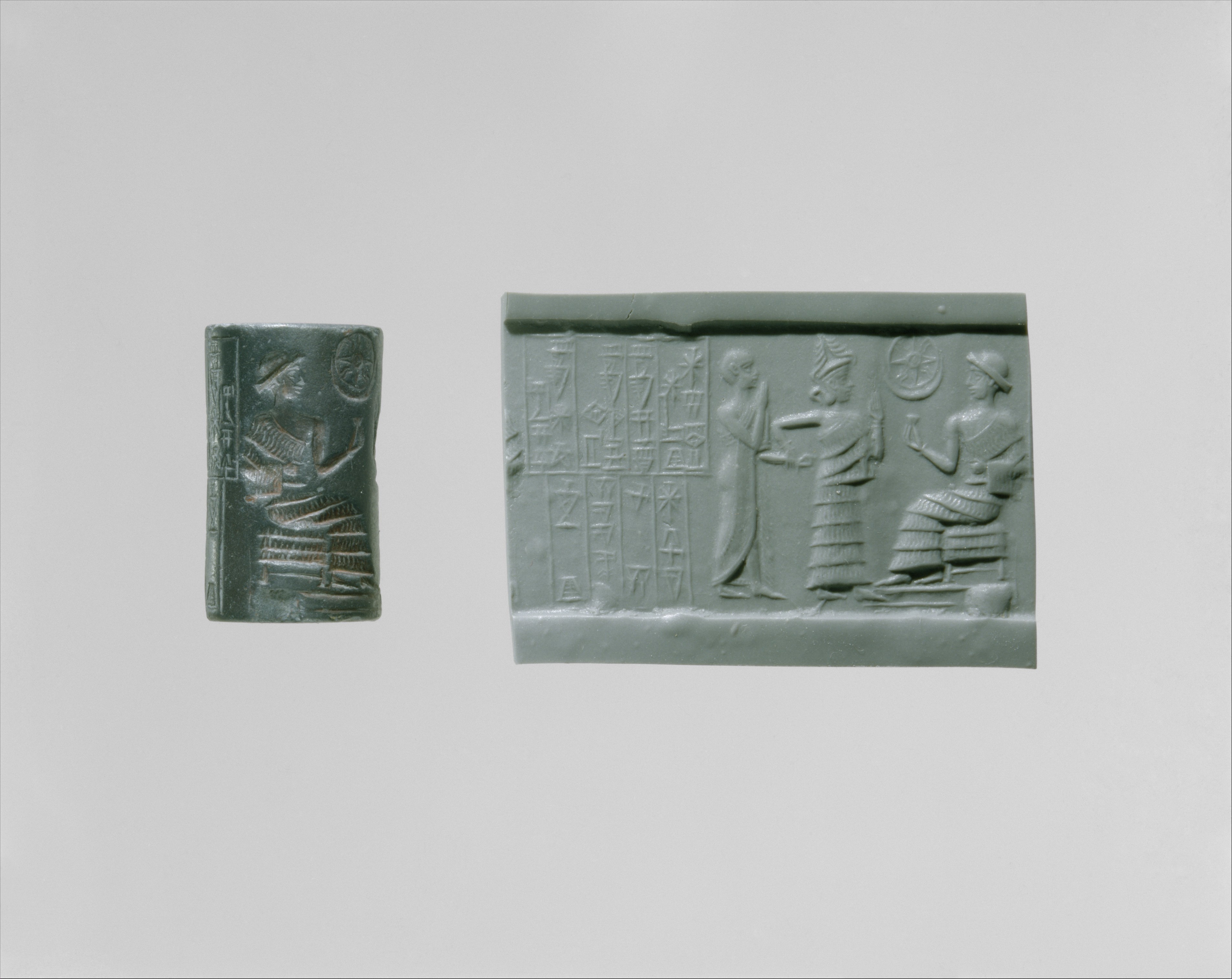
The cylinder seal is among the most consequential artifacts of ancient Near Eastern civilization, functioning simultaneously as a legal instrument, a marker of personal identity, and a vehicle for theological expression. Within the corpus of Neo-Sumerian glyptic art—roughly spanning the late third millennium BCE, particularly the Ur III period—the present seal, carved from hematite, offers a particularly refined example of the genre. Its subject—a seated figure approached by a goddess who leads a worshiper—condenses complex religious, social, and aesthetic priorities into a surface no larger than a human thumb. This standalone study examines the seal as both an object of material culture and a document of sacred diplomacy, analyzing its iconography, materiality, and stylistic grammar within the broader framework of Neo-Sumerian court art.
Materiality and Technique: The Significance of Hematite
The Stone and Its Associations
Hematite, an iron oxide mineral, was prized throughout Mesopotamia for its density, metallic luster, and deep gray-black hue. Unlike softer stones such as steatite or limestone, hematite resisted abrasion and thus preserved fine carving over millennia. Its hardness demanded exceptional technical skill: the engraver worked with a bow drill, copper tools, and abrasives such as emery, achieving relief so shallow yet articulate that the figures seem to breathe against the stone. In the Neo-Sumerian period, hematite seals were often associated with administrative elites and temple personnel—individuals whose legal and economic transactions required a durable, prestigious imprimatur.
Aesthetic Implications of the Medium
The choice of hematite was not merely practical. Its dark, reflective surface creates a dramatic interplay of light and shadow when rolled across clay, enhancing the legibility of the carved scene. The stone’s weight in the hand and its cool, metallic sheen also conveyed permanence and authority. For the modern curator, the material signals that this seal was likely commissioned by a person of means—someone for whom the act of sealing a document was also an act of devotional display.
Iconographic Analysis: The Seated Figure, the Goddess, and the Worshiper
The Seated Figure: Divine Authority and Kingship
At the center of the composition sits a figure on a throne, typically rendered in profile facing right. In Neo-Sumerian glyptic, the seated deity or king is a standard motif, but the precise attributes matter. Here, the figure wears a flounced robe and a horned crown—the latter a Near Eastern convention denoting divinity. The throne may be simple or elaborated with animal protomes, but the posture is unmistakable: legs together, one hand raised in a gesture of reception or blessing. This figure is likely a high god—Enki, Enlil, or Utu—or a deified king, a conflation common in Ur III art where royal and divine iconography merged.
The Goddess as Intercessor
Approaching from the left is a goddess, identifiable by her own horned crown and long, pleated garment. She leads a smaller, bare-headed figure by the hand: the worshiper. This triad—seated deity, intercessory goddess, and human supplicant—is a classic formula of Mesopotamian religious art. The goddess functions as a mediator, a role often filled by Inanna/Ishtar or a personal deity. Her forward stride and gentle grip on the worshiper’s wrist convey movement and intimacy, while the worshiper’s posture—one arm raised, eyes fixed on the seated figure—expresses reverence and petition.
The Worshiper: Identity and Agency
The worshiper is typically shown in a long robe, sometimes with a shaved head or a cap, indicating a priest or elite official. The absence of a horned crown marks him as mortal. His small scale relative to the deities emphasizes hierarchical proportion, a visual convention that persisted for millennia. Yet his presence is not passive: he is being introduced, presented, and granted access. The seal thus captures a moment of mediated encounter—a transaction of devotion that mirrors the legal transactions the seal itself would authorize.
Stylistic Grammar and the Neo-Sumerian Aesthetic
Linearity, Balance, and the Horror Vacui
Neo-Sumerian seal carvers favored a linear, almost calligraphic style. Figures are defined by crisp contours rather than modeled volume; interior details—pleats, musculature, throne decoration—are incised with fine, parallel lines. The composition is balanced but not static: the goddess’s stride and the worshiper’s lean create a subtle diagonal tension that draws the eye toward the seated figure. Negative space is used sparingly; a cuneiform inscription or a filling motif (such as a star or a vessel) often occupies the field, reflecting a horror vacui that ensures every part of the seal surface carries meaning.
Narrative Compression
Unlike monumental reliefs, which can unfold a narrative across multiple registers, the cylinder seal compresses a complete theological scene into a continuous frieze. When rolled, the image repeats, creating an endless procession of worshipers approaching an eternal deity. This repetition is not redundancy but ritual: each impression reenacts the original act of devotion. The seal thus operates as a portable temple, a microcosm of the divine-human interface.
Context and Function: The Seal as Social and Sacred Technology
Administrative and Devotional Dualism
In Ur III society, cylinder seals were indispensable for bureaucratic administration. They authenticated contracts, receipts, and letters. But they were also amulets, worn on the wrist or around the neck, and buried with their owners. The present seal’s subject—a goddess leading a worshiper—suggests that its owner sought divine favor in both professional and personal spheres. The act of rolling the seal onto clay was thus a double performance: a legal signature and a prayer.
Standalone Study and Museum Interpretation
As a standalone study, this seal invites us to consider how isolated objects can illuminate entire cultural systems. Without its original archival context—the tablets it once sealed, the tomb it once occupied—we must reconstruct meaning from iconography, material, and style. This is both a limitation and an opportunity. The seal becomes a node through which we can trace networks of trade (hematite often came from Iran or Anatolia), workshop practices, and theological shifts. In a museum vitrine, it demands close looking: the viewer must lean in, adjust the light, and mentally rotate the stone to recover its full narrative.
Conclusion: The Enduring Power of the Miniature
The Neo-Sumerian cylinder seal in hematite, depicting a seated figure approached by a goddess leading a worshiper, is a triumph of miniature engineering and theological imagination. It transforms a hard, dark stone into a stage for divine intercession, social hierarchy, and personal piety. Its value lies not only in its beauty—the elegant linearity, the balanced composition, the lustrous material—but in its capacity to encapsulate an entire worldview. For Katherine Fashion Lab, this seal exemplifies how the smallest artifacts can carry the heaviest cultural weight, reminding us that in the ancient Near East, as in contemporary couture, the most intimate objects often speak the loudest. The seal is a signature, a prayer, and a portrait of a civilization—all rolled into one.