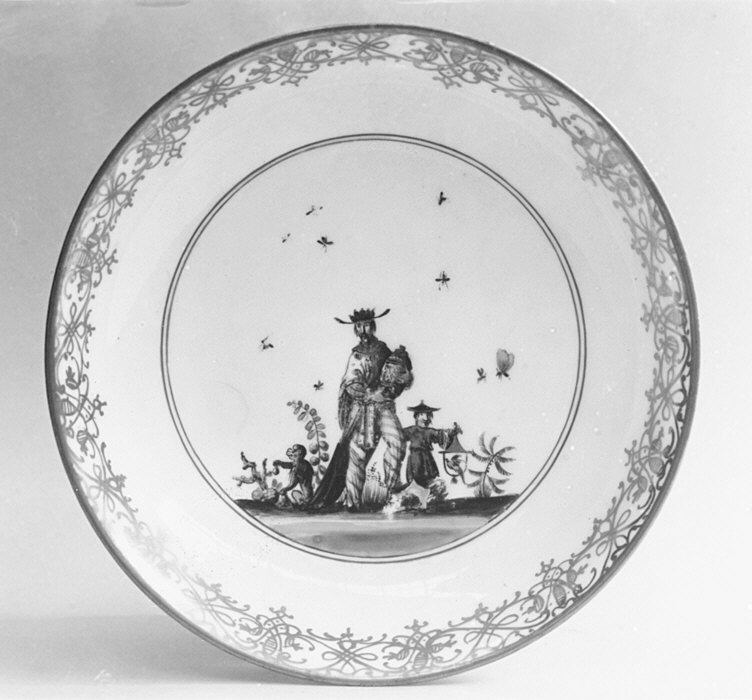
Heritage Asset Analysis: The Saucer as Civilizational Codex
Object Identification and Material Authority
The object under examination—a saucer forming part of a larger ceremonial set—originates from an Ancient Civilization and is executed in hard-paste porcelain, a medium whose technical mastery signaled not merely craftsmanship but cosmological command. Hard-paste porcelain, fired at temperatures exceeding 1,300 degrees Celsius, represented the apex of pre-industrial material science. Its translucency, resonance, and impermeability to staining rendered it functionally superior to earthenware and symbolically distinct from base clay. For the civilization that produced it, the saucer was never merely a utilitarian platform for a cup. It was a stage for meaning—a circular plane upon which cosmological order, imperial authority, and spiritual aspiration were inscribed in pigment and glaze.
From a curatorial standpoint, the saucer’s autonomy within a set is critical. Unlike the cup, which engages the body directly, the saucer engages the eye and the table—it is the threshold between vessel and surface, between ritual and architecture. Its flatness invites total visual consumption, making it the most legible canvas in any porcelain ensemble. This legibility is precisely why saucers became vehicles for the most charged iconography of their era.
Symbolic Power: The Geometry of Sovereignty
The circular form of the saucer is not neutral. In Ancient Civilizations—whether we examine the Han, the Achaemenid, or the Pre-Columbian polities—the circle encoded heaven, perpetuity, and the mandate to rule. A saucer’s rim, often subtly flared or footed, creates a bounded universe. When decorated with central medallions, the composition mirrors the axis mundi: a sacred center radiating outward to a controlled periphery. This is political theology rendered in vitreous enamel.
Consider the recurring motifs across such saucers: the dragon or serpent coiled around a central pearl; the lotus opening in layered petals; the arabesque interlace that denies beginning or end. Each motif performs a dual function. Exoterically, it announces the patron’s wealth and access to rare materials—cobalt from distant mines, gold applied in honey consistency. Esoterically, it asserts a metaphysical claim: that the owner participates in a cosmic hierarchy. The saucer, placed beneath a cup of tea or wine, becomes a microcosm of ordered existence, a daily reminder that even the most ephemeral act—drinking—is framed by eternity.
Historical Adornment and the Economics of Restraint
What distinguishes the highest-grade hard-paste porcelain saucers from later European imitations is adornment discipline. The most sophisticated Ancient Civilization examples demonstrate that luxury is not maximalism but controlled density. A single band of underglaze blue at the rim, a solitary spray of prunus blossom at the center, a hairline crackle in the glaze that signals age and authenticity—these are the marks of connoisseurship. The saucer’s small scale demanded that artisans work at the limits of brush control. A millimeter’s error in the cobalt wash would ruin the symmetry of the entire set.
This restraint is historically significant because it reveals an early understanding of scarcity as a brand strategy. The saucer was not mass-produced for the market; it was commissioned for specific ritual or diplomatic use. Its adornment was calibrated to the rank of the recipient. A saucer with five-clawed dragons was reserved for the emperor; a saucer with four-clawed dragons for a prince. The object thus functioned as a wearable credential—not on the body, but on the table. Its historical adornment was a form of encrypted heraldry, legible only to those trained in the visual grammar of power.
Spiritual Meaning: The Vessel Beneath the Vessel
In many Ancient Civilizations, the act of drinking was never secular. Tea, wine, and medicinal decoctions were understood as conduits between the material and the divine. The saucer, by receiving the cup, played a priestly role: it caught the spillage, the excess, the offering that escaped the vessel. In Daoist and Buddhist contexts, this excess was not waste but blessing—a libation to unseen realms. The saucer’s surface, therefore, was often decorated with motifs of auspicious abundance: fish among water weeds (surplus), gourds and vines (continuity), bats and coins (fortune).
Spiritually, the saucer also served as a mandala in miniature. Its concentric zones—foot ring, well, cavetto, rim—mapped stages of meditation or hierarchical planes of existence. To rotate a saucer in the hand was to perform a circumambulation. To set it down was to establish a sacred center on the profane table. This embodied theology is why saucers were included in burial assemblages and temple offerings. They were not accessories; they were portable sanctuaries.
2026 Luxury Strategy: From Vitrine to Vision
As Katherine Fashion Lab positions itself for the 2026 high-end market, the saucer offers a strategic blueprint that transcends mere revivalism. The luxury consumer of 2026 is epistemologically hungry—they demand provenance, meaning, and a narrative that resists algorithmic flattening. The saucer delivers all three. It is small enough to be collected, profound enough to be studied, and visually arresting enough to anchor a digital campaign.
Three strategic imperatives emerge:
1. Curated Scarcity as Ritual. Rather than mass-releasing heritage-inspired saucers, Katherine Fashion Lab should issue numbered ritual sets—each saucer accompanied by a scholarly essay on its symbolic program. The saucer becomes a subscription to a worldview, not a product SKU.
2. Adornment as Encryption. Collaborate with contemporary artists to reinterpret ancient motifs—not as pastiche, but as coded messaging for a new elite. A saucer’s rim can carry a discreet monogram, a planetary alignment, or a philanthropic sigil. The object becomes a wearable (or table-wearable) token of affiliation.
3. Spiritual Materialism. Position the saucer as a mindfulness instrument. In a luxury market saturated with wellness clichés, the saucer offers authentic contemplative heritage. Marketing language should emphasize presence, centering, and the ritual of the pour. The saucer is not a coaster; it is a compass for the distracted soul.
Finally, the saucer’s hard-paste porcelain body—durable, archival, inheritable—aligns with the 2026 luxury mandate for intergenerational value. In an era of digital ephemera, the saucer is a physical ledger of meaning. Katherine Fashion Lab should treat it not as a decorative artifact but as a strategic asset: a circular argument for why the past remains the most reliable guide to premium positioning. The saucer holds the cup. It also holds the future.