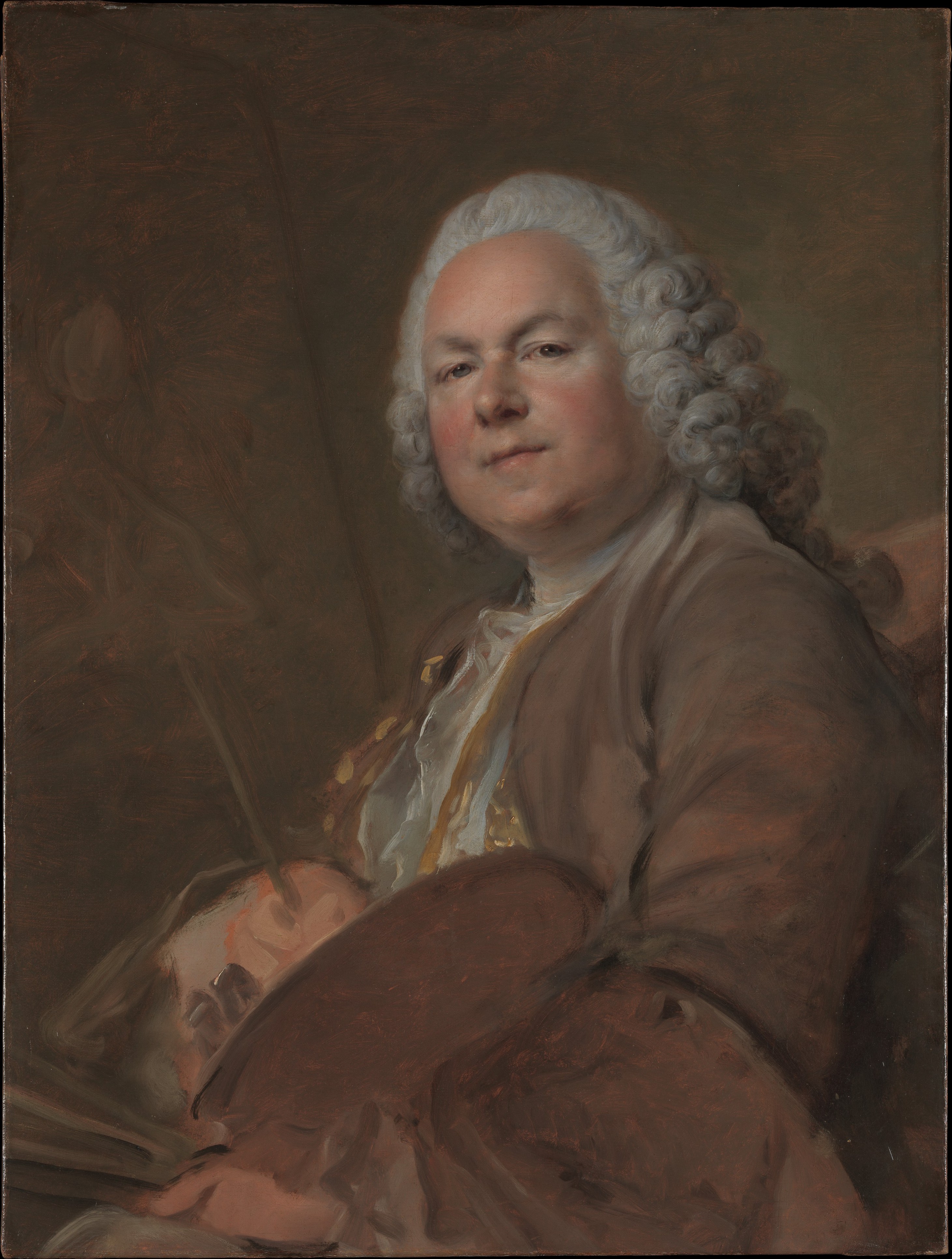
Jean Marc Nattier: The Painter of Allegorical Grace in Eighteenth-Century France
Within the rarefied ecosystem of eighteenth-century French court portraiture, Jean Marc Nattier (1685–1766) occupies a singular position. Neither a radical innovator nor a mere epigone of his contemporaries, Nattier constructed a visual language that fused mythological allegory with the precise materiality of the Rococo. His work, executed primarily in oil on canvas, represents a sophisticated negotiation between the demands of aristocratic self-fashioning and the painterly intelligence of a rigorously trained academician. As a standalone study within the Global Heritage canon, Nattier's oeuvre merits close re-examination—not as a footnote to the careers of Rigaud or Largillière, but as an autonomous aesthetic system that transformed portraiture into a theatre of idealized identity.
From History Painting to the Poetics of the Portrait
Born in Paris in 1685, Nattier received his earliest instruction from his father, Jean Nattier, a portraitist of modest reputation, before entering the studio of Jean Jouvenet and later Nicolas de Largillière. His academic credentials were formidable: he won the Prix de Rome in 1710 and subsequently spent time in Italy, absorbing the Venetian colorism and the dramatic chiaroscuro of the Bolognese school. Yet upon his return to Paris and his reception into the Académie Royale in 1718, Nattier made a decisive professional pivot. Rather than pursuing the grand genre of history painting—the theoretical summit of academic hierarchy—he applied its rhetorical devices to portraiture. This was not a retreat but a strategic recalibration. In Nattier's hands, the portrait became an arena for mythological narrative, a space where the sitter could be transfigured into a deity, a muse, or an allegorical virtue without surrendering the verisimilitude that elite patronage demanded.
This synthesis is the defining characteristic of Nattier's contribution to Global Heritage. He did not merely paint faces; he painted identities in flux—social identities, gendered identities, and political identities—all mediated through the prestigious filter of classical myth. The oil medium allowed him to achieve a distinctive surface: luminous flesh tones, diaphanous fabrics, and a chromatic palette that balanced cool silvery blues against warm rose and ochre. The canvas support, prepared with traditional gesso and oil ground, provided the stability necessary for his meticulous glazing technique, which lent his compositions an enamel-like finish and an almost supernatural luminosity.
The Allegorical Portrait as Commodity and Critique
Nattier's most celebrated works are his portraits historiques—paintings in which the sitter appears as a mythological or historical figure. Madame de Pompadour as Diana the Huntress (1746) and Madame Adélaïde as Diana (1745) exemplify this mode. In these canvases, the trappings of the hunt—the crescent moon diadem, the quiver, the bow—function less as narrative attributes than as semiotic markers of aristocratic virtue: chastity, agency, and martial vigor. Yet Nattier never allows the allegory to overwhelm the portrait. The face remains recognizably individual, the skin rendered with a cosmetic perfection that flatters while it idealizes. This double coding—mythological role and social identity—creates a productive tension. The viewer is invited to admire both the painter's erudition and the sitter's prestige, even as the painting quietly acknowledges that identity itself is a performance.
From an MBA-level perspective, Nattier's practice anticipates modern brand management. He identified a niche—the allegorical portrait—and dominated it through consistent quality, strategic networking, and a recognizable house style. His clientele included the royal family, the financier class, and the intellectual elite. Each commission was a bespoke product, tailored to the sitter's aspirations, yet unmistakably stamped with the Nattier signature: pearlescent skin, powdered hair, and a cool, silvery atmosphere that distinguished his work from the warmer, more robust manner of his rivals. This consistency built trust and commanded premium prices, positioning Nattier as the go-to painter for those who wished to appear both fashionable and learned.
Materiality and Technique: The Alchemy of Oil on Canvas
An analysis of Nattier's technique reveals a painter deeply attuned to the physical properties of his medium. He typically worked on medium-grain linen canvas, primed with a warm ochre or reddish-brown ground that lent depth to subsequent layers. His process involved a careful progression from a monochrome underpainting—often in raw umber—to local colors applied in thin, translucent glazes. This method, inherited from the Venetian tradition and refined by French academic practice, allowed him to achieve the soft transitions of tone that characterize his flesh passages. The cheeks of his sitters bloom with a restrained rouge, while their eyes glisten with a single, precise highlight. The fabrics—silk, velvet, lace—are rendered with a tactile sensitivity that transforms pigment into texture.
Crucially, Nattier's use of light is theatrical but controlled. He favors a cool, diffuse illumination that seems to emanate from the canvas itself rather than from a discernible source. This light flattens the picture plane slightly, pushing the figure forward and emphasizing the decorative surface. In this, he aligns with the Rococo sensibility of Watteau and Boucher, yet his restraint prevents the ornamental excess that would later provoke Diderot's criticism. Nattier's paintings are not frivolous; they are calculated, elegant, and quietly intellectual. The allegorical apparatus—the attributes, the gestures, the classical references—invites the informed viewer to participate in a game of recognition, transforming the act of looking into a form of social and cultural literacy.
Legacy and Critical Reassessment
For much of the nineteenth and early twentieth centuries, Nattier was dismissed as a lightweight, a painter of pretty faces for a decadent aristocracy. The rise of social history and feminist art history in the late twentieth century, however, has prompted a more nuanced appraisal. Scholars now recognize that Nattier's portraits are not merely decorative but ideological. They construct and contest notions of femininity, power, and class. The allegorical mode, far from being escapist, is a sophisticated strategy for negotiating the limitations placed on women in the ancien régime. By depicting his female sitters as Diana, Minerva, or Hebe, Nattier granted them a symbolic agency that their legal and social status denied them in reality.
Moreover, Nattier's technical brilliance—his mastery of oil on canvas—ensures his place in the Global Heritage narrative. He represents a high-water mark of French Rococo portraiture, a moment when the material properties of paint, the conventions of allegory, and the ambitions of a rising bourgeoisie and a entrenched nobility converged on the same canvas. His work invites us to consider how identity is always mediated, how the self is performed, and how art can simultaneously flatter and critique. In an era of curated online personas and branded selves, Nattier's eighteenth-century sitters—transfigured into goddesses yet unmistakably themselves—seem unexpectedly familiar. They remind us that the desire to be seen as more than we are is not a modern invention but a perennial human impulse, one that Nattier rendered with unparalleled grace and technical finesse.