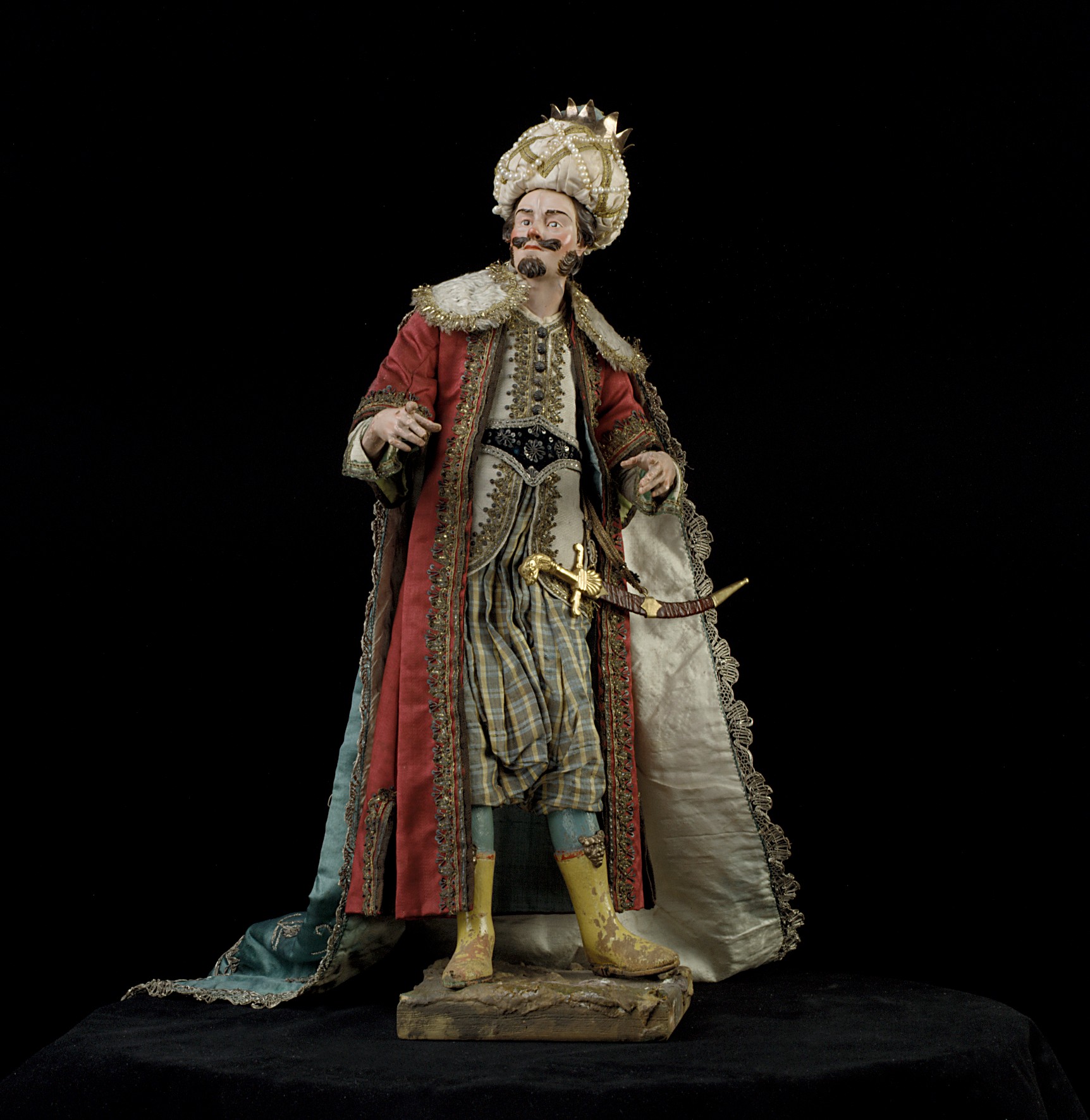
King: A Study in Ceremonial Authority and Material Synthesis
The object designated simply as King occupies a rare position within the Katherine Fashion Lab's standalone study collection: it is not a garment, nor a mannequin in the conventional sense, but a fully realized ceremonial effigy whose construction collapses the boundaries between sculpture, textile art, and regalia. Originating from a global heritage tradition of processional and votive figure-making, this work assembles a polychromed terracotta head and wooden limbs onto an armature of wire wrapped in tow, then clothes the resulting body in satin, silk, and velvet enriched with silver and metallic thread. A silver-gilt sword and crown complete the ensemble, while a leather sheath anchors the figure's martial identity. The result is a total look in the truest couture sense—every surface, from skin to steel, is authored.
The Head as Couture Surface
The polychromed terracotta head is the figure's psychological and aesthetic anchor. Unlike a painted portrait bust, which fixes identity in a single medium, this head functions as a wearable proposition: it must harmonize with fabrics that shift under light, with metal that throws reflection, and with a body whose proportions are deliberately artificial. The polychromy—layered pigment applied to fired clay—establishes a skin tone that is neither naturalistic nor purely symbolic, but rather a calculated ground against which satin's sheen and velvet's absorption can be read. In couture terms, the head is the equivalent of a foundation garment: it determines how everything above and below it will drape, catch light, and communicate status. That it is terracotta, a material associated with both antiquity and the kiln's transformative fire, lends the figure a permanence that fabric alone can never achieve.
Armature and the Architecture of Presence
Beneath the garments lies a body that is frankly prosthetic: wire wrapped in tow. This is a critical admission. The King does not pretend to be flesh; it declares itself as constructed. The wire provides poseability and structural memory, allowing the limbs to hold gestures that a rigid sculpture could not sustain. The tow—coarse, fibrous, inexpensive—serves as the interface between armature and garment, a padding that prevents metal from abrading silk and gives the limbs a volume that reads as anatomy at a distance. In the vocabulary of couture, this is the toile: the humble, unseen structure that makes the finished garment possible. That the Katherine Fashion Lab preserves this layer as part of the study, rather than concealing it, reframes the armature as intentional design. The King's authority is not innate; it is engineered.
Sartorial Hierarchy: Satin, Silk, Velvet, and Metallic Thread
The garments themselves constitute a graded hierarchy of luxury. Satin, with its high luster and smooth face, is deployed where the figure must catch and throw light—likely the outer robe or ceremonial mantle. Silk, more subdued and structurally versatile, forms the intermediate layers: sleeves, under-tunics, and the fine detailing that rewards close inspection. Velvet, with its dense pile and light-absorbing depth, provides the visual weight that grounds the composition, most probably in the lower body or as a contrasting panel against the satin's brilliance. The silver and metallic thread is the unifying agent: embroidery, passementerie, or woven figuring that traces the garments' edges and motifs, creating a continuous line of precious metal that links textile to sword to crown. This is not decoration for its own sake. In the semiotics of ceremonial dress, metallic thread signals proximity to power; its density and placement encode rank. The King wears its hierarchy literally on its sleeve.
Regalia: Sword, Crown, and Sheath
The silver-gilt crown and sword are the figure's punctuation marks. Gilt silver—gold applied over silver—is a deliberate material compromise: it delivers the visual authority of gold at a fraction of the weight and cost, a practical consideration for a figure that must be dressed, posed, and potentially processed. The crown sits at the apex of the composition, its metallic surface echoing the threadwork below and completing a vertical line of precious material that runs from head to hem. The sword, by contrast, introduces a diagonal, martial energy. It is a tool of enforcement, and its presence transforms the King from a mere display of wealth into a figure of active authority. The leather sheath is the quiet counterpoint: a utilitarian, organic material that protects the blade and grounds the metal in the practical world. Leather also provides tactile contrast—matte against sheen, animal against mineral—that prevents the ensemble from reading as a single, monotonous surface of luxury.
Global Heritage and the Standalone Study
Classifying King under "Global Heritage" is an acknowledgment that this mode of figure-making—polychrome head, articulated limbs, layered textiles, metal regalia—appears across multiple cultures, from European votive and processional traditions to West African and Latin American ceremonial arts. The Katherine Fashion Lab's decision to treat it as a standalone study rather than part of a regional or chronological sequence is methodologically significant. It isolates the object as a case study in how authority is manufactured through material. The King is not important because of where it comes from, but because of what it demonstrates: that power, in dress as in politics, is an assembly. Terracotta, wood, wire, tow, satin, silk, velvet, silver, gilt, leather—each material contributes a specific property, and the sum is a coherent, commanding presence that no single element could achieve alone.
Conclusion: The King as Total Look
In contemporary couture, the "total look" is the highest ambition: a unified statement in which garment, accessory, and styling are inseparable. King achieves this centuries before the term existed, and does so with materials that range from the ignoble (tow, wire) to the exalted (silver-gilt, velvet). Its genius lies in the seamlessness of that range—the viewer is not meant to see the armature, only the authority it supports. For the Katherine Fashion Lab, the figure serves as a permanent reminder that fashion's most enduring subject is not fabric, but power: how it is built, how it is worn, and how it is made to last.