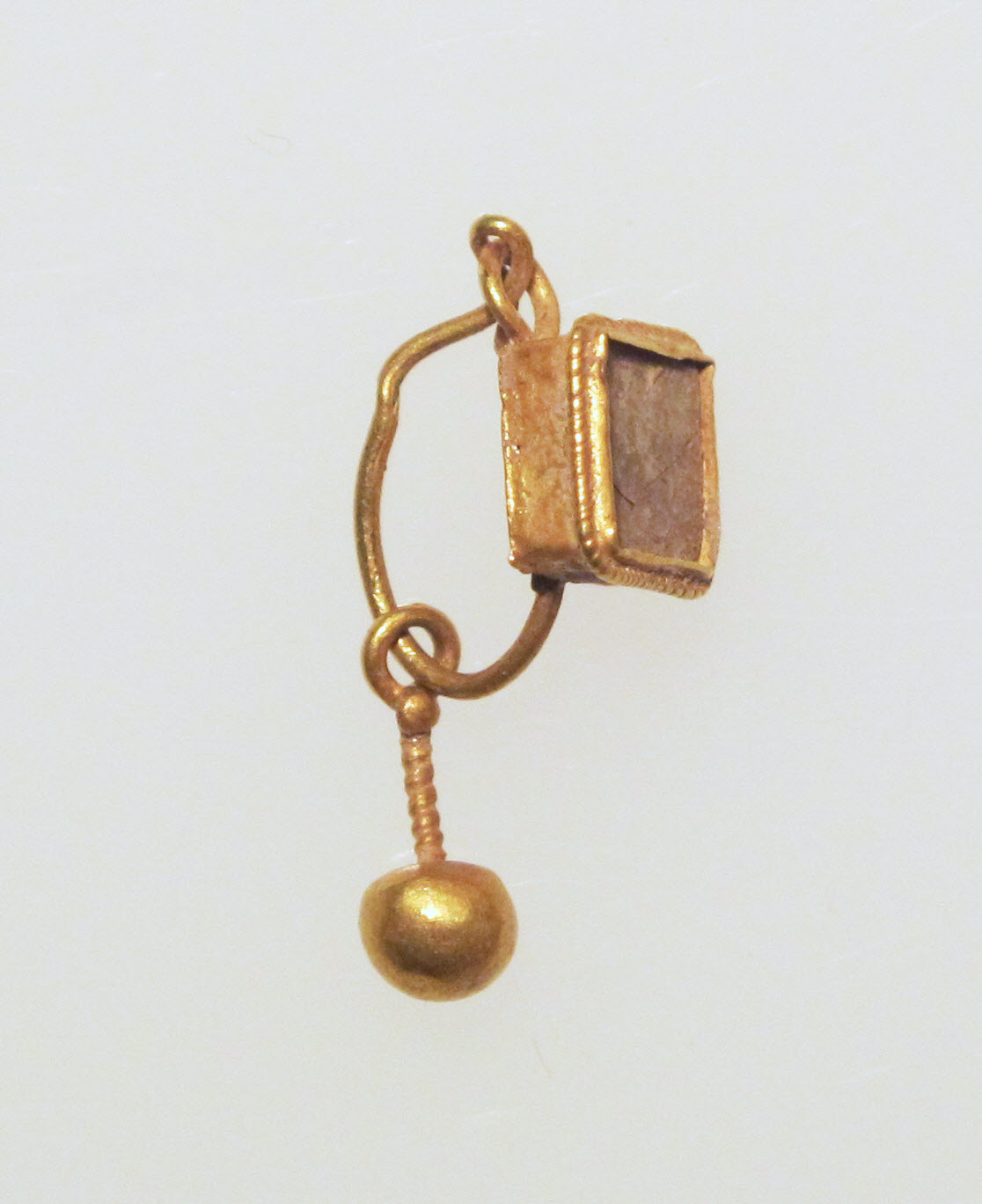
Heritage Asset Analysis: Roman Earring with Ball Pendant and Paste Setting
Object Classification and Material Profile
The artifact under review is a Roman earring featuring a spherical gold ball pendant suspended from a hoop or hook, set with colored glass paste in a bezel or box setting. Dating broadly to the Imperial period (circa 1st–4th century CE), this object belongs to a well-documented class of Roman personal adornment that circulated across the Mediterranean basin, from Pompeii and Herculaneum to Roman Britain and the Eastern provinces. The medium—sheet gold worked into hollow spheres, combined with cast or blown glass paste—reflects the Roman goldsmith's mastery of lightweight construction and the Empire's sophisticated glass industry. Glass paste, often colored to imitate emerald, garnet, or sapphire, was not a compromise material but a deliberate aesthetic and economic choice, widely traded and socially legible across class boundaries. For Katherine Fashion Lab, this object represents a strategic heritage asset: a compact, high-symbolism form with clear material narratives and direct translatability into contemporary luxury jewelry language.
Symbolic Power and Historical Adornment
In Roman society, earrings were among the most visible markers of status, gender, and cultural affiliation. Literary sources—including Pliny the Elder and Juvenal—attest to the moralizing discourse surrounding earrings, which were criticized as markers of excessive luxury yet simultaneously worn by matrons, courtesans, and, increasingly, men of certain social strata. The ball pendant form carried specific symbolic weight. The sphere, in Roman cosmological thought, evoked perfection, eternity, and the celestial order. Suspended from the ear, it moved with the wearer, catching light and drawing attention to the face—an early instance of adornment functioning as both personal ornament and social signaling device.
The paste setting introduced color as a communicative element. Roman glass paste in emerald green, wine-red, or cobalt blue referenced precious stones while remaining accessible to a broader market. This democratization of gemstone aesthetics was a deliberate commercial and cultural strategy, not a failure of authenticity. For a modern luxury house, this precedent is instructive: the Roman market understood that color, light, and form could deliver symbolic value independent of intrinsic material cost.
Spiritual and Apotropaic Meaning
Roman jewelry frequently carried apotropaic—evil-averting—functions. Earrings, worn at the threshold of the body, were understood as protective amulets. The ball pendant may have referenced solar or lunar deities, while the colored paste could invoke specific protective stones: green for fertility and healing, red for vitality and protection against the evil eye. Children in particular were adorned with such amulets, and the suspension of a pendant from the ear placed the protective force at the most vulnerable point of entry to the body.
This spiritual dimension elevates the object beyond mere ornament. It becomes a wearable talisman, a private ritual object made public through display. In the Roman funerary record, earrings are frequently found in burials, suggesting continuity of protection into the afterlife. The object thus operates across three registers: aesthetic, social, and metaphysical—a tripartite value structure that contemporary luxury brands rarely achieve with equal economy.
Materiality and Craft as Brand Narrative
The construction of a hollow gold ball pendant requires precise soldering, annealing, and finishing. Roman goldsmiths used granulation, filigree, and repoussé techniques that remain benchmarks of artisanal excellence. The glass paste setting, likely cast in a mold and polished, demonstrates cross-material integration—gold and glass in dialogue, each enhancing the other's optical properties. This is a precursor to the modern mixed-media jewelry strategy, where material contrast generates visual and tactile interest.
For Katherine Fashion Lab, the material story is directly actionable. The hollow gold sphere offers a lightweight, wearable form that can be scaled across price points without compromising silhouette. The paste setting provides a color-forward, ethically sourced alternative to mined gemstones—a critical consideration for 2026 luxury consumers who prioritize provenance and sustainability. The Roman precedent legitimizes this substitution not as cost-cutting but as heritage-informed design intelligence.
2026 Luxury Strategy: Positioning and Application
Entering 2026, the high-end jewelry market is defined by three consumer imperatives: provenance transparency, symbolic meaning, and wearable versatility. The Roman ball-pendant earring addresses all three. Its provenance is archaeologically documented and culturally rich. Its symbolism—protection, eternity, celestial order—offers a narrative depth that resonates with post-pandemic consumer psychology, which favors objects of personal meaning over pure status display. Its form is inherently versatile: a drop earring that transitions from day to evening, from casual to ceremonial.
Strategically, Katherine Fashion Lab can deploy this heritage asset in three ways. First, as a signature silhouette: a modern ball-pendant earring in recycled gold with laboratory-grown colored stones or high-grade glass paste, positioned as an accessible entry point to the brand's heritage line. Second, as a narrative platform: campaign storytelling that links the Roman protective amulet to contemporary concepts of personal sanctuary and self-care. Third, as a capsule collection anchor: a limited-edition series that pairs the ball pendant with other Roman-inspired forms—hoops, snake motifs, coin pendants—creating a coherent heritage story for retail and editorial placement.
The competitive advantage lies in authenticity. Many brands reference antiquity; few can trace a specific form, material logic, and symbolic system with this level of clarity. The Roman earring with ball pendant and paste setting is not a vague classical allusion but a precise, defensible heritage asset. Its translation into 2026 luxury language requires discipline: preserve the hollow sphere, honor the color-forward paste tradition, and articulate the apotropaic narrative in contemporary terms. Executed with rigor, this object can anchor a heritage line that is both commercially viable and intellectually credible—a rare equilibrium in the luxury sector.