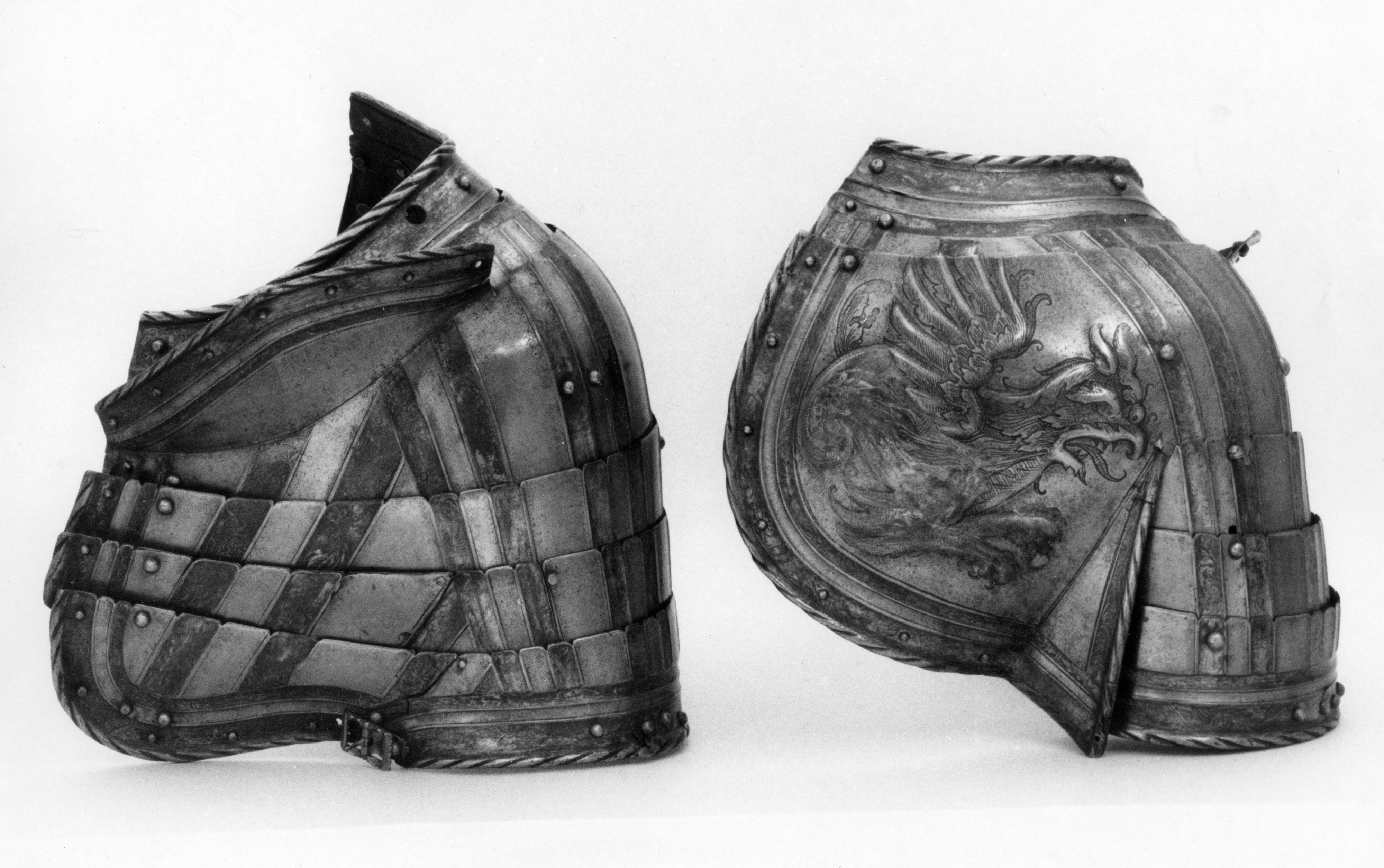
Executive Summary: Pauldrons as Proto-Luxury and Strategic Archetype
This heritage analysis examines a pair of German pauldrons, crafted from steel and gold, not as mere martial relics but as foundational artifacts of symbolic power and corporeal adornment. For Katherine Fashion Lab, these objects transcend their primary function as shoulder defenses to serve as a profound strategic blueprint. They embody a pre-industrial convergence of technical mastery, status signaling, and spiritual inscription directly onto the architecture of the human body. This research positions the pauldron as a critical archetype for a 2026 high-end luxury strategy, advocating for a design philosophy where protection, identity, and transcendence are engineered into wearable form. The analysis decodes the object across four vectors: its assertion of hierarchical power, its role as a historical canvas for adornment, its embedded spiritual meaning, and its actionable insights for future-facing luxury.
Decoding the Artifact: Materiality and Manufacture
The specified materials—steel and gold—establish a fundamental dialectic central to luxury’s enduring appeal: the interplay between resilience and radiance. The steel foundation speaks to Germanic metallurgical supremacy, a technical and disciplined craft yielding a material capable of withstanding brutal force. Its form—curved, articulated, and engineered to protect the vulnerable shoulder and deflect blows—represents functional perfection. The gold, applied through techniques such as mercury gilding or inlay, is not merely decorative. It is a deliberate, value-added transformation. This alchemical marriage signifies the elevation of the utilitarian to the ceremonial. The gold captures and commands light, ensuring the wearer is visually dominant on the battlefield and in the court, translating physical defense into a spectacle of inviolability. This material synergy prefigures modern luxury’s core tenets: exceptional craftsmanship (steel) married to precious, emotive materiality (gold) to create an object of both capability and awe.
Symbolic Power: The Architecture of Hierarchy
Pauldrons are inherently architectural, broadening the silhouette to create an imposing, top-heavy visual grammar of authority. In a German context, particularly within the Holy Roman Empire and its network of princely states, this was a deliberate political language. The exaggerated scale signaled a bearer of command, one who stood apart in the melee. Their placement on the shoulder—the body’s structural plinth—further emphasized this symbolism. They supported the mantle of leadership, literally and figuratively. For Katherine Fashion Lab, this translates into the strategic principle of silhouette as status. The pauldron demonstrates how modifying the body’s line can communicate power before a single word is spoken or logo recognized. A 2026 luxury strategy must consider not just the garment, but the engineered shape it creates—the modern pauldron might manifest as structured outerwear, innovative tailoring, or accessory-led contouring that projects confidence, authority, and a distinct personal fortress.
Historical Adornment: The Canvas of Identity
Beyond their form, these pauldrons served as a privileged canvas for narrative and affiliation. German armorers were master storytellers, etching, embossing, and damascening surfaces with intricate foliate patterns (Ranwerk), mythological scenes, or heraldic devices. This adornment was a wearable archive. It could declare feudal allegiance, commemorate a dynastic marriage, or illustrate a personal motto. The gold, in this context, functioned as the highlighter of this narrative, drawing the eye to specific symbolic details. This practice moves beyond decoration into the realm of encoded identity. For the contemporary luxury consumer, bespoke is not merely about fit, but about meaning. Katherine Fashion Lab’s strategy can integrate this by viewing each piece as a canvas for personal or collective symbolism—through algorithmic pattern generation tied to client heritage, micro-engraving of personal sigils, or the integration of narrative textiles. Adornment becomes a proprietary language, transforming the wearer into a curator of their own legend.
Spiritual Meaning: The Sanctuary of the Self
The spiritual dimension of armor, often overlooked, is paramount. Armor was ritually blessed; it was a mobile sanctuary for the soul in a world of mortal peril. The shoulder, as the site where a guardian angel was often iconographically depicted, held particular significance. Protecting it was both a physical and metaphysical imperative. The gold’s incorruptible, sun-like sheen amplified this, symbolizing divine favor, enlightenment, and an aura of celestial protection. This imbues the object with a profound sense of psychic defense and sanctity. In an era of digital saturation and psychological fragmentation, modern luxury seeks to offer not just products, but sanctuaries. Katherine Fashion Lab can interpret this by designing for emotional resilience. Materials can be selected for their tactile, grounding properties; designs can incorporate motifs of protection and safe passage; the very act of wearing a lab-created piece can be framed as an armor against the mundane, a second skin that empowers and centers the wearer. Luxury becomes a curated, personal ecosystem of well-being.
Strategic Imperatives for 2026 High-End Luxury
Synthesizing this analysis, Katherine Fashion Lab’s forward strategy must be built on the pauldron’s core principles, translated for a 2026 consciousness.
1. Engineered Iconicity:
Move beyond seasonal trends to create “wearable architecture”—signature pieces defined by innovative structure and silhouette that offer immediate recognition and symbolic weight, much like the instantly identifiable profile of a knight in full harness.
2. Cryptographic Personalization:
Develop a tier of narrative bespoke, where clients co-create pieces embedded with personal data, heritage motifs, or symbolic codes rendered through advanced techniques (laser etching, smart material integration, modular insignia), making each garment a unique testament to identity.
3. The New Alchemy:
Pioneer material innovation that mirrors the steel-gold dialectic. Explore biodegradable polymers coated in reclaimed precious metals, lab-grown gemstone substrates, or smart textiles that change state—materials that tell a story of future-facing ethics and transformative experience.
4. Sanctuary as a Service:
Frame collections within thematic universes of “Modern Armor” for specific contemporary arenas: the boardroom, the digital sphere, the social stage. Provide not just clothing, but a philosophy of dressed resilience, supported by content, experiences, and community that reinforces the brand as a curator of empowered identity.
Conclusion: From Martial Relic to Modern Creed
The German pauldron of steel and gold stands as a masterclass in integrated symbolic value. It successfully fused technical performance, social stratification, personal narrative, and spiritual aspiration into a single, potent artifact worn on the body. For Katherine Fashion Lab, this historical object is not an antique but a provocateur. It challenges the brand to design with equivalent depth and intention for the complex human of 2026. The strategic mandate is clear: to create luxury that protects (psychically and socially), projects (identity and status), and transcends (the ordinary, through meaning and material innovation). By adopting the pauldron’s foundational logic, Katherine Fashion Lab can architect a future where clothing is not merely worn, but inhabited—a definitive, dignified armor for the modern self.