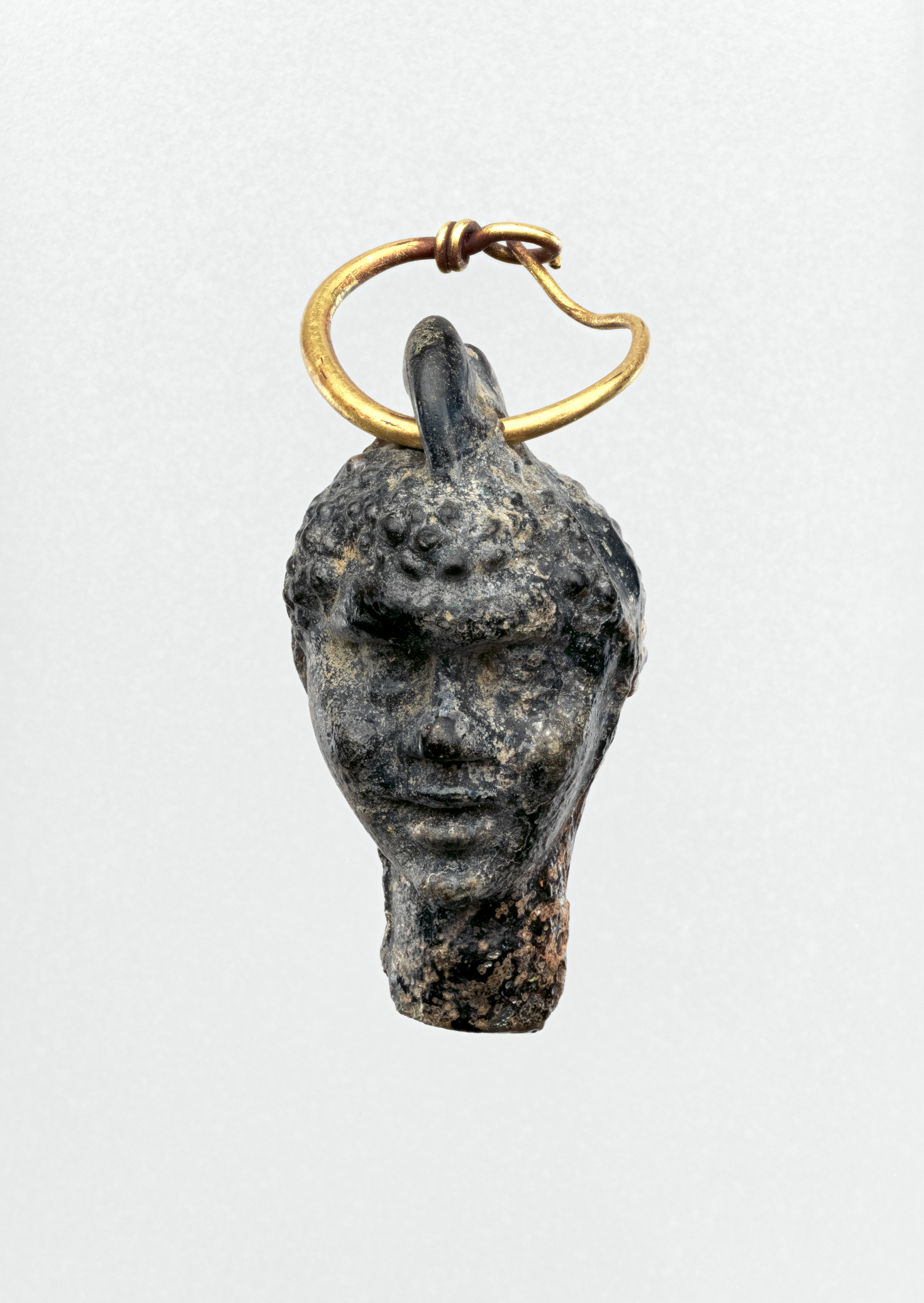
Heritage Analysis: Hellenistic Gold Earring with Glass Pendant in the Form of a Black African Head
Object Classification: Gold earring with glass pendant, anthropomorphic in the form of a Black African head
Culture: Greek, Eastern Mediterranean
Medium: Gold, glass
Research Context: Strategic Standalone Research
Prepared for: Katherine Fashion Lab, Heritage & Luxury Strategy Division
Introduction: A Small Object with an Expansive Cultural Footprint
Among the most arresting artifacts of the Hellenistic world is a category of jewelry that has, until recently, been underweighted in both academic and commercial narratives: gold earrings terminating in glass pendants molded as the heads of Black Africans. Produced primarily between the fourth and second centuries BCE across the Eastern Mediterranean — in workshops spanning Alexandria, Cyprus, the Levantine coast, and southern Italy — these objects compress an extraordinary density of meaning into a form no larger than a thumb. For Katherine Fashion Lab, they represent far more than antiquarian curiosity. They are a strategic case study in how adornment encodes power, how materials carry ideology, and how a 2026 luxury house can responsibly activate a heritage narrative that is both aesthetically commanding and historically honest.
The earring type typically consists of a gold hoop or disc-and-rosette assembly from which a glass pendant is suspended. The pendant is formed in a mold, its surface often detailed with crisp features — full lips, a broad nose, tightly curled hair rendered as raised pellets or incised spirals — and its color ranges from deep translucent amber to opaque black, emulating obsidian, jet, or exotic stone. Gold and glass are not incidental choices. They are the argument.
Symbolic Power: Gold, Glass, and the Politics of Representation
In the Greek and Hellenistic hierarchy of materials, gold signified incorruptibility, divine favor, and permanence. It was the metal of gods and of the elite who wished to align themselves with them. Glass, by contrast, was a technological marvel of the period — a material whose translucency and color could imitate precious stones at a fraction of the cost, and whose very artificiality was celebrated in Hellenistic poetry and technical writing. The pairing of gold with glass was therefore a deliberate negotiation between permanence and artifice, rarity and accessibility. It positioned the wearer within a sophisticated economy of taste: someone who understood that value could be constructed, not merely inherited.
The Black African head as a motif introduces a further layer. In the Eastern Mediterranean of this period — Alexandria above all — African peoples were present as traders, soldiers, artisans, and members of court circles. The depiction of African features in Hellenistic art was not uniformly derogatory; it ranged from ethnographic curiosity to idealized portraiture. On jewelry, the Black African head frequently functioned apotropaically. The gaze of the "other," fixed in glass and framed in gold, was understood to deflect envy and malevolent forces — a logic continuous with the broader Greek use of grotesque or foreign faces as protective amulets. The wearer thus carried a small, potent guardian at the ear, at the threshold of speech and perception.
Historical Adornment: The Ear as Ritual and Social Surface
Earrings in the ancient Mediterranean were never merely decorative. They marked the ear as a site of reception — of speech, of rumor, of divine communication — and therefore as a site requiring protection. Gold earrings of this type were worn by women of means, but also deposited in sanctuaries as votive offerings, and buried with the dead as grave goods. Their circulation across life, ritual, and death indicates that they were understood as objects with agency: things that could intercede.
The glass pendant's suspension is also significant. It moved. It caught light. It turned with the head. This kinetic quality gave the object a performative dimension that static sculpture lacks. In a 2026 luxury context, this is a critical insight: the most enduring adornment is not the most monumental, but the most responsive to the body and to light.
Spiritual Meaning: The Amuletic Logic of the Foreign Gaze
The apotropaic reading deserves emphasis. Hellenistic amuletic practice frequently employed images of beings at the edges of the known world — dwarfs, pygmies, and African figures among them — precisely because their liminal status was believed to confer protective power. The Black African head on a gold earring thus operated on two registers simultaneously: as a marker of cosmopolitan taste and as a spiritual technology. This duality is the object's greatest strategic asset for a luxury house. It resists reduction to either "exotic ornament" or "identity symbol." It is both, and it is more.
2026 Luxury Strategy: Activation Without Appropriation
For Katherine Fashion Lab, the activation pathway is clear but demands discipline. First, the house should treat the object as a narrative anchor, not a motif to be copied literally. A 2026 collection could translate the earring's structural grammar — suspended weight, translucent color over gold, kinetic movement — into contemporary forms while crediting the Hellenistic source explicitly in campaign and catalogue copy.
Second, the house must address the representation question directly. Any modern use of an African head pendant requires collaboration with scholars and, ideally, with contemporary Black artists and designers, ensuring that the narrative is authored in partnership rather than extracted. The historical object was made in a multicultural Mediterranean; its modern afterlife should be equally collaborative.
Third, the material strategy should mirror the original's intelligence: gold paired with a non-precious, technologically advanced medium — today, perhaps, recycled glass or lab-grown crystal — to reproduce the ancient tension between permanence and invention. This is not cost engineering; it is heritage fidelity.
Finally, the house should position the object within a broader Heritage Provenance Program, using it to demonstrate that luxury's deepest value lies in interpretation, not possession. The earring is small. Its strategic footprint need not be.
Conclusion
The Hellenistic gold earring with a glass pendant in the form of a Black African head is a masterpiece of compression: gold and glass, protection and display, center and periphery, all suspended from a single wire. For Katherine Fashion Lab, it offers a rare opportunity to build a 2026 luxury narrative that is aesthetically rigorous, historically grounded, and ethically awake. The object has waited two thousand years for a thoughtful interlocutor. The house should be that interlocutor — with scholarship in one hand and craft in the other.