The Embroidered Darning Sampler: A Study in Structural Mending as Couture Language
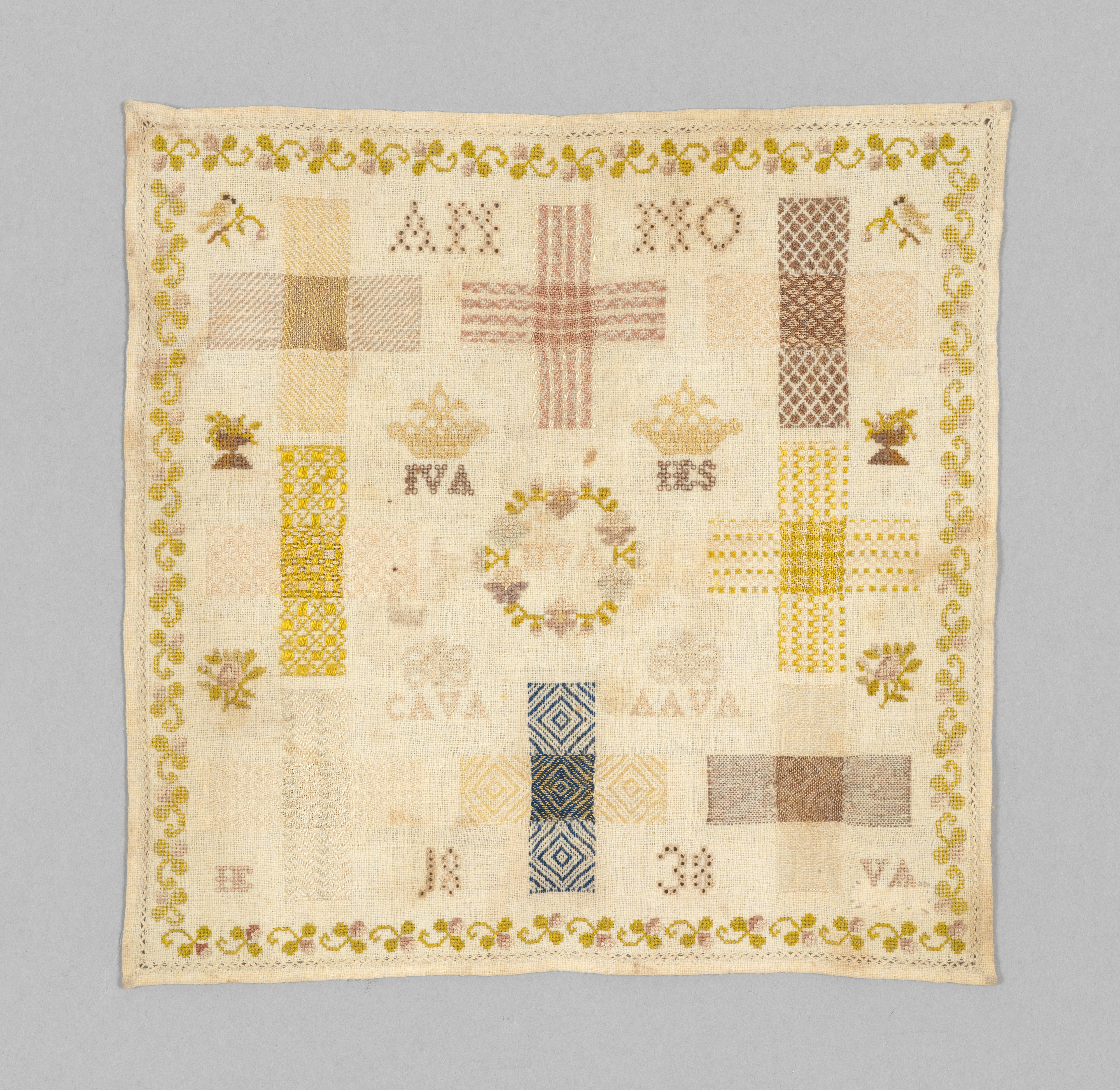
The embroidered darning sampler occupies a paradoxical position within the global heritage of textile arts. Ostensibly a pedagogical exercise—a young needleworker's demonstration of proficiency in repairing worn cloth—it has increasingly been repositioned within contemporary couture discourse as a foundational text of structural embellishment. Executed in silk upon cotton, this standalone study interrogates the boundary between utility and ornament, between the invisible labor of conservation and the visible assertion of skill. For Katherine Fashion Lab, the darning sampler is not merely an artifact of domestic economy but a precursor to the most sophisticated practices of couture surface design, where repair becomes a generative rather than a restorative act.
Materiality and the Syntax of Silk on Cotton
The material constitution of the darning sampler—silk thread worked into a cotton ground—establishes a deliberate hierarchy of value and function. Cotton, the substrate, represents the quotidian: sturdy, utilitarian, and historically associated with mass-produced cloth. Silk, the intervention, represents refinement, luster, and the luxury of skilled labor. This juxtaposition is not incidental. In the context of global heritage, the silk-on-cotton sampler encodes a fundamental tension between the economics of repair and the aesthetics of display.
From a technical standpoint, silk's tensile strength and sheen allow the embroiderer to create darning stitches that are simultaneously structural and decorative. Unlike the coarse wool or linen threads typically used for utilitarian mending, silk permits a density of coverage that transforms a functional patch into a deliberate surface intervention. The cotton ground, often a plain weave with a modest thread count, provides a neutral field against which the silk's chromatic and reflective properties can be read. This relationship anticipates the logic of modern couture embroidery, where base fabrics are selected not only for their drape but for their capacity to host embellishment without competing with it.
Katherine Fashion Lab's analysis identifies three distinct material registers within this sampler: the structural stitch (the darning weave itself, which reinforces the cotton), the chromatic accent (silk threads in contrasting hues that outline or fill the darned areas), and the edge treatment (often a buttonhole or blanket stitch that frames the exercise). Each register corresponds to a different level of visibility, from the nearly invisible reinforcement to the overtly ornamental border. This tripartite structure is, in effect, a grammar of repair that later couture houses would adapt for entirely decorative ends.
The Darning Sampler as Proto-Couture Surface
To understand the darning sampler as a proto-couture object requires a reconsideration of what constitutes "design" in textile practice. The sampler is not a garment; it is a study. Yet its internal logic—the repetition of motifs, the variation of scale, the controlled introduction of color—mirrors the compositional strategies of haute couture embroidery. In both cases, the maker works within a defined field, negotiating between negative space and intervention, between the integrity of the ground and the assertiveness of the applied thread.
Consider the darning sampler's typical layout: a grid of square or rectangular patches, each demonstrating a different technique—plain darning, twill darning, diagonal darning, and so forth. This modularity is strikingly similar to the sample books and swatch archives maintained by couture ateliers. The difference lies in intentionality. The darning sampler's primary purpose was educational and evaluative; the couture swatch book serves commercial and archival functions. Yet both are exercises in systematic variation, the disciplined exploration of a technique's expressive range.
Furthermore, the darning sampler's emphasis on reversibility and reinforcement—the ability to restore integrity to a compromised cloth—finds a direct parallel in couture's obsession with structural engineering. A Chanel bouclé jacket, for instance, relies on hidden chain stitching and weighted hems to maintain its shape; a Dior Bar suit depends on internal corsetry and pad stitching. In both the darning sampler and the couture garment, what is visible is only the surface expression of a deeper structural logic. The sampler makes that logic explicit, even pedagogical, whereas couture conceals it beneath a polished exterior.
Global Heritage and the Politics of Repair
The designation "Global Heritage" for this darning sampler invites a critical examination of how repair practices circulate across cultures. Darning is not a singular tradition. In Japan, sashiko employs running stitches to reinforce and decorate indigo-dyed cotton, often in geometric patterns that resemble the darning sampler's grid. In the Andes, q'eswa techniques use intricate woven repairs to extend the life of textiles for generations. In Europe, the darning sampler emerged as a formal pedagogical tool in the eighteenth and nineteenth centuries, particularly in Protestant regions where needlework was both a moral and economic imperative.
What unites these traditions is a shared understanding that repair is not an admission of failure but an assertion of value. To darn is to declare that a cloth is worth preserving, that its history of use is not a defect but a credential. This ethos stands in stark opposition to the logic of fast fashion, where disposability is engineered into the product lifecycle. Katherine Fashion Lab positions the darning sampler as a counter-narrative: a heritage object that proposes longevity as a luxury and skill as a form of resistance.
Moreover, the sampler's global circulation—through colonial trade routes, missionary networks, and later through museum acquisition—reveals how techniques migrate and hybridize. A darning stitch developed in one region may appear, with variations, in another, adapted to local fibers and color sensibilities. The silk-on-cotton sampler is thus a palimpsest of cross-cultural exchange, its very materials (silk from Asia, cotton from the Americas or India) bearing witness to global trade even as its form remains rooted in local pedagogy.
Conclusion: The Sampler as Couture Proposition
For Katherine Fashion Lab, the embroidered darning sampler is not a quaint relic of domestic instruction but a sophisticated treatise on surface, structure, and value. Its silk-on-cotton construction establishes a dialogue between the utilitarian and the luxurious; its modular composition anticipates the swatch archives of couture ateliers; its global heritage situates repair within a politics of longevity and resistance. To study this sampler is to recognize that the most advanced couture techniques—the invisible mending, the reinforced seam, the decorative patch—are not inventions of the atelier but inheritances from the hearth. The darning sampler teaches us that to mend is to design, and that the most radical act of fashion may be to refuse to discard.