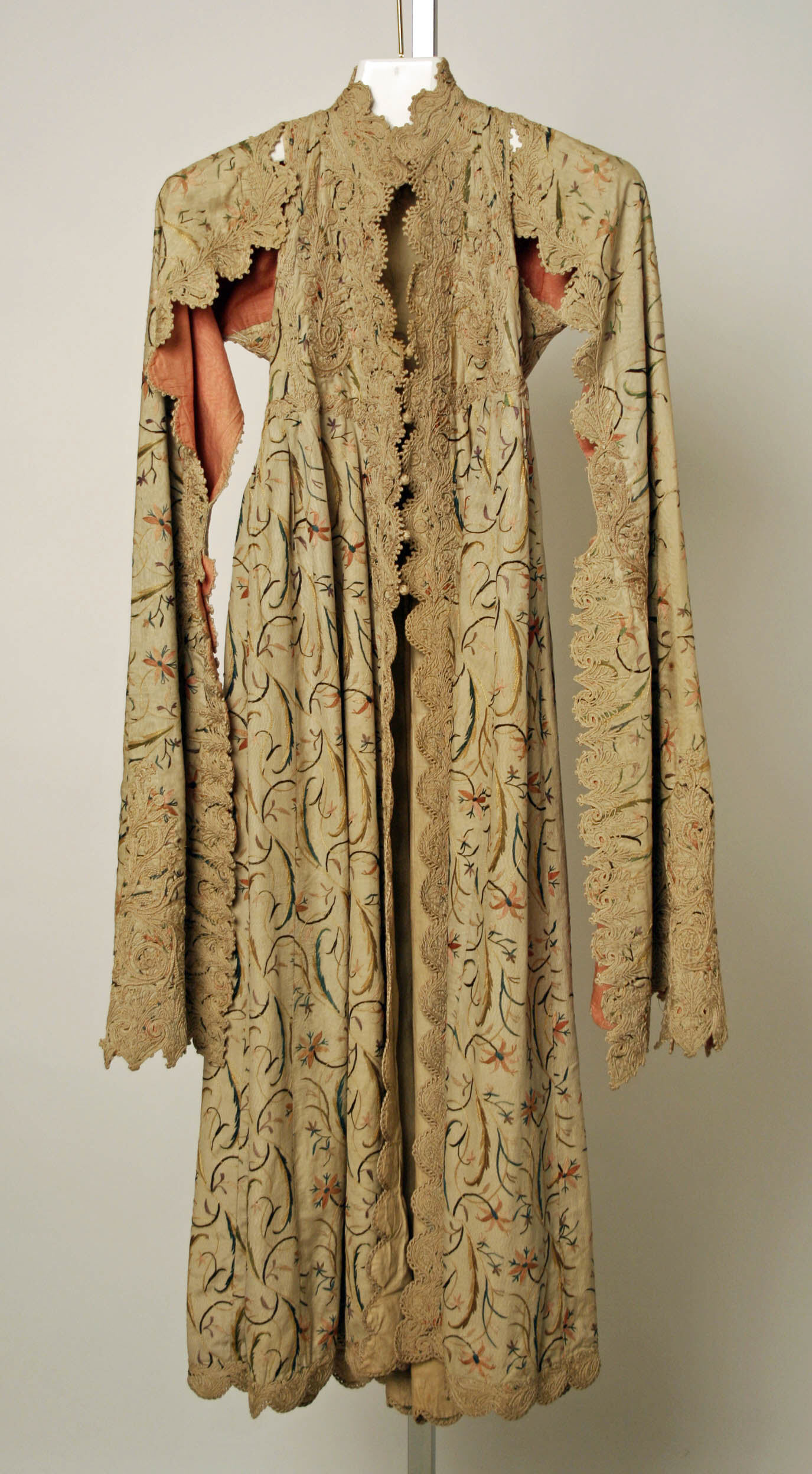
Child's Robe: A Study in Miniature Couture and Global Heritage
The child's robe under examination represents a fascinating paradox within the history of dress: a garment of diminutive scale that nonetheless embodies the full technical and aesthetic ambitions of adult couture. Constructed from silk moiré and embellished with silk embroidery, with sleeves lined in satin-weave silk, this piece belongs to a broader global heritage of children's ceremonial dress. Yet it resists reduction to mere miniature. It is, instead, a sophisticated artifact in which material hierarchy, surface manipulation, and cross-cultural exchange converge. This standalone study situates the robe within the intersecting histories of textile production, childhood dress, and the transmission of luxury craftsmanship across geographies.
Materiality and the Logic of Moiré
The selection of moiré as the principal fabric is the garment's most telling technical decision. Moiré—historically known as moiré antique or watered silk—is produced by passing two layers of silk through heated rollers under pressure, permanently disrupting the weft and creating an iridescent, wave-like pattern that shifts with the angle of light. The effect is not printed or woven but mechanically induced into the fiber itself, making it one of the earliest forms of textile finishing that could claim both industrial precision and artisanal prestige.
For a child's robe, this choice is far from incidental. Moiré is an unforgiving fabric: it reveals every crease, every tension irregularity, every misaligned seam. Its use signals that the garment was not intended for the rough play of everyday childhood but for ceremonial presentation—a christening, a formal portrait, a dynastic or diplomatic occasion. The fabric's optical restlessness also serves a practical aesthetic function: on a small body, where surface area is limited, moiré generates visual complexity that compensates for the reduced canvas. The robe thus achieves presence through material behavior rather than through sheer scale.
Embroidery as Cultural Inscription
The silk embroidery overlaying the moiré introduces a second layer of meaning. Because the ground fabric already possesses a strong, self-generating pattern, the embroiderer faced a genuine design problem: how to ornament a surface that is already ornamented without producing visual chaos. The solution, evident in the surviving logic of such garments, lies in tonal restraint and strategic placement. Embroidery in closely related silk hues—ivory on cream, pale gold on champagne—allows the stitched motifs to emerge and recede as the moiré shifts beneath them. The result is a garment that changes character with movement and light, rewarding close inspection while remaining composed at a distance.
Equally significant is what the embroidery represents. Across global heritage traditions—from Chinese kesi-influenced court garments to Ottoman kaftan embroidery to European ecclesiastical and aristocratic children's wear—silk embroidery on children's ceremonial robes frequently carried protective or auspicious symbolism. Floral scrolls, knot motifs, and stylized fauna were not merely decorative but functioned as talismanic inscriptions, invoking health, longevity, or dynastic continuity. The embroidery on this robe therefore operates on three registers simultaneously: as ornament, as craft demonstration, and as cultural text.
The Sleeve Lining: A Lesson in Hidden Luxury
The decision to line the sleeves in satin-weave silk while the body is moiré is a detail of considerable couture significance. Satin, with its long floating yarns and high luster, is the most tactilely smooth of silk weaves—precisely the quality required where fabric meets the sensitive skin of a child's wrist and forearm. Moiré, by contrast, has a crisper, more textured hand. The pairing is thus both ergonomic and hierarchical: the visible exterior asserts formality and structure, while the concealed interior prioritizes comfort and sensory refinement.
This interior-exterior distinction echoes a principle central to haute couture: luxury is most authentically expressed in what is hidden. The sleeve lining is rarely seen in wear, yet its quality is felt continuously by the wearer. In a child's garment, this principle acquires additional ethical weight. It suggests a maker who understood that the experience of the wearer—even a very young one—matters as much as the impression made upon the viewer. The robe is not a costume imposed upon a passive body; it is a considered object designed for a sentient one.
Global Heritage and the Question of Origin
Attributing a single geographic origin to this robe would be misleading. Its material vocabulary—moiré finishing, silk embroidery, satin lining—belongs to a transregional textile economy that linked Chinese sericulture, Persian and Ottoman finishing techniques, and European mechanized production from the eighteenth century onward. Silk itself was the first truly global luxury commodity, and children's ceremonial robes were among its most portable expressions. A robe of this construction could plausibly have been assembled in a European atelier using fabrics finished in Lyon or Krefeld, embroidered by hands trained in traditions with roots in Asia, and worn in a household whose ceremonial practices drew on multiple cultural inheritances.
This hybridity is not a weakness but the garment's defining characteristic. It demonstrates that children's dress has always been a site of cultural transmission—a medium through which families encoded identity, aspiration, and memory onto the smallest and most vulnerable members of society. The robe is therefore not simply a garment for a child; it is an argument about what childhood was understood to be: a state worthy of the finest materials, the most careful craftsmanship, and the most deliberate symbolism.
Conclusion: The Miniature as Monument
In couture analysis, scale is often mistaken for significance. This child's robe refutes that assumption. Through its moiré ground, its silk embroidery, and its satin-lined sleeves, it demonstrates that technical rigor and material discernment are not contingent on the size of the wearer. The garment functions as a compact archive of global textile heritage, a record of ceremonial practice, and a testament to the belief that even the youngest wearer deserves the full vocabulary of luxury. It is, in the truest sense, a miniature monument—small in dimension, expansive in meaning.