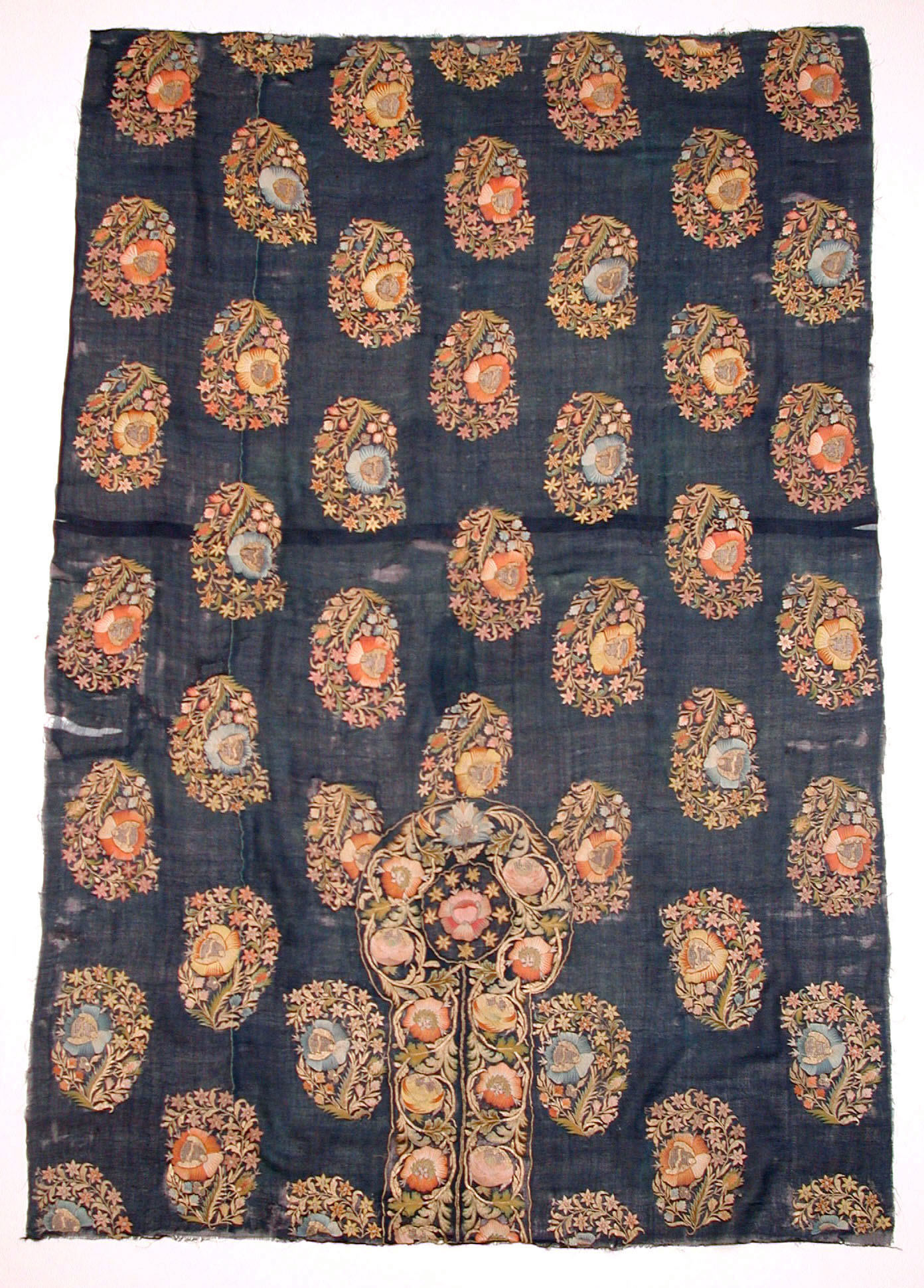
The Barber's Apron: A Global Heritage of Silk, Status, and Sartorial Code
Within the lexicon of dress history, few garments occupy a more paradoxical position than the barber's apron. Ostensibly a functional shield against soap, lather, and the detritus of personal grooming, the apron has, across civilizations and centuries, functioned as a far more complex signifier—a marker of guild membership, a canvas for extraordinary textile art, and a subtle instrument of social performance. This standalone study examines the barber's apron as a global heritage object, with particular attention to its most rarefied expression: the silk apron embroidered in silk and gold and silver wrapped thread. In doing so, it argues that the apron deserves reclassification from utilitarian accessory to legitimate couture artifact.
Origins and the Global Diffusion of a Functional Form
The apron is among the oldest garments in human history, appearing independently across cultures as a protective layer for the body's front. Its migration into the barbering and shaving trades, however, reflects the specific material demands of that profession. Barbers in the medieval Islamic world, in Song-dynasty China, in Edo-period Japan, and across Renaissance Europe all required a garment that could withstand water, oil, and repeated laundering while permitting freedom of movement. The apron answered this need with remarkable economy.
Yet the apron's global heritage is not uniform. In West Africa, particularly among the Yoruba and in the broader Sahelian textile traditions, aprons and wrappers served ceremonial as well as practical functions, often woven from locally produced cloth and embellished with symbolic motifs. In South Asia, the barber communities—variously known as Nai, Hajjam, or Ambastha—developed distinctive occupational dress that communicated their place within the caste and guild hierarchy. In Ottoman and Persian contexts, barbers attached to royal courts wore aprons of fine fabric, sometimes silk, as a mark of proximity to power. The apron thus accumulated meaning wherever it traveled, becoming a palimpsest of local materials, hierarchies, and aesthetic priorities.
Silk as Material Statement
The decision to execute a barber's apron in silk is, from a material-culture perspective, a deliberate act of elevation. Silk—whether Chinese Bombyx mori filament, Indian mulberry silk, or Persian and Byzantine sericulture—carries associations of luxury, refinement, and long-distance trade. Its tensile strength, lustrous hand, and receptivity to dyes and embroidery made it the preferred substrate for garments intended to signal status.
For a barber, silk represented something more specific: a declaration that the wearer did not merely cut hair but served a clientele of means. In eighteenth- and nineteenth-century Europe, the master barber-surgeon's silk apron, worn over a linen shirt and beneath a tailored coat, distinguished the proprietor from the apprentice. In the Ottoman berber tradition, silk aprons were often reserved for those who attended the imperial household or the households of high-ranking officials. The material itself performed the work of social differentiation, even before a single stitch of embroidery was applied.
Embroidery in Silk, Gold, and Silver Wrapped Thread
The true couture significance of the barber's apron emerges in its embroidered surface. Silk and gold and silver wrapped thread—known in various traditions as zari, passementerie, or metal thread embroidery—transforms the apron from garment into textile artwork. The technique involves wrapping a silk core with fine metal strip, then stitching it through the fabric to create relief, sheen, and a play of light that shifts with the wearer's movement.
In Indian and Persian workshops, zardozi embroidery on silk aprons often featured floral arabesques, cypress motifs, and calligraphic borders. In European court contexts, metal-thread embroidery on silk aprons drew on the same ateliers that supplied ecclesiastical vestments and noble liveries, resulting in aprons that could rival a chasuble in technical ambition. The iconography was rarely random: scissors, razors, combs, and basins might be rendered in silver thread, while gold thread delineated borders and cartouches. These were not merely decorative choices but heraldic ones—an occupational coat of arms executed in precious metal.
The labor intensity of such embroidery cannot be overstated. A single apron panel might require hundreds of hours of handwork, executed by specialists who rarely signed their output. This anonymity is itself a feature of global heritage textile production, where the embroiderer's skill survives in the object while the embroiderer's name does not.
Reading the Apron as Couture
To classify the embroidered silk barber's apron as couture is to insist on several criteria: exceptional material, hand-executed embellishment, bespoke construction, and a clientele capable of commissioning and understanding such work. The apron meets all four. It also disrupts the conventional couture narrative, which privileges the gown, the suit, and the coat. By placing a service garment at the center of analysis, we acknowledge that status in dress has never been confined to the ballroom.
Moreover, the apron's semiotics are unusually rich. It simultaneously conceals and reveals, protects and displays, humbles and elevates. Worn by a barber, it announces proximity to the body of another—an intimacy that in many cultures carried ritual weight. Embroidered in gold and silver, it converts that intimacy into luxury.
Conservation, Provenance, and Contemporary Relevance
Surviving examples of embroidered silk barber's aprons are rare, held in textile collections, ethnographic museums, and private archives. Their fragility—silk degrades, metal thread tarnishes and abrades—makes conservation challenging. Provenance is often incomplete, reflecting the historical undervaluation of occupational dress.
For contemporary designers, the apron offers a productive provocation. Its silhouette is simple; its surface is where meaning resides. This division of labor between form and embellishment is precisely the logic of much modern couture, where a restrained cut serves as the armature for extraordinary surface treatment. The barber's apron, in its silk-and-metal-thread incarnation, thus anticipates a central strategy of twenty-first-century luxury: the elevation of the mundane through material and handwork.
Conclusion. The barber's apron, read through the lens of global heritage and couture technique, is not a footnote to dress history but a concentrated expression of it. In silk and embroidered with gold and silver wrapped thread, it demonstrates how a functional object can be transformed into a statement of status, skill, and cultural exchange. Katherine Fashion Lab regards it as a foundational case study—one that rewards the same close reading we afford to the corset, the kimono, or the court mantua.