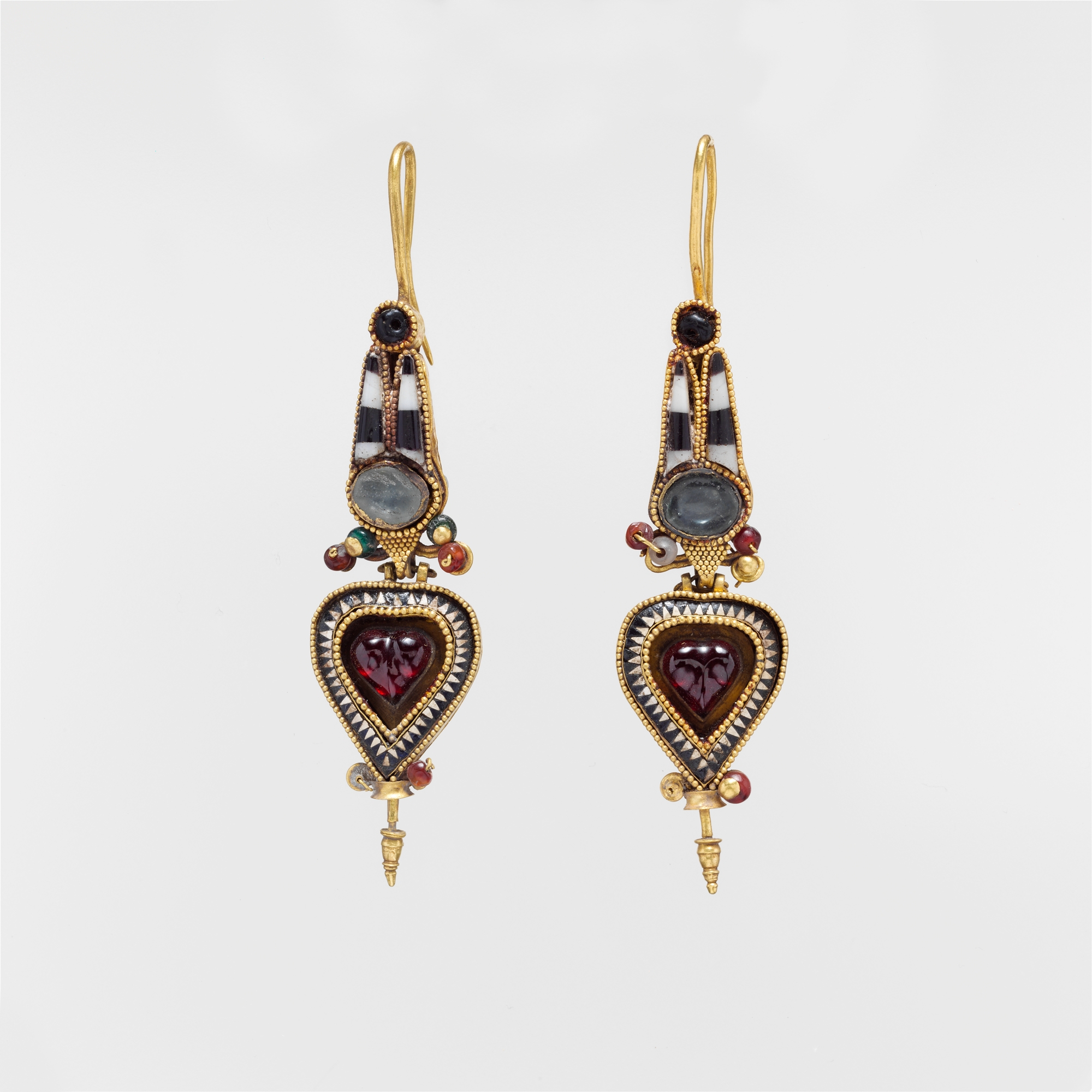
Heritage Analysis: Greek Gold Earrings with the Egyptian Atef Crown
Within the Katherine Fashion Lab Heritage Archive, few objects embody the strategic convergence of cross-cultural symbolism and artisanal mastery as completely as the pair of Greek gold earrings featuring the Egyptian Atef crown, set with stone and glass. Catalogued under Strategic Standalone Research, this artifact serves as a critical case study in how ancient adornment functioned as a vehicle for ideological transmission—and how that mechanism informs 2026 luxury brand architecture. The earrings are not merely ornaments; they are portable manifestos of power, belief, and cultural exchange.
Historical Provenance and the Hellenistic Exchange
The earrings originate from the Greek world, most likely the Hellenistic period (circa 323–31 BCE), when Alexander the Great's conquests dissolved the boundary between the Aegean and the Nile. Following Alexander's death, the Ptolemaic dynasty established a syncretic Greco-Egyptian court in Alexandria, where Greek goldsmiths encountered Egyptian religious iconography at an unprecedented scale. The Atef crown—a tall, conical headdress flanked by ostrich feathers and often adorned with a uraeus cobra—was the exclusive attribute of Osiris, god of resurrection, agriculture, and the afterlife. Its appearance on Greek earrings signals deliberate appropriation, not accidental borrowing. Greek artisans adapted the crown's silhouette into a wearable format, translating monumental temple reliefs into intimate personal adornment.
The medium reinforces this hybridity. Gold, prized in both cultures for its incorruptibility, forms the structural base. Stones and glass—likely carnelian, garnet, or turquoise alongside polychrome glass inlays—provide chromatic contrast. In Egyptian cosmology, these materials carried specific valences: carnelian evoked blood and vitality, turquoise signaled protection and fertility, and glass, though man-made, mimicked lapis lazuli's celestial authority. The Greek wearer thus donned a compressed pantheon of Egyptian meaning, recontextualized within Hellenistic fashion.
Symbolic Power: The Atef Crown as Ideological Technology
The Atef crown's presence on a Greek earring is a strategic semiotic move. In Egyptian theology, the crown was not decorative but operative—it conferred legitimacy, invoked resurrection, and aligned the wearer with Osiris's cyclical triumph over death. By miniaturizing and relocating this symbol to the earlobe, the Greek artisan democratized divine authority. The wearer, likely a woman of means in a cosmopolitan trading hub, could claim a fragment of pharaonic power without priestly mediation.
This is symbolic power in its most portable form. The earrings functioned as amuletic jewelry, believed to ward off harm while signaling cultural literacy. In a Hellenistic world where Egyptian cults—particularly that of Isis and Serapis—were spreading across the Mediterranean, wearing the Atef crown demonstrated participation in a transregional spiritual economy. It was, in modern terms, a luxury good with embedded brand equity: the brand being Osiris, the equity being resurrection and sovereignty.
Spiritual Meaning and the Adorned Body
Earrings in antiquity were never spiritually neutral. Piercing the earlobe created a permanent aperture, a site where the body remained open to both adornment and influence. Greek and Egyptian medical and magical texts alike warned of malevolent forces entering through bodily orifices; apotropaic jewelry sealed these vulnerabilities. The Atef crown, with its uraeus (where present) and ostrich feathers—symbols of Ma'at, cosmic order—acted as a metaphysical seal. The stones and glass amplified this function: their colors and luminosity were understood to attract benevolent forces and deflect chaotic ones.
The spiritual meaning thus operated on three levels. First, the crown invoked Osiris's promise of rebirth, offering the wearer symbolic participation in eternal renewal. Second, the materials themselves were charged with protective properties, making the earrings a wearable ritual. Third, the act of wearing them performed a public declaration of piety and sophistication, merging spiritual capital with social capital. This tripartite function—soteriological, apotropaic, and performative—explains why such objects survived as grave goods and heirlooms, transmitting their power across generations.
2026 Luxury Strategy: From Artifact to Brand Narrative
For Katherine Fashion Lab's 2026 high-end strategy, this artifact offers a blueprint for heritage-driven luxury that resists mere nostalgia. The earrings demonstrate that the most durable luxury objects are those that encode meaning dense enough to be reinterpreted without exhaustion. Three strategic imperatives emerge.
First, curate syncretism, not purity. The earrings' power lies in their hybridity—Greek form, Egyptian symbol, multicultural materials. A 2026 collection inspired by this object should embrace deliberate cultural layering, positioning the brand as a translator rather than a gatekeeper. This aligns with the luxury consumer's growing demand for narratives that acknowledge global interconnectedness.
Second, weaponize miniaturization. The Atef crown was monumental; the earring made it intimate. Luxury's future lies in compressing grand narratives into wearable, talismanic forms. A pendant, a cufflink, a signet—each can carry the weight of a civilization if the symbolism is rigorously researched and elegantly executed.
Third, restore the amuletic function. Contemporary luxury consumers seek protection, grounding, and meaning in uncertain times. Positioning jewelry as spiritual technology—without descending into New Age cliché—requires the kind of scholarly rigor Katherine Fashion Lab applies through Strategic Standalone Research. The 2026 collection should present each piece with its symbolic genealogy, inviting the wearer into a lineage of empowered adornment.
Conclusion: The Strategic Value of Deep Heritage
The Greek gold earrings with the Egyptian Atef crown are not a curiosity of ancient cross-cultural exchange. They are a masterclass in how adornment operationalizes power, spirit, and identity. For Katherine Fashion Lab, they validate a strategic direction: luxury that is researched, symbolic, and unapologetically intellectual. In a market saturated with surface-level heritage references, the brand that can articulate why an Atef crown belongs on a Greek ear—and what that means for a woman in 2026—will own the narrative. The artifact's enduring lesson is that true luxury is never merely seen. It is understood, worn, and believed.