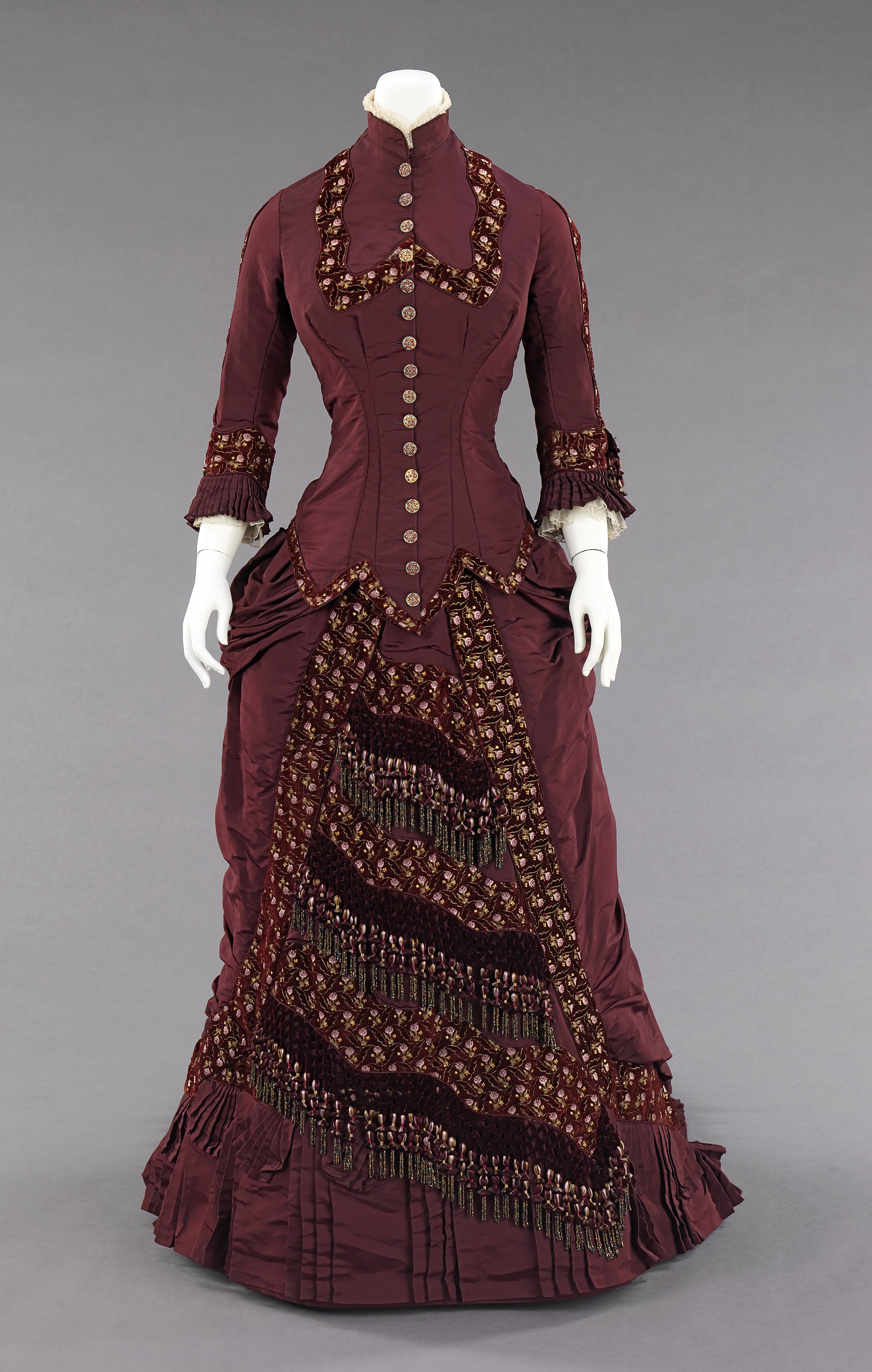
The American Dinner Dress: A Study in Silk and Social Performance
The dinner dress occupies a distinct and often under-theorized position within the taxonomy of American couture. Neither the ceremonial weight of the full evening gown nor the studied informality of the cocktail frock, the dinner dress constitutes a garment of precise social calibration—an object engineered for the liminal hours between the close of the working day and the commencement of private leisure. When executed in silk, this category of dress transcends mere utility and becomes an instrument of cultural signaling, encoding assumptions about class, geography, and the performance of femininity that have evolved considerably across the American twentieth century.
This standalone study examines the American silk dinner dress as both artifact and argument. It asks not merely what such a garment is, but what it does—how its material properties, silhouette conventions, and contextual obligations conspire to produce a specific kind of wearer.
The Semiotics of the Dinner Hour
To understand the dinner dress, one must first understand the dinner hour itself. In the American social imaginary, dinner has long functioned as a ritual of reintegration—the moment when the dispersed energies of the day are gathered back into the domestic or semi-public sphere. The dress code attached to this hour has historically been governed by an unwritten but rigorously enforced logic: one must appear to have made an effort without appearing to have labored. This paradox—effortless effort—is the central problem that the silk dinner dress exists to solve.
Silk is uniquely suited to this task. Its natural luster catches light without the aggressive sparkle of sequins or the brittle sheen of synthetics; its drape responds to the body's movement with a fluidity that reads as innate rather than contrived. A woman in a silk dinner dress communicates refinement, but a refinement that appears to emanate from her person rather than from her wardrobe. The fabric, in other words, naturalizes the labor of self-presentation.
Material Properties and Their Consequences
The choice of silk is not incidental to the dinner dress's social function; it is constitutive. Silk possesses a thermal responsiveness that makes it viable across the seasonal range of American entertaining—breathable in the humid summers of the Eastern seaboard, yet capable of holding warmth when layered over a slip in the cooler months. This adaptability mirrors the dinner dress's broader cultural role as a garment of transition.
Moreover, silk's weight and hand determine silhouette. A heavier silk crêpe de chine falls in vertical columns, producing a restrained, almost architectural line that flatters without exposing. A lighter silk chiffon or georgette, by contrast, introduces a diaphanous quality that softens the body's contours and introduces an element of visual mystery. The American designer's selection among these weights is therefore never merely technical; it is a statement about the kind of woman the dress imagines and the kind of room she is expected to enter.
American Inflections: From Seventh Avenue to the Suburbs
While the dinner dress is not an exclusively American invention, its American iteration bears distinctive markers. European couture has historically treated the dinner dress as a scaled-down version of the grand evening gown—a compromise garment for occasions of diminished formality. American design, particularly as it matured through the mid-century ready-to-wear industry, treated the dinner dress as a category in its own right, one deserving of dedicated design intelligence.
This is evident in the American preference for separates and adaptable constructions. A silk dinner dress from an American house might feature a detachable overskirt, a convertible neckline, or a jacket that transforms the garment from dinner-appropriate to cocktail-ready. Such devices reflect a pragmatic national sensibility: the American woman, particularly outside the rarefied circles of inherited wealth, was expected to move between contexts within a single evening, and her wardrobe was engineered accordingly.
The suburbanization of American life after 1945 further inflected the dinner dress. As entertaining migrated from urban restaurants to private homes, the dress's requirements shifted. It needed to be comfortable enough for hostessing, elegant enough for the arrival of guests, and resilient enough to survive an evening of movement between kitchen and dining room. Silk, with its relative resistance to wrinkling when properly weighted, proved an ideal ally.
Conclusion: The Dress as Social Contract
The American silk dinner dress is, finally, a social contract rendered in fabric. It promises the wearer that she will be seen as poised, cultivated, and appropriately feminine without appearing to have tried. It promises the host or hostess that she will honor the occasion without overshadowing it. And it promises the observer a visual pleasure that is sophisticated rather than strident.
That such a modest garment should carry such weight is a testament to the density of meaning that American culture has historically invested in women's clothing. To study the dinner dress is to study the terms on which American women have been permitted to appear in public—and the ingenuity with which they have negotiated those terms, one silk seam at a time.