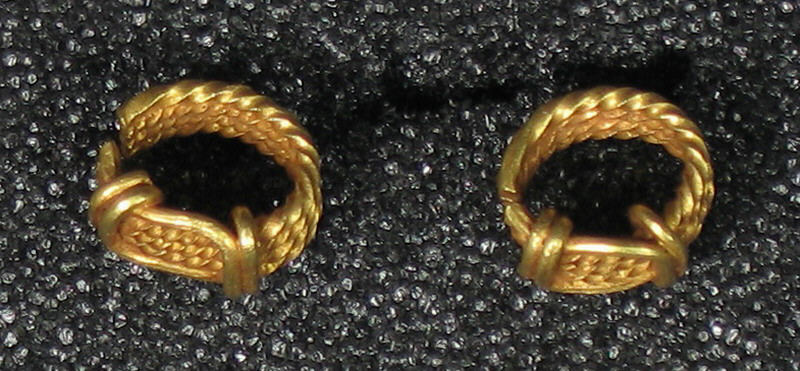
Heritage Asset Analysis: Pennanular Gold Hoop Earrings, Central Java
Object Identification and Material Profile
The subject of this analysis is a pair of pennanular hoop earrings in gold, attributed to the courtly goldsmithing traditions of Central Java, Indonesia. The term pennanular—from the Latin paene (almost) and anulus (ring)—describes a hoop that is nearly, but not fully, closed, leaving a deliberate gap between the terminals. This formal detail is not a manufacturing flaw but a considered design decision, and it situates the object within a broader Southeast Asian and Indo-Pacific lineage of annular and penannular adornment that stretches from the Dong Son horizon into the classical Javanese temple period.
The choice of gold as the exclusive medium is equally deliberate. In Central Java, gold was never merely a decorative material; it was understood as a physical manifestation of cahya—radiance, luminosity, the visible signature of divine presence. Javanese goldsmiths worked with a sophisticated command of granulation, repoussé, and filigree, and the surviving corpus of gold ornaments recovered from sites such as Wonoboyo, Plosokuning, and the slopes of Gunung Merapi demonstrates technical standards that rival contemporaneous work in the Mediterranean and South Asia. The pennanular hoop, in its relative formal restraint, represents the austere end of that spectrum: an object whose power derives from proportion, weight, and surface rather than from applied ornament.
Symbolic Power and the Logic of the Incomplete Circle
The penannular form carries a dense symbolic charge across cultures, and Central Java is no exception. The circle itself is a near-universal signifier of continuity, cyclicity, and cosmic order—in Javanese thought, the recurrent rhythm of cakra and the wheel of time. Yet the deliberate interruption of the circle introduces a second, more complex meaning: the gap as a threshold, an aperture through which energy, breath, or spirit may pass. In this reading, the pennanular hoop is not a closed system but an open one, a device that admits exchange between the wearer and the surrounding world.
Worn at the ear—the body's principal aperture for sound and one of its most exposed points—the hoop functions as a mediator between interior and exterior. It frames the ear as a site of reception and, by extension, of discernment. In the classical Javanese context, where ornament was closely bound to status, ritual function, and cosmological alignment, such an object would have been understood as protective as much as decorative. The gold's incorruptibility reinforced the promise of endurance; the hoop's openness acknowledged that endurance is maintained through circulation, not closure.
Historical Adornment and the Body as Archive
Javanese gold ear ornaments appear in relief panels at Borobudur and Prambanan, where they are worn by deities, attendants, and idealized royal figures. These depictions confirm that the pennanular hoop was not a peripheral accessory but an integral element of the adorned body—one component in a coordinated system of diadem, armlet, necklace, and girdle that together constituted a legible statement of rank and spiritual standing. The body, in this system, functioned as an archive: each ornament recorded lineage, affiliation, and ritual capacity.
This principle of adornment as documentation is central to the object's heritage value. Unlike a coin or an inscription, the earring does not state its meaning discursively; it encodes it formally. Its diameter, alloy, and weight would have communicated information to those trained to read them, much as a heraldic device or a tailored silhouette does in later European and, indeed, contemporary luxury contexts.
DNA Correlation: The Mirror and the Sarcophagus
The research context supplied for this analysis—the study of a silver mirror with gold-inlaid palm fronds on one face and a stone sarcophagus lid bearing relief narrative on the other—establishes a productive dialectic. The mirror and the coffin represent two poles of the same cultural logic: the reflective surface that captures the living image, and the carved stone that preserves the story of the dead. Both are technologies of memory, and both depend on the interplay of a smooth, legible exterior and a dense, encoded interior.
The pennanular hoop participates in this dialectic directly. Its outer surface, polished and unbroken, corresponds to the mirror's silver face: immediate, seductive, addressed to the eye. Its inner curve and terminal gap correspond to the sarcophagus relief: structural, narrative, revealed only upon closer inspection and physical intimacy with the object. The earring thus carries within a single form the same tension between surface and depth that organizes the larger Javanese funerary and devotional program. This is the DNA correlation: not a literal motif, but a shared grammar of concealment and revelation.
Strategic Positioning for 2026 High-End Luxury
The 2026 luxury landscape is defined by three converging pressures: provenance transparency, material integrity, and narrative depth. Consumers at the highest tier are no longer persuaded by logo visibility alone; they are persuaded by objects that can sustain a researched story and that demonstrate verifiable cultural lineage. The pennanular hoop satisfies all three pressures.
First, its provenance is specific and defensible. Central Javanese goldsmithing is a documented tradition with museum-grade comparanda, which permits the house to make precise, evidence-based claims rather than generalized "ethnic" references. Second, its material is singular and noble: gold, worked by hand, with no reliance on synthetic substitutes. Third, its symbolic architecture—the open circle, the threshold, the archive of the adorned body—offers a narrative that is both intellectually rigorous and emotionally resonant.
For Katherine Fashion Lab, the strategic recommendation is to position the pennanular hoop not as a revival but as a continuation. The object should be presented within a curated narrative that pairs it with the mirror-and-sarcophagus research, framing both as expressions of a single Javanese epistemology of surface and depth. Communication should foreground the gap—the deliberate incompleteness—as the defining luxury gesture: an object that refuses closure, that invites the wearer into an ongoing relationship with its meaning. In a market saturated with finished statements, the pennanular hoop offers something rarer and more valuable: an open question, cast in gold.