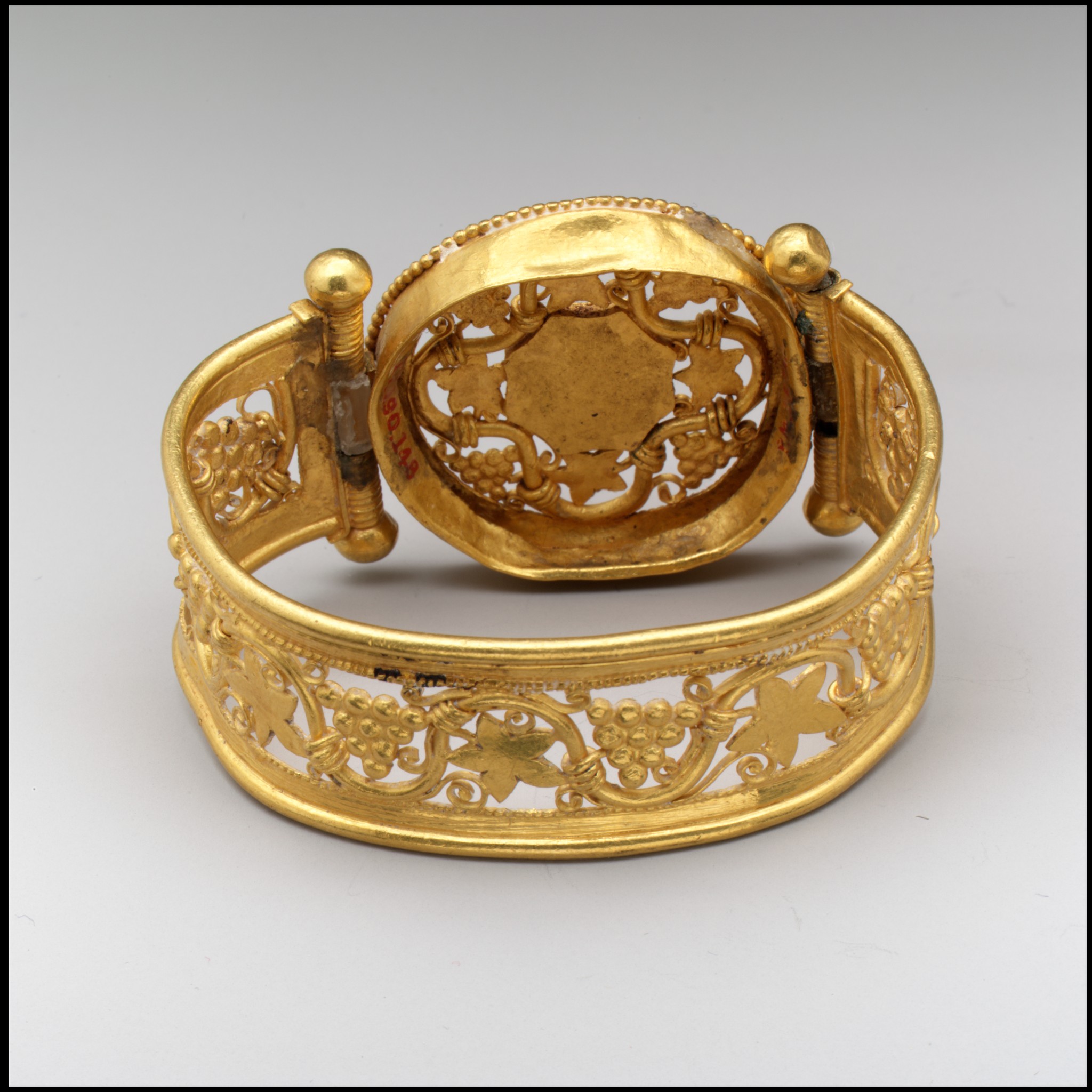
Heritage Analysis: The Byzantine Grapevine Bracelet
Object Overview and Material Composition
The artifact under examination is a Byzantine gold bracelet featuring an engraved grapevine pattern, executed in a sophisticated combination of sheet gold, rod, plain and beaded wire, granulation, and triangular-sectioned strip. Its composite construction reflects the technical mastery of Byzantine goldsmiths between the fourth and eleventh centuries, a period in which the empire's workshops in Constantinople set the standard for luxury metalwork across the Mediterranean and beyond. The bracelet's structural logic—sheet gold formed into a broad band or articulated segments, reinforced by rod and triangular strip, then embellished with wire and granulation—reveals an object designed not merely for adornment but for permanence. In the Byzantine worldview, permanence of material was inseparable from permanence of meaning.
Each technique carries its own semiotic weight. Granulation, the fusing of tiny gold spheres onto a surface, was an inheritance from Etruscan and Hellenistic traditions, yet Byzantine artisans deployed it with a distinctive restraint, using it to frame and accentuate rather than overwhelm. Beaded wire delineates the vine's tendrils and leaves with a precision that suggests both botanical observation and theological intentionality. The triangular-sectioned strip, often overlooked in stylistic analyses, serves a dual purpose: structural integrity and visual rhythm, creating a faceted edge that catches candlelight in liturgical or domestic settings. This is an object engineered for the interplay of light and gold, a medium through which the divine was understood to manifest.
Symbolic Power: The Grapevine as Cosmological Signifier
The grapevine is among the most densely encoded motifs in Byzantine visual culture. Rooted in Jewish tradition, where the vine represented Israel as a chosen people, it was reinterpreted in Christian theology as Christ himself: "I am the true vine" (John 15:1). In Byzantine iconography, the vine appears on sarcophagi, chalices, architectural friezes, and personal adornment, functioning as a compressed narrative of sacrifice, resurrection, and Eucharistic promise. When worn on the wrist, the grapevine bracelet transformed the body into a participant in this sacred economy. The wearer did not merely display wealth; they entered into a symbolic contract with the divine.
Critically, the grapevine also carried imperial connotations. Byzantine emperors styled themselves as Christ's vicegerents on earth, and court ceremonial frequently employed vine imagery to articulate the relationship between earthly and heavenly sovereignty. A gold bracelet of this type, therefore, occupied a liminal space between private devotion and public allegiance. It could be worn by a wealthy matron in her domestic quarters, by a courtier in the imperial presence, or by a pilgrim seeking protection on the road to Jerusalem. The object's meaning was not fixed but relational, activated by context, gesture, and the body that bore it.
Historical Adornment and the Byzantine Body
Byzantine attitudes toward jewelry were shaped by a productive tension between ascetic suspicion and sensory celebration. Church fathers warned against vanity, yet the imperial court and aristocratic households invested heavily in goldsmithing. Bracelets occupied a particularly intimate category. Unlike rings, which could signal betrothal or rank, or fibulae, which secured garments, bracelets encircled the wrist—a joint associated with agency, labor, and gesture. To adorn the wrist was to sanctify action itself. The grapevine pattern, wrapping around the limb, created a continuous loop of meaning: the vine that gives wine, the wine that becomes blood, the blood that redeems. The bracelet was thus a wearable theology, a catechetical device in gold.
Archaeological evidence from sites such as Sardis, Corinth, and the Black Sea colonies suggests that such bracelets circulated widely, not only in metropolitan Constantinople but across the empire's trade networks. Their portability made them ideal vehicles for cultural transmission. A bracelet could be gifted, inherited, or looted, carrying its symbolic freight into new contexts. In this sense, the grapevine bracelet was an early example of what we might now call a global luxury product: locally made, universally legible, and infinitely adaptable.
Spiritual Meaning and the Aesthetics of Continuity
The spiritual power of the grapevine bracelet lies in its formal continuity. The vine does not begin or end; it curves, branches, and returns, suggesting eternity and the cyclical nature of salvation history. Byzantine theologians such as Pseudo-Dionysius emphasized that material beauty was a ladder to immaterial beauty, and the bracelet's gold—incorruptible, luminous, resistant to tarnish—served as a physical analogue of divine permanence. The granulation, each granule a tiny sphere, evoked the countless souls gathered into the mystical body of Christ. The beaded wire, catching light along its length, suggested the unbroken chain of tradition linking the wearer to the apostles and martyrs.
This is not mere allegorical reading. Byzantine viewers were trained to read objects in this way. The bracelet was designed to be seen up close, in the hand, in candlelight, during prayer or at table. Its meaning unfolded slowly, through touch and contemplation. In an age before mass reproduction, such objects were unique performances of faith and identity.
2026 Luxury Strategy: From Heritage to High-End Positioning
For Katherine Fashion Lab, the Byzantine grapevine bracelet offers a strategic template for 2026 luxury positioning. The contemporary market for high-end jewelry is saturated with minimalist geometry and branded iconography. The Byzantine example suggests an alternative: narrative density. Today's luxury consumer, particularly the ultra-high-net-worth client, seeks objects that combine provenance, craftsmanship, and personal meaning. The grapevine bracelet delivers all three. Its techniques—granulation, beaded wire, triangular strip—are reproducible by master artisans and can be certified as heritage craft. Its symbolism—vine, gold, continuity—resonates with contemporary interests in wellness, spirituality, and sustainability.
Strategically, Katherine Fashion Lab should position a revived grapevine collection as "wearable heritage": limited edition, hand-finished, and accompanied by scholarly documentation. The object's Byzantine origin provides a deep historical anchor, while its formal beauty ensures contemporary desirability. Marketing should emphasize the bracelet as a talisman for the modern age—a symbol of resilience, connection, and enduring value. In a luxury landscape increasingly defined by experiences and stories, the Byzantine grapevine bracelet is not merely a product; it is a narrative artifact, ready for its next millennium.