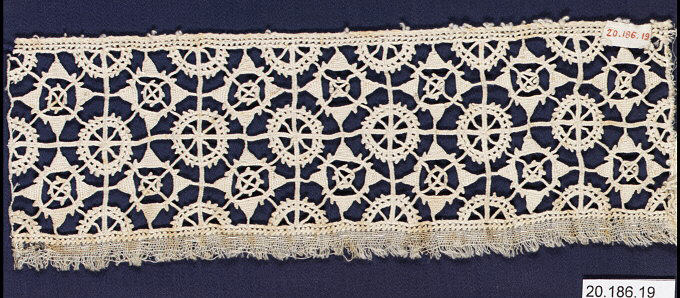
Strip: The Architecture of Reduction in Needle Lace
The strip is arguably the most underestimated structural unit in the history of dress. Neither a full garment nor a mere trimming, it occupies a liminal category: a linear module that carries the full weight of an aesthetic system within a narrow band. When executed in needle lace—the slowest, most exacting of all textile techniques—the strip ceases to function as decoration and becomes instead a thesis statement about restraint, repetition, and the economics of time. This standalone study examines the strip as a couture proposition, tracing its global heritage and its persistent capacity to convert thread into architecture.
Defining the Strip as a Couture Object
In technical terms, a strip is a narrow length of fabric or lace, typically uniform in width, produced either as a continuous run or as repeated motifs joined end to end. Its logic is modular. Unlike a panel, which is shaped to a body, a strip is generated first and applied second. This sequence matters. It means the strip carries its own internal order—a rhythm of picots, reseau, and cordonnet—before it ever encounters a garment. In needle lace, that internal order is built stitch by stitch, each loop tied to the last, producing a surface with no woven grain and no mechanical short-cuts.
Needle lace, known in its classical European forms as punto in aria—"stitches in air"—is constructed from a single element: the buttonhole stitch worked over a temporary outline. There is no loom, no bobbin, no continuous filament laid down by machine. The strip therefore represents a paradox: it is the most reproducible format in lace, yet in needle lace it is produced by the least reproducible method. This tension between modularity and singularity is precisely what makes the strip a couture subject rather than a folk one.
Global Heritage: The Strip Across Cultures
The strip's heritage is genuinely global, and its migrations reveal how formal solutions recur independently across geographies. In sixteenth-century Venice, needle lace strips were worked as border edgings for ecclesiastical linen, their geometric reticella patterns functioning as a display of both piety and technical mastery. In Flanders and France, the strip evolved into the wide flounce and the barbes of point de France, where the format's linearity was exploited to frame the face and neckline.
Beyond Europe, the strip appears in structurally comparable forms. West African narrow-band weaving produces long, strip-woven lengths—kente and its regional relatives—that are cut and reassembled, treating the strip as a unit of composition rather than a finished cloth. In the Andean tradition, narrow woven bands and tubular edgings carry complex symbolic coding, again using the strip as a carrier of meaning within a bounded field. Japanese kumihimo braids and sashiko banding operate on the same principle: a narrow, repeatable length that accumulates significance through repetition and placement.
What unites these traditions is not shared technique but shared logic. The strip is a response to a universal constraint: how to produce a long, consistent, portable ornament from a labor-intensive process. Needle lace answers this constraint with the highest possible time cost per centimeter, which is why, in a couture context, the needle-lace strip reads as an unmistakable signal of value.
Material Behavior: Needle Lace Under Tension
Needle lace behaves unlike any other strip material. It has no true grain, which means it does not bias-drape or fray in the conventional sense; it can be cut and rejoined with minimal loss, provided the cordonnet is respected. Yet it is also fragile under direct tension, since the buttonhole stitch network distributes stress unevenly across the motif. A strip of needle lace therefore requires careful mounting—typically onto a stable ground, a tulle, or a hand-stitched organza—before it can be used structurally.
This material behavior has design consequences. The needle-lace strip resists being used as a load-bearing element; it excels instead as a planar accent, a border, a seam treatment, or a repeated vertical. Couture houses have historically exploited this by running needle-lace strips in parallel, creating rhythm through repetition rather than through shaping. The strip becomes a metronome: regular, insistent, and deliberately unvaried, with interest generated by spacing and scale rather than by silhouette.
Construction and the Economics of Time
A single centimeter of fine needle lace can require thirty to sixty minutes of skilled handwork, depending on the density of the reseau and the complexity of the motif. A couture strip of one meter, therefore, may represent several hundred hours of labor. This is not an incidental fact; it is the central design constraint. The strip's narrowness is not a limitation but a strategy for managing time. By reducing the format to a band, the maker concentrates effort into a repeatable unit, allowing a small atelier to produce a coherent, high-value length without committing to the expense of a full shaped panel.
This is the strip's quiet commercial genius. It converts an unaffordable luxury—entirely handmade needle lace on a couture scale—into a feasible one, distributed across a linear format. The buyer receives the full technical signature of needle lace: the raised cordonnet, the irregular tension of the hand, the picoted edge. The maker receives a manageable production unit. Both parties accept the strip's terms.
Stylistic Reading: Repetition as Restraint
In contemporary couture, the needle-lace strip functions as an exercise in restraint. It refuses the maximalism of the fully encrusted bodice and instead proposes sequence. Designers who use it well—whether as a vertical spine down a column gown, a repeated cuff, or a horizontal band across a corseted waist—are making an argument about discipline. The strip says: one idea, executed perfectly, is enough.
This aligns the strip with a broader movement in luxury toward legibility. In an era of visual saturation, a narrow band of handmade lace communicates more effectively than a surface entirely covered in ornament, because the eye can parse it. The strip is legible. It has a beginning, a middle, and an end. It can be counted. In needle lace, where every stitch is a decision, that legibility is the ultimate luxury.
Conclusion: The Strip as Permanent Proposition
The strip is not a trend. It is a structural constant, recurring across centuries and continents because it solves a permanent problem: how to make time visible in cloth. In needle lace, that solution is at its most refined and its most expensive. The strip asks the wearer to accept a narrow field of attention, and in return it offers something increasingly rare in fashion—an object whose value is not asserted but demonstrated, stitch by stitch, centimeter by centimeter. For the couture client who understands that restraint is the final sophistication, the needle-lace strip remains the most articulate answer.