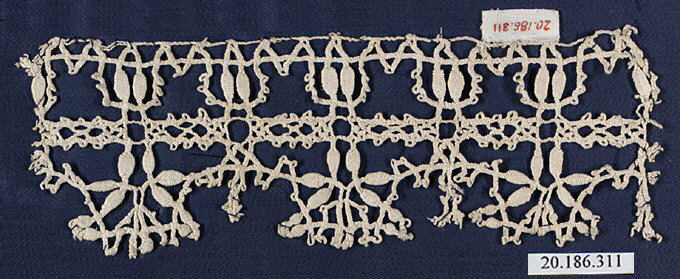
Heritage Analysis: Bobbin Lace Edging as Cultural Capital
Introduction: The Strategic Value of an Overlooked Artifact
Within the Katherine Fashion Lab portfolio of heritage assets, few categories possess the latent commercial and symbolic equity of bobbin lace edging. Unlike embroidered surfaces or woven brocades, edging occupies a liminal position in dress history: it borders, frames, and finishes. This marginal status has historically obscured its cultural weight. Yet for a luxury house operating in 2026, the edge is precisely where meaning concentrates. This analysis examines bobbin lace edging as a carrier of symbolic power, spiritual function, and aristocratic signaling, and proposes a strategic framework for its deployment in high-end collections.
Origins in Ancient Civilization: The Pre-Lace Impulse
Bobbin lace as a codified technique emerged in sixteenth-century Europe, but its conceptual ancestry reaches into ancient civilizations where the finishing of cloth carried ritual significance. In Egyptian tomb textiles, border bands of knotted and plaited thread protected the wearer from spiritual intrusion; the edge was understood as a threshold between the body and the world. Mesopotamian and later Greco-Roman garments employed decorative selvedges and applied trims that marked status and lineage. These early edgings were not ornamental afterthoughts but apotropaic devices—guards against malevolent forces. The ancient mind did not separate decoration from protection. To finish an edge was to seal a garment's spiritual perimeter.
Bobbin Lace: Technique as Symbolic Architecture
Bobbin lace, or pillow lace, is constructed by interlacing multiple threads wound on bobbins, guided by pins on a pricked pattern. This method produces a textile that is simultaneously open and structured—a paradox that explains its enduring symbolic charge. Unlike needle lace, which builds stitch upon stitch, bobbin lace grows through tension and counter-tension, a metaphor for social order and cosmic balance. The lacemaker's hands enact a choreography of restraint and release, and the resulting edging is a record of disciplined labor. In heritage terms, this technique encodes patience, precision, and the economics of time—values that luxury consumers in 2026 increasingly seek as authenticity markers.
Historical Adornment and the Semiotics of the Edge
From the seventeenth century onward, bobbin lace edging became a primary vehicle of aristocratic display. Flemish and Italian laces trimmed collars, cuffs, and ruffs, and their width and complexity were regulated by sumptuary laws. The edge was a legible text: a narrow lace signaled modest means, while a deep, intricate border announced access to international trade networks and skilled ateliers. In ecclesiastical contexts, lace edging on albs and surplices demarcated sacred from profane space. The altar cloth's edge was a threshold where the divine entered the material world. This dual function—social ranking and spiritual mediation—gave bobbin lace edging a density of meaning that few textiles could match.
Spiritual Meaning: The Threshold as Sacred Technology
Anthropologically, the edge is a liminal zone. It belongs neither to the garment nor to the void. Bobbin lace edging, with its pierced geometry, literalizes this liminality. The holes are not absence but structured openings—windows through which the eye and, symbolically, the spirit may pass. In medieval and early modern devotional practice, lace borders on veils and altar linens were believed to filter prayer and protect against evil. The spiderweb-like fineness evoked the fragility of life and the interconnectedness of creation. For Katherine Fashion Lab, this spiritual dimension offers a narrative of protection and passage, a counterpoint to the aggressive branding of contemporary luxury.
2026 Luxury Strategy: Recontextualizing the Edge
The 2026 high-end market is defined by provenance, craft scarcity, and meaningful symbolism. Bobbin lace edging aligns with all three. Strategically, the house should treat edging not as a trim but as a signature architectural element. A tailored jacket finished with hand-made bobbin lace at the cuff becomes a wearable artifact—an edge that carries centuries of threshold logic. The spiritual narrative can be activated through capsule collections titled around concepts of boundary, protection, and passage. Collaborations with heritage lace ateliers in Flanders and Burano can secure supply chain authenticity and generate documentary content for digital channels. Pricing strategy should reflect the labor intensity: a single meter of fine bobbin lace can require twenty or more hours, justifying a premium that positions the house alongside haute joaillerie rather than fast luxury.
Conclusion: From Margin to Center
Bobbin lace edging has spent centuries at the periphery of garments and, consequently, of fashion history. Yet the periphery is where power is negotiated. For Katherine Fashion Lab, the strategic opportunity is to invert the hierarchy: to make the edge the protagonist. By foregrounding the ancient symbolism of the threshold, the spiritual technology of the pierced border, and the disciplined craft of bobbin lace, the house can claim a heritage position that is at once scholarly and commercially potent. In a market saturated with surface, the edge offers depth.