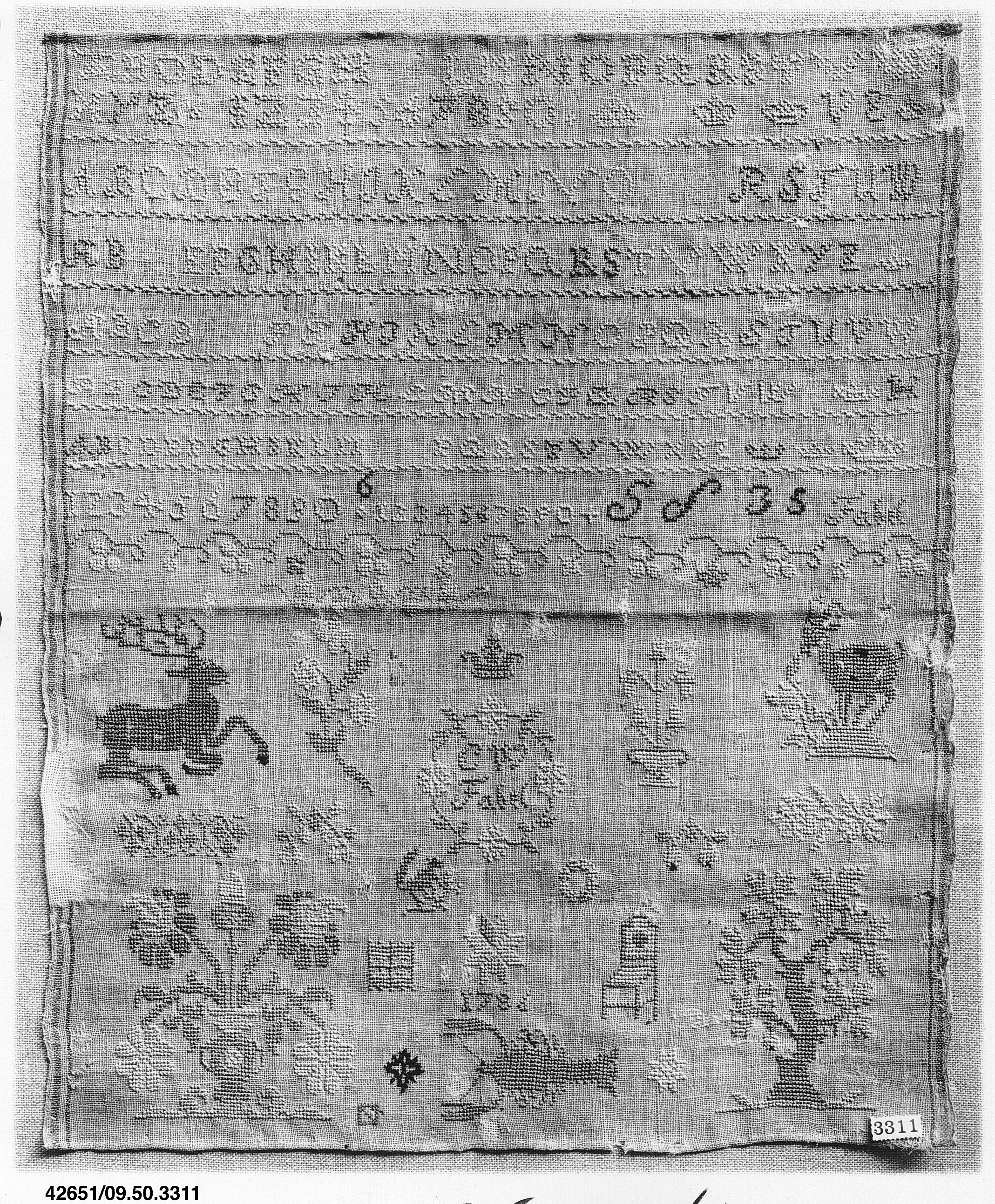
Sampler: A Study in Silk on Linen Canvas
The sampler occupies a curious position within the hierarchy of textile arts. Long dismissed by the institutional art world as mere pedagogical exercise—the domestic accomplishment of schoolgirls learning their letters and stitches—it has nonetheless persisted as one of the most revealing artifacts of material culture. At Katherine Fashion Lab, our standalone study of the sampler engages this form not as a footnote to fashion history but as a legitimate object of couture analysis. Executed in silk thread upon a linen canvas ground, the sampler is a document of technical mastery, a record of global heritage, and a meditation on the relationship between discipline and expression.
Origins and Global Heritage
The sampler's lineage resists any single point of origin. Its ancestors appear across cultures and centuries: the pre-Columbian textiles of the Andes, where weavers recorded complex motifs in cotton and camelid fiber; the medieval European exemplars, where nuns and noblewomen stitched reference bands of stitches for later use; the Ottoman embroidery traditions that traveled along trade routes into the Balkans and beyond; and the Chinese silk needlework whose precision set an enduring standard for fineness. What unites these disparate traditions is function: the sampler was, at its core, a repository—a place to store technique.
By the seventeenth and eighteenth centuries, the form had bifurcated. In Europe and colonial America, the sampler became a formal component of female education, its alphabets and moral verses testifying to both literacy and virtue. Elsewhere, in the textile workshops of Gujarat, in the embroidery circles of Palestine, and in the domestic economies of West Africa, the sampler remained a working tool—a means of preserving pattern across generations. This global heritage is precisely what makes the sampler so compelling to the contemporary couturier: it is a form that belongs to no one culture and to every culture, a shared grammar of the needle.
Silk on Linen: The Material Argument
The choice of silk thread upon linen canvas is not incidental. It is the material argument of the entire object. Linen, woven from the fibers of the flax plant, provides a ground of exceptional stability—its natural stiffness and even weave make it an ideal substrate for counted work, where each stitch must align with the warp and weft. It is a humble material, associated with utility and endurance rather than luxury. Silk, by contrast, carries the opposite associations: luster, expense, refinement, and the labor of sericulture. When silk is worked upon linen, the result is a deliberate tension between the ordinary and the precious, the domestic and the exotic.
This tension is central to our analysis. The sampler in silk on linen is a study in controlled contrast—the matte, neutral ground against the luminous, saturated thread. The linen disciplines the silk; the silk elevates the linen. In couture terms, this is the same principle that governs the pairing of a structured wool tailoring cloth with a silk charmeuse lining, or a raw-edged linen garment with hand-finished silk embroidery. The sampler teaches proportion, restraint, and the intelligence of juxtaposition.
Technique as Content
To examine a sampler is to read a curriculum. Cross-stitch, tent stitch, satin stitch, French knots, eyelets, and drawn-thread work each appear as discrete lessons, yet the finest samplers integrate them into a coherent visual field. The stitch vocabulary becomes the content itself. A band of alphabets demonstrates the discipline of letterforms; a border of floral motifs demonstrates the management of curve and color; a central verse demonstrates the ability to plan and execute a large-scale composition.
For the couture atelier, this is directly analogous to the sample book—the bound volumes of fabric swatches, embroideries, and finishing techniques that couture houses maintain as institutional memory. The historical sampler and the modern sample book share a function: they are archives of capability. They exist not to be worn but to be consulted, to prove that a technique has been mastered and can be reproduced. In this sense, the sampler is the ancestor of the couture carnet, the designer's working notebook of fabric and finish.
Standalone Study: The Sampler Reconsidered
As a standalone study, the sampler resists the temptation to become a finished garment. It does not need to be worn to be complete. Its completeness lies in its internal logic—the balance of empty linen and worked silk, the rhythm of bands and borders, the visible evidence of the hand. In an era of digital reproduction and algorithmic pattern, the sampler asserts the value of the irreproducible gesture: the slight irregularity of a hand-stitched line, the tension of thread pulled through cloth by a human hand.
At Katherine Fashion Lab, we treat the sampler as a foundational text. It is where the hand learns before the eye decides. It is where heritage is transmitted stitch by stitch, culture by culture. And it is where silk meets linen—the luxurious and the utilitarian—in a dialogue that remains, centuries later, the essential conversation of couture itself.