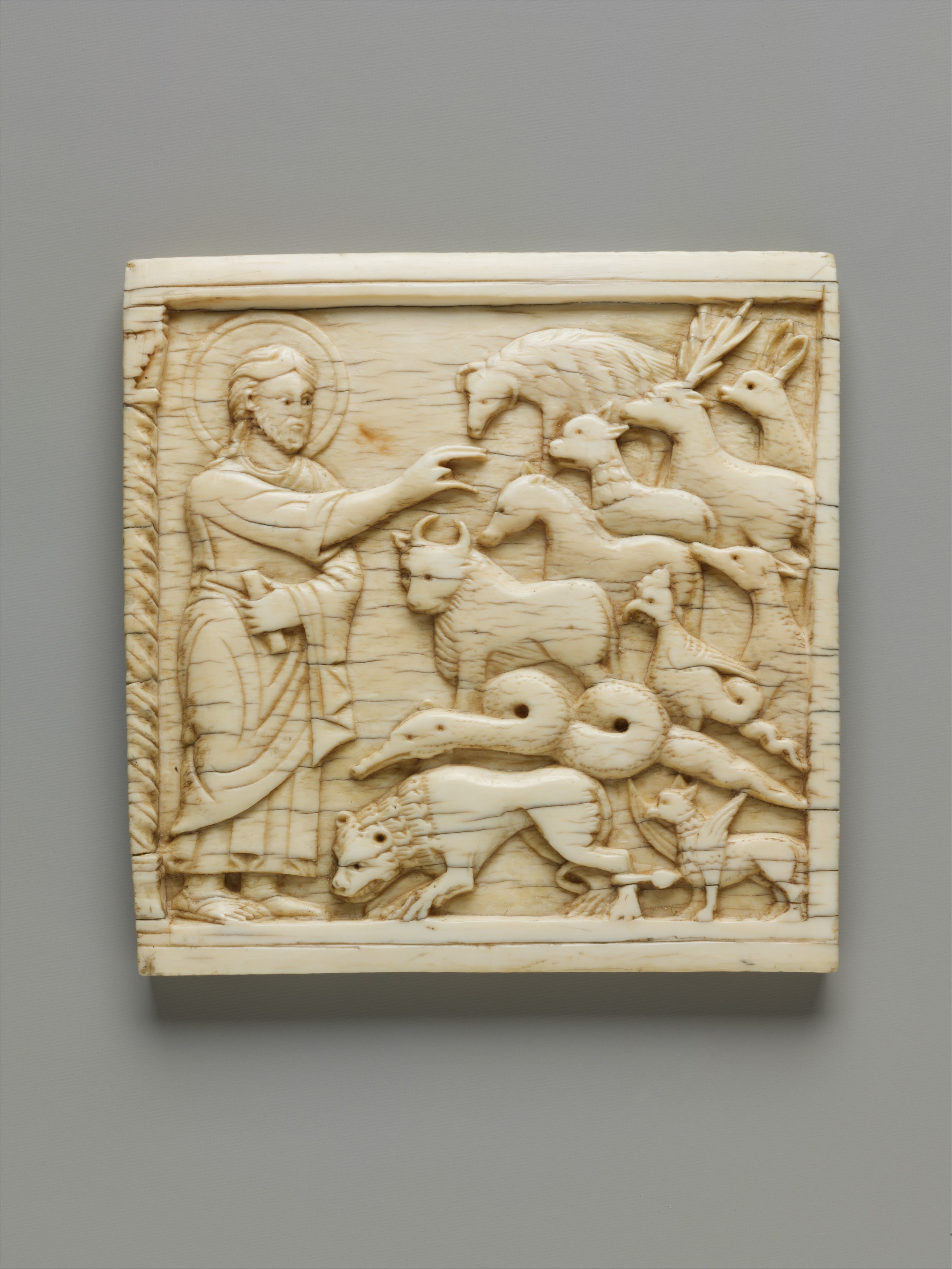
Heritage Analysis: Plaque with God Creating the Animals
Object Overview and Materiality
The Plaque with God Creating the Animals is a South Italian carved elephant ivory, likely produced between the late eleventh and early thirteenth centuries, a period in which the Mezzogiorno functioned as a cultural crucible where Byzantine, Latin, Norman, and Islamic visual traditions converged. The plaque depicts the Creator in the act of forming living creatures, a subject drawn from Genesis and inflected through medieval theological commentary on divine craftsmanship. Its medium is not incidental: elephant ivory was a rare, imported, and prestige material whose acquisition required long-distance trade networks linking South Italy to North Africa and the eastern Mediterranean. The object therefore encodes both sacred narrative and material scarcity, a dual economy of meaning that remains strategically relevant to contemporary luxury positioning.
Symbolic Power: Creation as Divine Artistry
The iconography of God creating the animals carries layered symbolic force. In the medieval imagination, the act of creation was frequently analogized to the work of the artisan: God as faber, the divine craftsman who shapes, orders, and animates matter. A carved ivory plaque literalizes this metaphor, since the image of creation is itself produced through the patient subtraction of material by a human hand. The plaque thus performs a reflexive argument about making: the carver imitates the Creator, and the beholder is invited to read technical virtuosity as theological virtue.
The animals themselves are not decorative filler. In South Italian exegetical tradition, the diversity of creatures signified the plenitude of divine wisdom and the ordered hierarchy of being. Each beast occupies a position within a cosmic chain that extends from the inanimate to the angelic. For a modern luxury audience, this translates into a narrative of ordered abundance: not randomness, but curated diversity under a unifying intelligence. The plaque's symbolic power lies in its capacity to make hierarchy feel harmonious rather than coercive, a distinction of considerable value to brands negotiating questions of taste, authority, and inclusion.
Historical Adornment and the Politics of Display
Ivory plaques of this type were not conceived as autonomous artworks. They were components of larger ensembles: book covers, caskets, reliquaries, and liturgical furnishings. Their function was adornment in the service of devotion and status. To own such an object was to participate in a network of ecclesiastical and aristocratic patronage that signaled learning, connectivity, and material reach. South Italian workshops, positioned between Latin Europe and the Byzantine world, produced ivories that circulated widely, making them early examples of transregional luxury goods.
This history matters for brand strategy because it demonstrates that adornment has never been merely ornamental. It is a technology of social positioning. The plaque's original viewers encountered it in low light, within ritual or domestic settings, where its polished surface and fine carving would catch candlelight. The object was designed for intimate, embodied encounter, not mass visibility. That distinction between spectacle and intimacy is a strategic lever for 2026 luxury, where exclusivity increasingly depends on private, sensorial, and knowledge-rich experiences rather than logo-driven display.
Spiritual Meaning and the Ethics of Making
The theological content of the plaque also raises ethical questions that resonate with contemporary sustainability discourse. Elephant ivory is a contested material, and any responsible heritage strategy must acknowledge the extractive violence embedded in its supply chain, even as it honors the artistry of historical objects. The medieval carver worked within a worldview that regarded nature as a book of divine signs; modern luxury operates within a worldview that must regard nature as a finite and vulnerable resource. The plaque therefore serves as a case study in the transformation of spiritual meaning into ethical accountability. A brand that engages this object must do so with transparency about provenance, conservation, and the difference between historical appreciation and contemporary replication.
Strategic Implications for 2026 High-End Luxury
For Katherine Fashion Lab, the plaque offers a template for a standalone heritage narrative that connects sacred iconography, material rarity, and artisanal mastery. Three strategic directions follow.
First, narrative-led product development. The plaque's subject, divine creation through craft, supports a collection concept organized around the idea of making as meaning. Rather than citing the object decoratively, the brand can translate its compositional logic: centralized authority, radiating diversity, and meticulous surface control. This yields design language that feels both archival and contemporary.
Second, provenance as luxury content. The object's South Italian origin and transregional circulation provide a story of cultural fusion that aligns with global luxury consumers who value hybrid heritage over monolithic tradition. Educational content, museum partnerships, and archival research can position the brand as a custodian of knowledge, not merely a purveyor of goods.
Third, ethical repositioning of ivory heritage. The brand should treat historical ivory as a museum-grade reference, not a production material. By explicitly separating appreciation from replication, Katherine Fashion Lab can engage the plaque's aesthetic and spiritual power while affirming modern commitments to conservation and animal welfare. This is not a concession to contemporary sensitivities; it is a sophisticated articulation of the difference between heritage and extraction.
Conclusion
The Plaque with God Creating the Animals is a compact artifact of enormous strategic density. It unites symbolic power, historical adornment, spiritual meaning, and material ethics in a single carved surface. For a 2026 luxury house, its value lies less in its imagery than in its argument about making: that creation is ordered, that adornment is positional, and that beauty carries obligations. Katherine Fashion Lab can draw on this object to build a heritage strategy that is intellectually rigorous, ethically transparent, and aesthetically distinctive, converting medieval theology into modern brand equity.