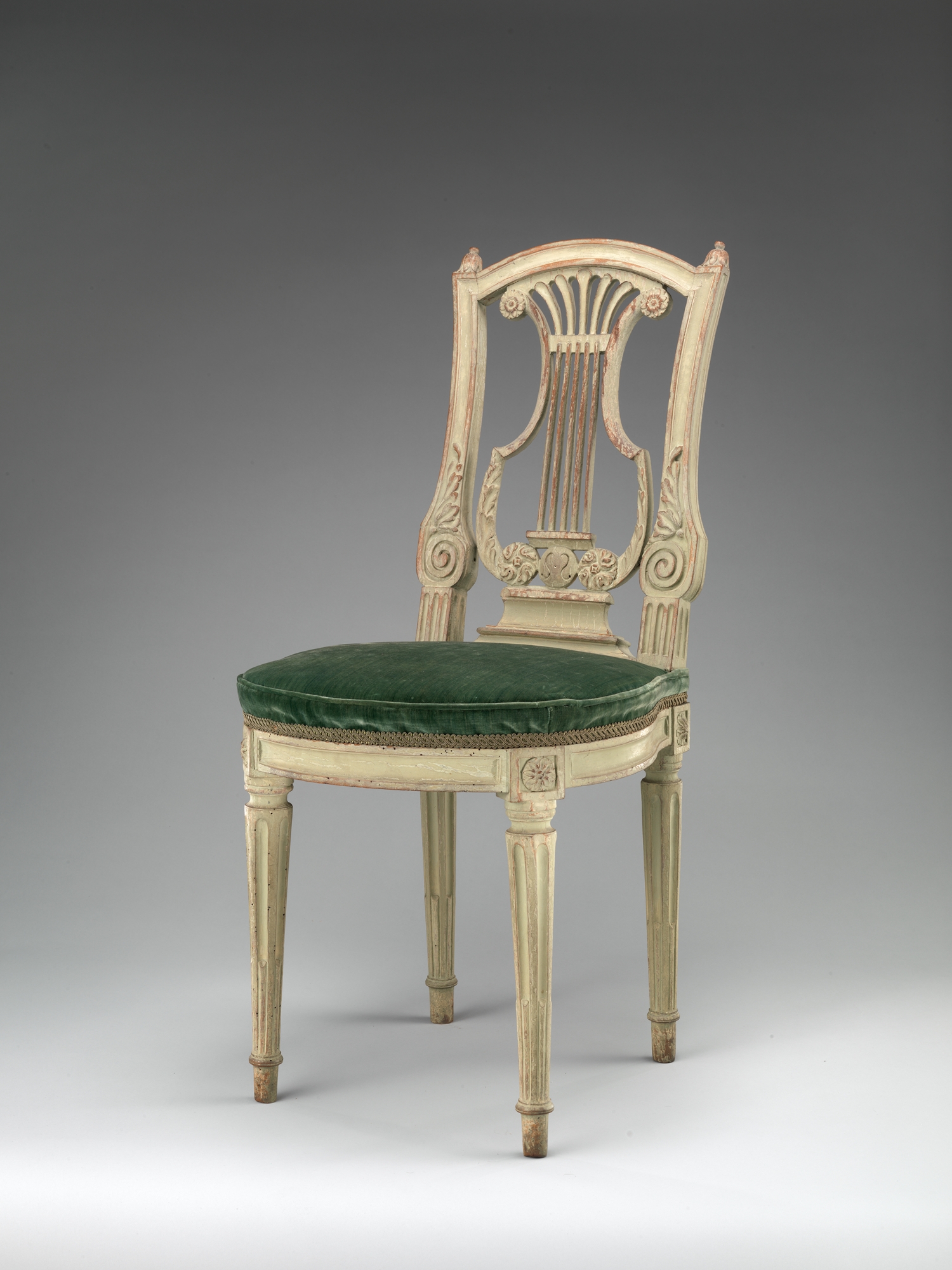
Object Analysis: Side Chair (One of a Pair) — Walnut, Carved and Painted Grey, with Velvet Upholstery
The object under examination is a single side chair from a matched pair, executed in walnut that has been carved, finished, and subsequently painted in a cool, muted grey, with its seat and back panel upholstered in velvet. While the chair is presented here as a standalone study, its identity as one of a pair is not incidental; it is constitutive of its design logic, its proportional system, and its social function. The paired side chair belongs to a distinct typology within the history of seating furniture—one that privileges symmetry, restraint, and the choreography of the interior over the singular expression of the armchair or the throne. This analysis situates the chair within the broader currents of global heritage furniture traditions, examines the material and technical decisions embedded in its construction, and argues that its painted surface and velvet upholstery represent a sophisticated negotiation between structural honesty and decorative dissimulation.
Typology and the Logic of the Pair
The side chair—sometimes called a back stool or, in French usage, a chaise à dos—emerges historically as a seat without arms, designed to be placed against a wall or arranged in symmetrical groupings around a room. Its lack of arms is not a deficiency but a deliberate economy: without arms, the chair can be drawn close to a table, aligned tightly in a row, or positioned in mirrored pairs flanking a console, a doorway, or a fireplace. The pair, therefore, is the natural unit of the side chair. A single side chair is a fragment; two side chairs constitute a composition. This object, studied alone, must nonetheless be read as half of a dialogue—its carving, its proportions, and its painted surface were conceived with a twin in mind, and the symmetry of the pair is itself a form of ornament.
In the context of global heritage, the side chair appears across cultures with remarkable consistency of function if not of form: the Chinese guanmaoyi, the English Queen Anne side chair, the French chaise à la reine, and the Venetian painted side chair all share the same fundamental brief—to provide dignified, portable, non-hierarchical seating. The present chair, with its carved walnut and painted grey finish, belongs to this broad lineage, though its specific treatment suggests a Western European or colonial atelier working within inherited classical vocabularies.
Material and Technique: Walnut, Carving, and the Painted Surface
Walnut is a choice that rewards close reading. It is a hardwood of medium density, prized for its fine, straight grain and its capacity to hold crisp carved detail without splintering. Unlike oak, which can be coarse, or mahogany, which can be heavy and dark, walnut lends itself to the lighter, more attenuated forms of the eighteenth and nineteenth centuries. The decision to carve the chair—likely in the crest rail, the splat, the stiles, and the knees of the legs—indicates that the maker was not merely assembling a utilitarian object but engaging in a recognized decorative program. Carving in walnut is a subtractive act of confidence: the carver must commit to the cut, and the wood's relative softness compared to ebony or rosewood makes precision both easier and more necessary.
The subsequent application of grey paint over the carved walnut is the chair's most conceptually interesting feature. In the history of furniture, painting over fine hardwood is often read as a later intervention—a Victorian or Edwardian correction, a way of harmonizing an older piece with a lighter, more neoclassical interior. Yet grey paint on walnut is not necessarily a disguise. In the eighteenth-century goût grec and the later Directoire and Empire styles, grey and off-white painted finishes were used deliberately to evoke stone, plaster, and the archaeological fragments of Herculaneum and Pompeii. A grey-painted carved chair participates in this taste for the antique: it transforms a warm, organic material into something cooler, more architectural, and more abstract. The paint does not hide the carving; it clarifies it, casting shadows into the recesses and lending the ornament a lapidary quality.
Velvet Upholstery and the Politics of Comfort
The velvet upholstery—covering the seat and, in all likelihood, the back panel—introduces a second material register. Velvet is a pile fabric, traditionally woven in silk, cotton, or a blend, and its value lies in its depth of color and its tactile richness. Where the painted walnut is hard, matte, and cool, the velvet is soft, light-absorbing, and warm. This contrast is not accidental; it is the central aesthetic tension of the chair. The upholstery also signals function: a velvet-covered side chair is a chair for the drawing room, the reception room, or the formal dining room, not the kitchen or the study. Velvet is a fabric of occasion, and its presence elevates the chair from the merely useful to the ceremonial.
Historically, velvet upholstery on side chairs also carried social meaning. In many European courts, the color and quality of velvet were regulated by sumptuary laws, and the right to sit on velvet was itself a marker of status. Even after such laws fell away, the association persisted: velvet remained the fabric of the salon, the embassy, and the museum. This chair, with its grey-painted frame and its velvet seat, thus occupies a middle ground—grand enough for formal use, restrained enough for modern interiors, and historically resonant enough to reward sustained connoisseurial attention.
Conclusion: A Chair of Negotiated Identities
As a standalone study, this side chair rewards analysis precisely because it refuses easy categorization. It is carved but painted; it is walnut but grey; it is a seat but not an armchair; it is one but implies two. Its global heritage is legible in its typology, its technique, and its materials, yet its specific combination of these elements is distinctive. For the collector or curator, the chair offers a lesson in the value of the pair, the intelligence of the painted surface, and the enduring eloquence of the side chair as a form. It is not a masterpiece of singularity, but it is a masterpiece of fit—fit for the room, fit for the pair, and fit for the long history of sitting with dignity.