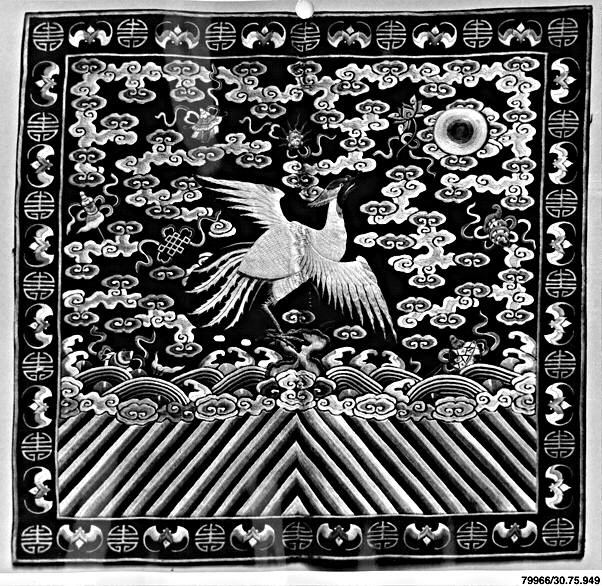
The Rank Badge with Silver Pheasant: A Study in Bureaucratic Splendor
Within the pantheon of Chinese textile arts, few objects embody the intersection of political hierarchy, metaphysical cosmology, and virtuosic craftsmanship as compellingly as the rank badge. This standalone study examines a particularly refined example: a Rank Badge with Silver Pheasant, executed in silk on silk, originating from Qing Dynasty China. Though modest in scale, these embroidered squares—known in Chinese as buzi—functioned as the wearable constitution of an empire, encoding the precise station of every civil and military official within the imperial bureaucracy. The silver pheasant, specifically, designated the fifth rank among civil officials, a position of substantial administrative authority that placed its holder at the threshold between provincial governance and the central court.
To understand this object is to understand the Qing state's genius for visual legibility. The badge was not merely ornamentation; it was a technology of governance, a standardized interface through which the emperor's authority could be read at a glance across the vast distances of the realm.
Materiality and Technique: The Discipline of Silk on Silk
The designation "silk on silk" is deceptively simple, belying the complexity of execution that distinguishes court-grade embroidery from provincial approximations. The foundation fabric would typically be a finely woven silk, often a kesi or satin ground, upon which the artisan built up the image through meticulous stitchwork. The most prestigious examples employed kesi—"silk tapestry" or slit tapestry weave—where discontinuous weft threads create the image with a precision that rivals painting. Alternatively, the badge might be executed in su xiu (Suzhou embroidery), whose needlework traditions supplied the imperial workshops with their most skilled hands.
The silver pheasant itself is rendered through a sophisticated repertoire of stitches. Satin stitch (ping zhen) establishes the broad planes of plumage, its lustrous surface catching light in a manner that simulates the iridescent sheen of actual feathers. Finer details—the eye, the beak, the articulation of individual feather barbs—are achieved through shorter, denser stitches, sometimes layered to create dimensional relief. The bird stands against a ground that may incorporate couched gold or silver-wrapped threads, their metallic cores lending an understated radiance that frames the avian subject without overwhelming it.
The palette, though constrained by the conventions of rank, is anything but monotonous. The silver pheasant's plumage in nature is a study in greys, whites, and blacks, with delicate vermiculations and a striking red facial wattle. The embroiderer translates this into silk with nuanced gradations: undyed or bleached white for the brightest plumage, charcoal and deep grey for contrast, and a single, disciplined accent of coral or crimson for the wattle. This chromatic restraint is itself a mark of refinement; the artisan conveys the bird's identity through structural precision rather than coloristic excess.
Iconography and the Symbolic Order
The silver pheasant is not an arbitrary choice. In the Confucian-influenced cosmology of the Qing court, each animal emblem carried moral and metaphysical associations. The pheasant, with its upright posture and distinctive plumage, signified courage, integrity, and martial vigilance—qualities deemed essential to the civil official who must, paradoxically, embody both scholarly gentility and decisive authority. The bird's association with the fifth rank placed it within a highly codified hierarchy: the first rank wore the crane, the second the golden pheasant, the third the peacock, the fourth the wild goose, and the fifth the silver pheasant. Below it, the sixth through ninth ranks wore the egret, mandarin duck, oriole, and quail respectively.
The composition of the badge follows a standardized iconography. The pheasant typically faces the sun, represented by a red or gold disc in the upper corner—a symbol of the emperor himself, toward whom all officials orient their loyalty. The bird may stand upon a rock formation (tai shi), a visual pun signifying stability and the enduring foundations of the state. Surrounding clouds, rendered in stylized ruyi forms, evoke the celestial realm and the emperor's role as the Son of Heaven. Waves at the base, if present, suggest the terrestrial waters over which the official exercises jurisdiction. Every element is legible, every motif purposeful.
What distinguishes a superior badge from a merely competent one is the vitality of the bird. The finest examples convey a sense of arrested motion—the pheasant seems poised to step forward, its neck extended, its eye alert. This dynamism, achieved through subtle asymmetries in the feather placement and the directional flow of stitches, elevates the badge from bureaucratic insignia to genuine artistic expression.
Context and Connoisseurship: The Standalone Badge
This badge is presented as a standalone study, detached from the robe it once adorned. This decontextualization is both a loss and an opportunity. The loss is evident: we no longer see the badge as it was intended—centered on the chest of a dark blue or black surcoat, framed by the wearer's posture and movement, animated by the play of light across the entire ensemble. The opportunity lies in the close reading that isolation permits. Freed from the garment, the badge becomes a self-contained composition, its technical and artistic merits available for sustained scrutiny.
For the collector and curator, the standalone badge demands a connoisseurship attentive to condition, technique, and provenance. Originality of materials is paramount: the silk ground should retain its integrity, without the brittle shattering that afflicts degraded fibers. The embroidery should exhibit consistent tension and density, without the flattened or coarsened appearance of later restitching. The metallic threads, if present, should show the patina of age rather than the uniform brightness of modern replacements. Traces of the original mounting—stitch holes along the edges, or remnants of the backing paper—provide evidence of authenticity and help reconstruct the object's biography.
Yet the badge also invites a broader meditation on the nature of bureaucratic art. Here is an object whose primary function was to classify and control, to render the human subject legible to the state. And yet, within that functional constraint, the embroiderer achieved something that transcends mere administration. The silver pheasant badge is a testament to the capacity of human craftsmanship to invest even the instruments of power with beauty, to make of a uniform a work of art. It reminds us that the Qing bureaucracy, for all its rigidity, was sustained by a material culture of extraordinary sophistication—one that understood that authority is most effective when it is also aesthetically compelling.
In the end, the Rank Badge with Silver Pheasant stands as a double artifact: a document of imperial governance and a masterpiece of textile art. To study it is to encounter the Qing state at its most intimate and most ambitious—stitched, thread by thread, into the fabric of everyday power.