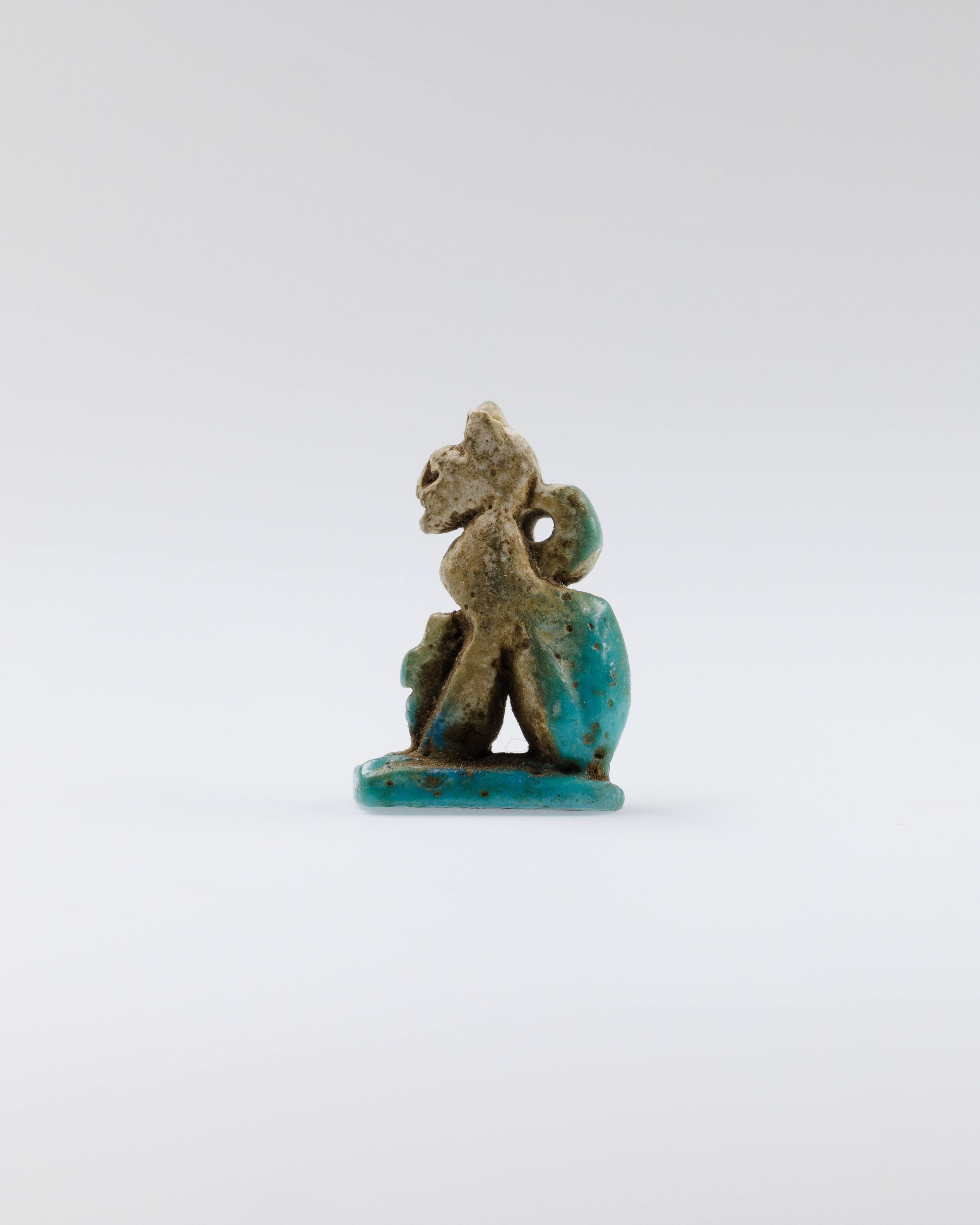
Executive Summary: The Feline Guardian as Luxury Archetype
Within the Katherine Fashion Lab heritage portfolio, few artifacts possess the strategic elasticity of the ancient Egyptian cat amulet rendered in faience. This small, luminous object—typically no larger than a modern thumb—condenses three thousand years of symbolic capital into a single wearable form. For 2026 luxury positioning, the cat amulet offers a rare convergence: it is simultaneously an object of spiritual protection, feminine authority, and artisanal mastery. This analysis examines its historical adornment function, its layered symbolic power, and its direct translation into a high-end strategy for the contemporary market.
Historical Adornment and the Faience Medium
Materiality as Status Signal
Faience—a sintered quartz paste with a vitreous alkaline glaze—was not a cheap substitute for precious metal. In the ancient Egyptian and broader Mediterranean contexts, it was a technological luxury. Its production required controlled kiln atmospheres, metallic oxide colorants (copper for turquoise, cobalt for deep blue), and specialized workshops often attached to temple or palace economies. The cat amulet in faience was therefore an accessible yet elevated adornment: worn by the living, placed among mummy wrappings, or deposited in foundation deposits. Its surface mimicked the sacred luminosity of lapis lazuli and turquoise—stones associated with the sun god and the heavens—without the prohibitive cost. For a modern luxury house, this establishes a heritage precedent for democratized exclusivity: a material innovation that carries spiritual weight and visual prestige.
Wearable Ritual
These amulets were strung on linen or gold wire, worn as pectorals, rings, or hair ornaments. The cat form—often seated, alert, with tail curled—was not decorative neutrality. It was a portable altar. The wearer did not merely display an animal; they activated a relationship with a deity. This distinction is critical for 2026 luxury strategy: the cat amulet is not a charm in the modern sense of luck, but a contractual object—a physical pledge of protection, fertility, and grace under pressure.
Symbolic Power: Bastet, Sekhmet, and the Feline Duality
The Benevolent and the Fierce
Ancient Egyptian theology encoded a deliberate duality in the feline. Bastet, the cat goddess of Bubastis, governed home, fertility, joy, and the protection of children. Her amulets were worn by pregnant women and placed in domestic shrines. Yet Bastet’s shadow was Sekhmet—the lioness warrior goddess of plague, healing, and righteous destruction. The same amulet could invoke either face depending on context: a mother’s protective tenderness or a sovereign’s lethal authority. This dual symbolic power is the cat amulet’s greatest strategic asset. It resists a single narrative. It can be marketed as soft power (nurturing, intuitive, cyclical) or hard power (regal, predatory, decisive)—or, most compellingly, as the integration of both.
Spiritual Meaning: The Eye, the Moon, and the Threshold
Feline eyes in ancient iconography were linked to the sun and moon—the pupils contracting and expanding like lunar phases. The cat’s nocturnal vision made it a guardian of liminal spaces: doorways, dreams, the passage between life and death. Amulets were often placed at the throat or heart, the body’s own thresholds. In spiritual terms, the cat amulet promised vigilance without anxiety—a state of calm, unblinking awareness. For a luxury consumer in 2026, saturated with digital noise and performative wellness, this is a potent promise: not escape, but grounded presence.
Strategic Translation for 2026 High-End Luxury
From Amulet to Icon: Product Architecture
Katherine Fashion Lab should treat the cat amulet not as a motif to be reproduced, but as a structural archetype for a standalone collection. Three tiers are recommended:
Tier One – The Votive: Small-scale faience-inspired pendants in recycled glass paste or hand-glazed ceramic, priced at accessible luxury. These function as entry points and everyday talismans. Each piece carries a unique glaze variation, reinforcing the ancient workshop logic of one-of-a-kind firing.
Tier Two – The Guardian: Solid gold or bronze amulets with inlaid enamel or carved semi-precious eyes. Worn as signet rings or heavy chain pendants. The cat is seated, tail wrapping the wearer’s finger or collarbone—a physical sensation of embrace and alertness.
Tier Three – The Sovereign: One-of-a-kind high jewelry pieces combining faience revival techniques with ethically sourced gemstones. A cat’s head in carved rock crystal, whiskers in diamond pavé, the body a single baroque pearl. These are collector objects, exhibited in museum-adjacent trunk shows.
Narrative and Ritual in Retail
The 2026 luxury consumer does not buy objects; they buy participation in a lineage. Each cat amulet should arrive with a small papyrus-textured card detailing the specific deity invoked (Bastet for joy, Sekhmet for boundary-setting), the faience recipe, and a suggested ritual: wear on the left side for receiving, the right for acting. This is not superstition; it is experiential luxury—a choreography of meaning that elevates a purchase into a practice.
Competitive Differentiation
Competitors in the talismanic jewelry space lean heavily on generic evil eyes or zodiac signs. The cat amulet, anchored in a specific and well-documented ancient civilization, offers deep provenance without cultural appropriation risk when handled with scholarly transparency. Katherine Fashion Lab should partner with Egyptology departments for authentication of design motifs and publish open-source research notes. This positions the brand as a custodian, not a colonizer, of heritage.
Conclusion: The Strategic Feline
The ancient faience cat amulet is not a quaint historical curiosity. It is a high-performance symbolic technology—compact, durable, and emotionally resonant across millennia. For Katherine Fashion Lab’s 2026 strategy, it offers a rare triple bottom line: spiritual meaning for the consumer, artisanal narrative for the brand, and a defensible intellectual property position built on genuine historical depth. The cat does not chase. It waits. And in luxury, as in ancient Thebes, the one who waits with perfect stillness ultimately commands the room.