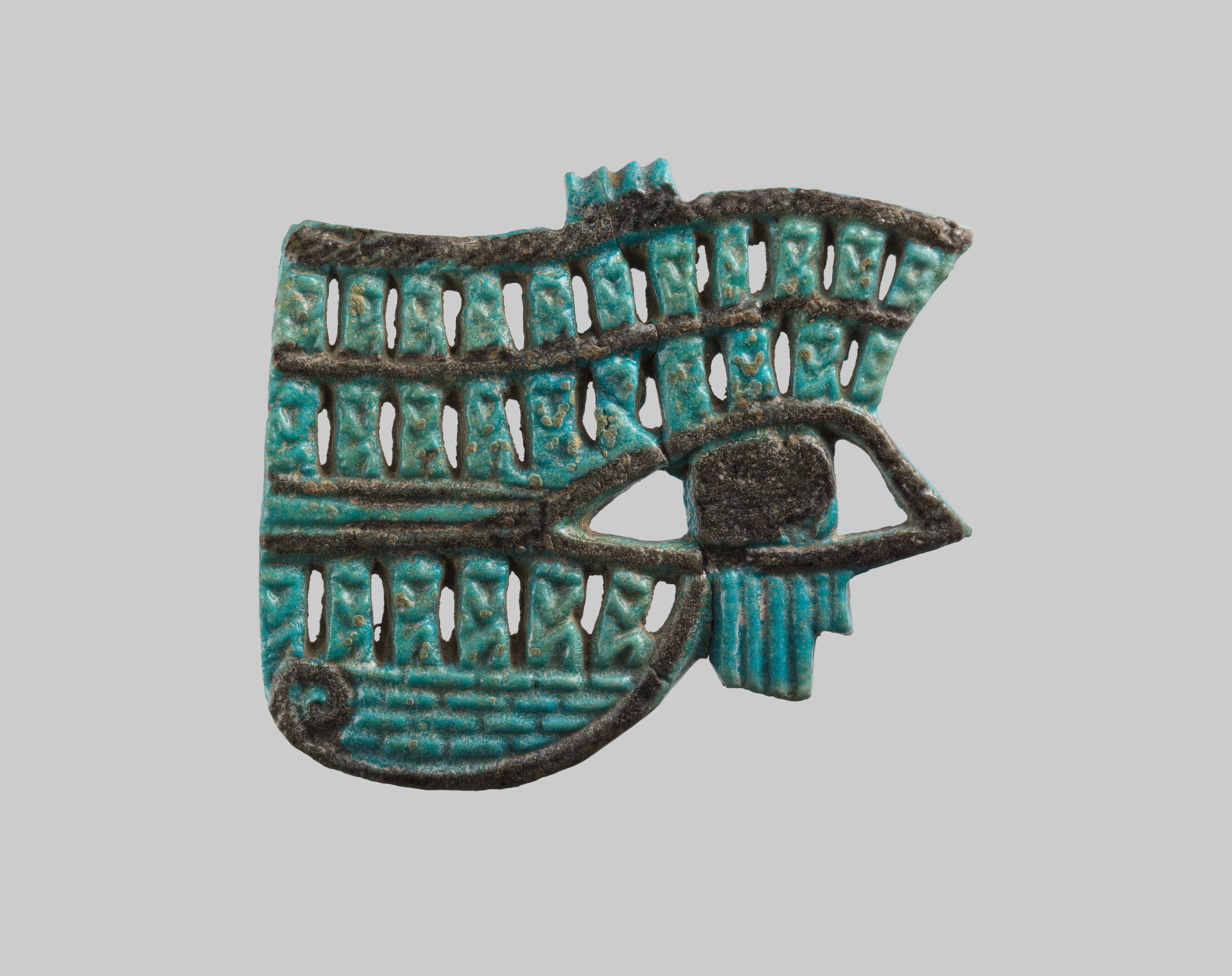
Executive Summary: The Wedjat Eye as a Strategic Heritage Asset
This analysis examines a specific iteration of the ancient Egyptian Wedjat eye amulet—crafted in faience and flanked by baboons—as a profound cultural artifact. For Katherine Fashion Lab (KFL), this object is not merely a relic but a dense repository of symbolic capital, representing a 4,000-year legacy of protective adornment, spiritual belief, and apotropaic power. The strategic deconstruction of its layered meanings—from its core mythology to its materiality and attendant fauna—provides a unique blueprint for a 2026 high-end luxury strategy. This research posits that the Wedjat with baboons transcends aesthetic inspiration, offering a narrative framework for a collection that operationalizes heritage as a conduit for modern identity, resilience, and spiritual armor in the luxury consumer landscape.
Deconstructing the Artifact: Symbolic Power and Historical Adornment
The Core Mythology: Restoration, Wholeness, and Sovereign Power
The Wedjat eye, representing the healed eye of the god Horus, is one of ancient Egypt's most potent and enduring symbols. Its narrative foundation lies in the mythic conflict between Horus and Seth, where the eye was damaged and subsequently restored by Thoth. This act transformed the symbol from one of injury to one of magical restitution, completeness, and indestructible royal power. As an amulet, it was worn to channel these very qualities to the bearer, offering protection, good health, and restored vitality. In the context of historical adornment, it was integrated into jewelry, placed within mummy wrappings, and used in architectural contexts, signifying its role as a functional, spiritually-charged accessory essential for both daily life and the afterlife.
Material Semiotics: The Sacred Blue-Green of Faience
The choice of faience as a medium is critically significant. This sintered quartz ceramic, with its signature turquoise-to-blue glaze, was not a mere economic substitute for precious stone. Its color evoked the life-giving waters of the Nile, the lushness of vegetation, and the celestial dome of the heavens. More profoundly, its shimmering, luminous quality was associated with divine radiance and eternal rebirth. The manufacturing process itself—transforming humble materials into a glistening, durable object through fire—mirrored the Egyptian concept of cyclical regeneration. For KFL, this underscores that material choice is a primary carrier of meaning; the "value" lies not in intrinsic preciousness alone, but in the depth of its cultural and symbolic resonance.
The Baboon Guardians: Solar Vigilance and Apotropaic Amplification
The inclusion of baboons elevates this specific amulet variant. In Egyptian iconography, baboons (particularly the hamadryas baboon) were sacred to Thoth, god of wisdom and the moon, but also, critically, to the solar cycle. Baboons were observed greeting the dawn with raucous cries, leading to their association with solar adoration, vigilance, and the dispelling of chaos. Flanking the Wedjat eye, they act as divine sentinels, amplifying the eye's protective power and framing it within a cosmology of daily renewal and cosmic order. This transforms the amulet from a personal protective device into a microcosm of the universe's harmonious functioning, guarded against entropy.
Strategic Translation: A 2026 Luxury Framework for Katherine Fashion Lab
From Spiritual Amulet to Modern Talisman: The "Armored Identity" Proposition
The 2026 luxury consumer seeks more than status; they seek meaning, authenticity, and tools for personal empowerment in an uncertain world. KFL can position the Wedjat narrative not as historical pastiche, but as a framework for "Modern Talismans." The core value proposition shifts from "adornment" to "spiritual and psychological armor." Collections can be structured around themes drawn directly from the artifact: Restoration (pieces focused on resilience and self-care), Integrity (designs emphasizing wholeness and personal sovereignty), and Vigilance (items embodying protection and clarity). Each piece must be engineered to feel like a contemporary heirloom, carrying this coded narrative.
Material Innovation as Heritage Dialogue
Mirroring the innovative spirit of ancient faience artisans, KFL's 2026 strategy must pioneer material storytelling. This involves moving beyond literal faience reproduction to develop proprietary composites and finishes that capture its essence: luminosity, texture, and chromatic significance. Imagine ceramic-metallic hybrids with a subsurface glow, or sustainably sourced polymers dyed with mineral pigments that reference the sacred blue-green palette. The "baboon" element translates not into literal animal forms, but into structural motifs—asymmetric guards, clasp mechanisms, or architectural elements in pieces that "frame" the central eye motif, representing protective architecture.
Operationalizing the Symbol: Collection Architecture and Experiential Clienteling
The launch should be a standalone, high-jewelry and object-based collection titled, for instance, "Oculus: The Restored Gaze." The architecture should be tiered:
1. The Icon: A literal, yet hyper-modern, interpretation of the artifact as a centerpiece pendant or brooch, using advanced materials and gem-setting to abstract the eye and baboon forms.
2. The Encoded Abstraction: A broader range where the Wedjat geometry is dissected—the spiral tear duct becomes a earring form, the eyebrow a bracelet contour, the baboon's vigilant posture the silhouette of a clutch frame.
3. The Ritual Object: Moving beyond wearables, limited edition vanity items, fragrance cases, or timepiece dials that incorporate the amulet's function as a tool for daily ritual and preparation.
Clienteling must educate without pedantry. Sales associates become narrators, equipped with the mythic and symbolic background. Purchases can be accompanied by discreet, beautifully crafted folios explaining the heritage, positioning the client not just as a buyer, but as a custodian of a reactivated narrative.
Conclusion: Heritage as a Living System
For Katherine Fashion Lab, the faience Wedjat eye amulet with baboons is a strategic case study in depth over superficiality. Its power lies in a coherent, multi-layered system of meaning: myth (restoration), material (sacred faience), form (the eye), and amplification (baboons). A successful 2026 luxury strategy will not simply replicate this form but will transpose this symbolic system into a contemporary lexicon of materials, silhouettes, and brand experiences. By doing so, KFL can move beyond fashion to create artifacts for the modern psyche, offering wholeness, protection, and sovereign identity—the very same values that made this ancient amulet indispensable for millennia. This approach transforms heritage from a reference point into a dynamic, value-creating engine for the future of luxury.