Introduction: The Winter Needlework Picture as a Standalone Masterwork
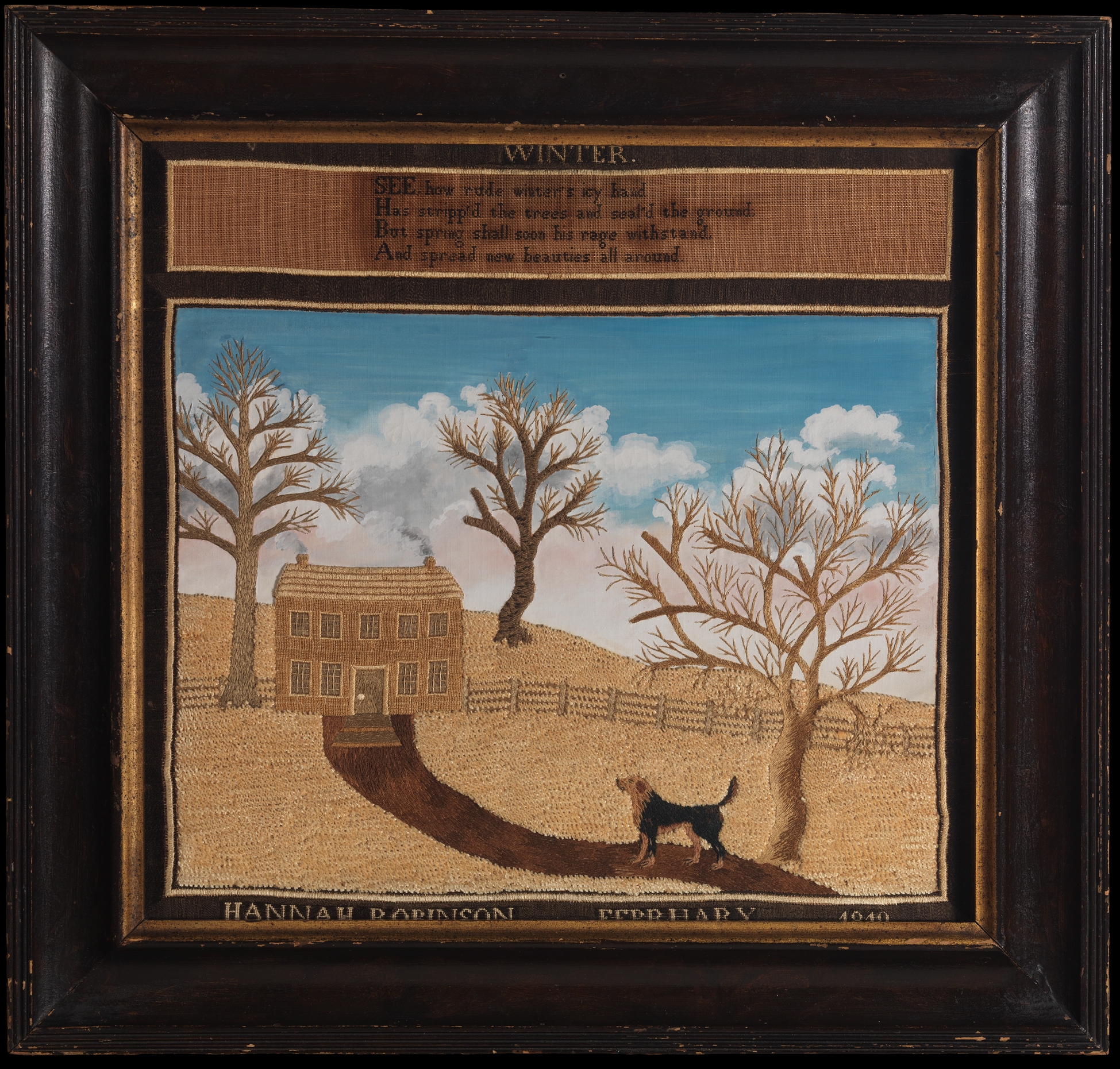
Within the broader historiography of American schoolgirl needlework, the "Winter" needlework picture occupies a distinctive and somewhat enigmatic position. Unlike the elaborate mourning pictures, family registers, or allegorical scenes that frequently emerged from the academies of the late eighteenth and early nineteenth centuries, this work presents itself as a standalone study—a singular, self-contained meditation on seasonality, materiality, and feminine accomplishment. Executed in silk and chenille embroidery and paint on a linen ground, the picture demonstrates a sophisticated integration of media that places it at the intersection of textile craft and pictorial art. For Katherine Fashion Lab, this object serves as a critical case study in how domestic needlework transcended its utilitarian origins to engage with the aesthetic and intellectual currents of the early American republic.
Materiality and Technique: The Interplay of Silk, Chenille, and Paint
The Linen Ground and Its Implications
The choice of linen as the foundational support is significant. Linen, with its sturdy weave and neutral tone, provided a stable surface for the dense embroidery that defines the composition. Unlike silk grounds, which can be delicate and prone to degradation, linen offered a robust canvas that allowed the needleworker to apply layered stitches without risking structural compromise. The visible grain of the linen also contributes to the picture's textural depth, subtly interacting with the raised chenille and the flat application of paint.
Silk and Chenille: Contrasting Textures
The use of silk and chenille embroidery reveals a deliberate manipulation of surface quality. Silk floss, with its characteristic sheen and fine filament, was ideal for rendering intricate details—the delicate tracery of bare branches, the crisp edges of ice formations, or the soft folds of a figure's garment. Chenille, by contrast, is a tufted cord with a plush, velvety pile. Its incorporation into the picture introduces a sculptural, three-dimensional element that is unusual in flat needlework. In a winter scene, chenille could simulate the heavy accumulation of snow on evergreen boughs, the rough texture of a stone wall, or the depth of a fur-trimmed cloak. The tension between the reflective silk and the light-absorbing chenille creates a dynamic optical experience, encouraging the viewer to move closer and engage with the work as a tactile object.
Paint as a Unifying Agent
The addition of paint—likely watercolor or gouache—on the linen ground is not merely a shortcut for background elements. Instead, paint functions as a unifying agent that extends the pictorial field beyond the limits of embroidery. It may define a pale winter sky, the distant horizon, or the subtle gradations of a frozen pond. By combining paint with needlework, the artist signals an awareness of contemporary debates about the hierarchy of the arts. In the early nineteenth century, painting was often considered a masculine, academic pursuit, while needlework was relegated to the domestic sphere. This picture collapses that distinction, asserting that the needle can achieve pictorial effects comparable to the brush.
Iconography of Winter: Allegory, Sentiment, and the Standalone Study
Winter as a Moral and Emotional Trope
In eighteenth- and nineteenth-century Anglo-American culture, winter was a multivalent symbol. It represented death, dormancy, and hardship, but also the cozy comforts of the hearth, the purity of snow, and the promise of renewal. A standalone "Winter" needlework picture likely drew on these associations without embedding them in a larger narrative cycle. Unlike the four-season sets that were sometimes produced in academies, this work invites the viewer to dwell on a single season's mood. The bare trees, the muted palette, and the possibly solitary figure (if one is present) evoke a contemplative, even melancholic atmosphere. Yet the very act of creating such a picture—labor-intensive and time-consuming—also speaks to the virtue of perseverance, a quality particularly associated with winter's demands.
The Standalone Study as a Genre
Why would a needleworker produce a standalone winter scene rather than a series? The answer may lie in the pedagogical and exhibition practices of American female academies. Some schools encouraged students to complete a "study" as a capstone project, demonstrating mastery of multiple techniques within a single composition. A winter scene offered an ideal subject: it required the needleworker to render bare branches (linear silk work), snow (chenille for texture), and sky (paint). Moreover, winter's limited color palette—whites, greys, browns, and occasional deep greens—allowed for a cohesive aesthetic that could be achieved without the extensive silk inventory needed for a floral or allegorical piece. The standalone study thus represents both an artistic choice and a practical accommodation to available materials.
Context and Attribution: American Origin and the Problem of Anonymity
Despite its American origin, the specific maker of this "Winter" picture remains unknown. This anonymity is typical of much schoolgirl needlework, which was often signed only with initials or a first name, if at all. The lack of a definitive attribution does not diminish the work's art historical value; rather, it invites a broader consideration of the thousands of women who practiced needlework as a form of intellectual and creative expression. The picture's American provenance can be inferred from stylistic markers: the relatively restrained use of paint compared to British examples, the preference for linen over silk grounds, and the incorporation of chenille, which became more widely available in the United States in the early nineteenth century. These details situate the work within a distinctly American tradition of female accomplishment, one that valued both domestic virtue and artistic ambition.
Conclusion: The Winter Picture as a Site of Material Intelligence
For Katherine Fashion Lab, the "Winter" needlework picture is more than a charming antique. It is a document of material intelligence—a record of how women negotiated the boundaries between craft and art, between domestic duty and personal creativity. The strategic combination of silk, chenille, and paint on linen demonstrates a sophisticated understanding of how different media can be orchestrated to produce a unified pictorial effect. As a standalone study, it resists the narrative impulses of allegorical sets and instead invites quiet, sustained looking. In an era when the fashion and textile industries increasingly look to historical techniques for inspiration, this picture offers a lesson in the expressive potential of mixed-media embroidery. It reminds us that winter, far from being a season of mere dormancy, can be a time of intense and deliberate making.