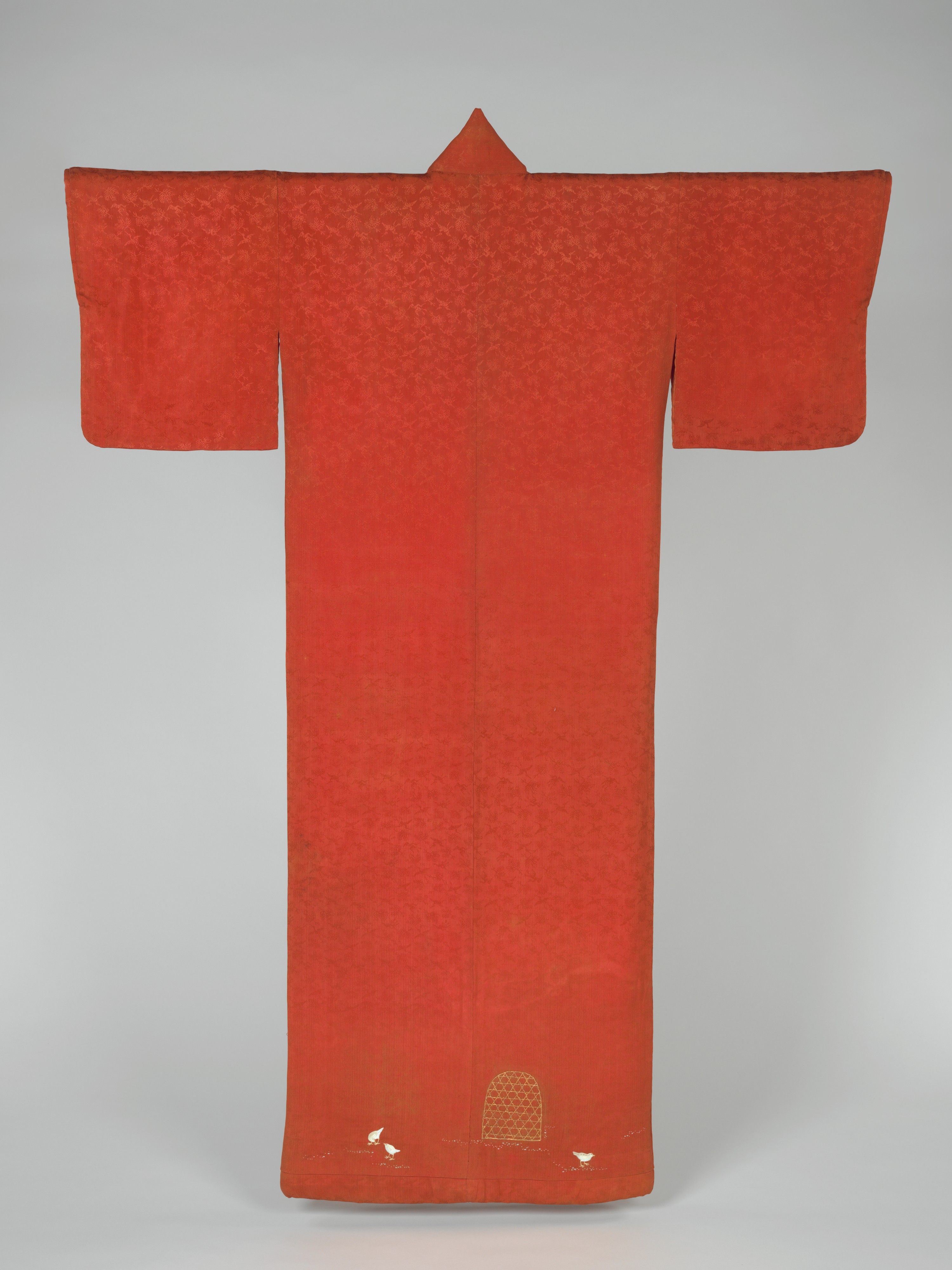
Kosode Robe with Roosters and Hens: A Study in Japanese Textile Artistry
The Kosode Robe with Roosters and Hens represents a masterful confluence of Japanese textile craftsmanship, symbolic iconography, and the refined aesthetic sensibilities of the Edo period. As a standalone study in the Katherine Fashion Lab collection, this garment offers a compelling lens through which to examine the evolution of Japanese dress, the technical virtuosity of embroidered figured crepe, and the cultural narratives woven into every thread. Unlike the rigidly structured court robes of earlier eras, the kosode—literally "small-sleeved thing"—emerged as a versatile garment that transcended class boundaries, ultimately becoming the canvas for some of the most sophisticated surface design in global textile history.
Historical Context and the Kosode as a Cultural Artifact
The kosode originated in the Heian period (794–1185) as an undergarment worn beneath the voluminous hakama and uchigi of the aristocracy. However, by the Muromachi period (1336–1573), it had evolved into an outer garment, and by the Edo period (1615–1868), it had become the primary form of dress for both men and women across social strata. This democratization of the kosode coincided with a flourishing of textile arts, driven by the rise of the merchant class, whose increasing wealth fueled demand for luxurious fabrics and innovative decorative techniques.
The Kosode Robe with Roosters and Hens exemplifies the mature phase of this tradition, likely produced during the late Edo period when embroidery and metallic thread work reached unprecedented levels of refinement. The garment's material composition—silk, metallic thread, and embroidered figured crepe—reflects both the technical sophistication of Japanese weavers and the symbolic weight carried by fabric choice. Figured crepe (rinzu) provided a subtle, self-patterned ground that added depth without competing with the embroidered motifs, while metallic thread introduced a dimension of luminosity that would shift with the wearer's movement, creating an almost kinetic visual experience.
Materiality and Technique: The Alchemy of Silk and Metal
Silk production in Japan was not merely an industry but a cultural practice embedded in ritual and regional identity. The silk used in high-quality kosode was typically cultivated from Bombyx mori larvae, with the finest filaments reserved for aristocratic and wealthy merchant patrons. The figured crepe ground of this robe demonstrates the weaver's mastery of complex loom mechanics: the fabric's characteristic crinkled texture, achieved through highly twisted weft threads, creates a visual and tactile richness that elevates the garment beyond mere clothing to a work of art.
The embroidery itself—depicting roosters and hens—required extraordinary precision. Japanese embroidery (shishū) employed techniques such as satin stitch and couching, the latter particularly effective for metallic threads, which are too brittle to pass repeatedly through fabric. In couching, the metallic thread is laid across the surface and secured with tiny stitches of silk, allowing the artisan to create continuous, unbroken lines of gold or silver. The roosters' combs, wattles, and intricate tail feathers would have demanded hundreds of hours of meticulous labor, each stitch contributing to the illusion of plumage and vitality.
The combination of silk and metallic thread was not merely decorative but economic: metallic thread signaled wealth and status, as its production was costly and its application required specialized skill. The presence of roosters and hens further intensified this semiotic density, as we shall explore.
Iconography of Roosters and Hens: Symbolism in Japanese Art
In Japanese culture, the rooster (niwatori) carries multifaceted symbolism. As the tenth animal in the Chinese zodiac, the rooster represents punctuality, vigilance, and the dawn—qualities associated with the sun goddess Amaterasu, from whom the imperial line traditionally claimed descent. The rooster's crow was believed to summon Amaterasu from the cave where she had hidden, restoring light to the world. Thus, a garment adorned with roosters could invoke protection, renewal, and divine favor.
Hens, meanwhile, symbolize fertility, nurturing, and domestic harmony. The pairing of roosters and hens in textile design often alludes to marital felicity and the proper ordering of the household—a theme particularly resonant for a garment likely worn by a woman of the merchant or samurai class. The rooster's strident posture and the hen's more subdued demeanor reinforce Confucian ideals of complementary gender roles, yet the artistry transcends mere didacticism: the birds are rendered with such naturalism that they seem to inhabit a living garden, their feathers catching the light of the metallic thread.
It is worth noting that bird-and-flower motifs (kachō-ga) were a staple of Japanese painting and textiles, influenced by Chinese precedents but adapted to Japanese sensibilities. The roosters and hens on this kosode may also reference classical literature, such as the Ise Monogatari or Genji Monogatari, where birds often serve as poetic emblems of longing or seasonal change.
Aesthetic Principles and the Kosode as Wearable Art
The design of the Kosode Robe with Roosters and Hens adheres to several core Japanese aesthetic principles. First, asymmetry: the motifs are unlikely to be perfectly centered, instead flowing across the garment in a dynamic, organic arrangement that respects the body's contours. Second, negative space (ma): the figured crepe ground is not merely a backdrop but an active participant, its subtle patterns providing breathing room for the embroidered figures. Third, seasonality: roosters and hens are associated with autumn in traditional Japanese iconography, suggesting the garment was intended for a specific time of year, its wearer attuned to the rhythms of nature.
Moreover, the kosode's construction—flat, rectangular panels sewn together with minimal cutting—reflects a philosophy of conservation and adaptability. Unlike Western tailoring, which molds fabric to the body through darts and seams, the kosode drapes the body in a continuous plane, allowing the textile itself to dictate the garment's form. This approach elevates the fabric to the primary expressive medium, making the embroidered roosters and hens not merely decoration but the very substance of the robe.
Conclusion: Legacy and Contemporary Relevance
The Kosode Robe with Roosters and Hens stands as a testament to the heights achieved by Japanese textile artists during the Edo period. Its silk and metallic thread embroidery on figured crepe represents a synthesis of material science, technical mastery, and symbolic depth. For the contemporary viewer—and for students of fashion history at Katherine Fashion Lab—this garment offers lessons in patience, precision, and the power of clothing to encode cultural values. In an era of fast fashion and digital reproduction, the kosode reminds us that true luxury lies not in logos but in the human hand, the cultivated eye, and the enduring dialogue between maker, material, and meaning.
As a standalone study, this robe invites us to consider how dress functions as both personal adornment and public statement, how motifs migrate across media and centuries, and how the simplest of garments—a robe with small sleeves—can contain multitudes.