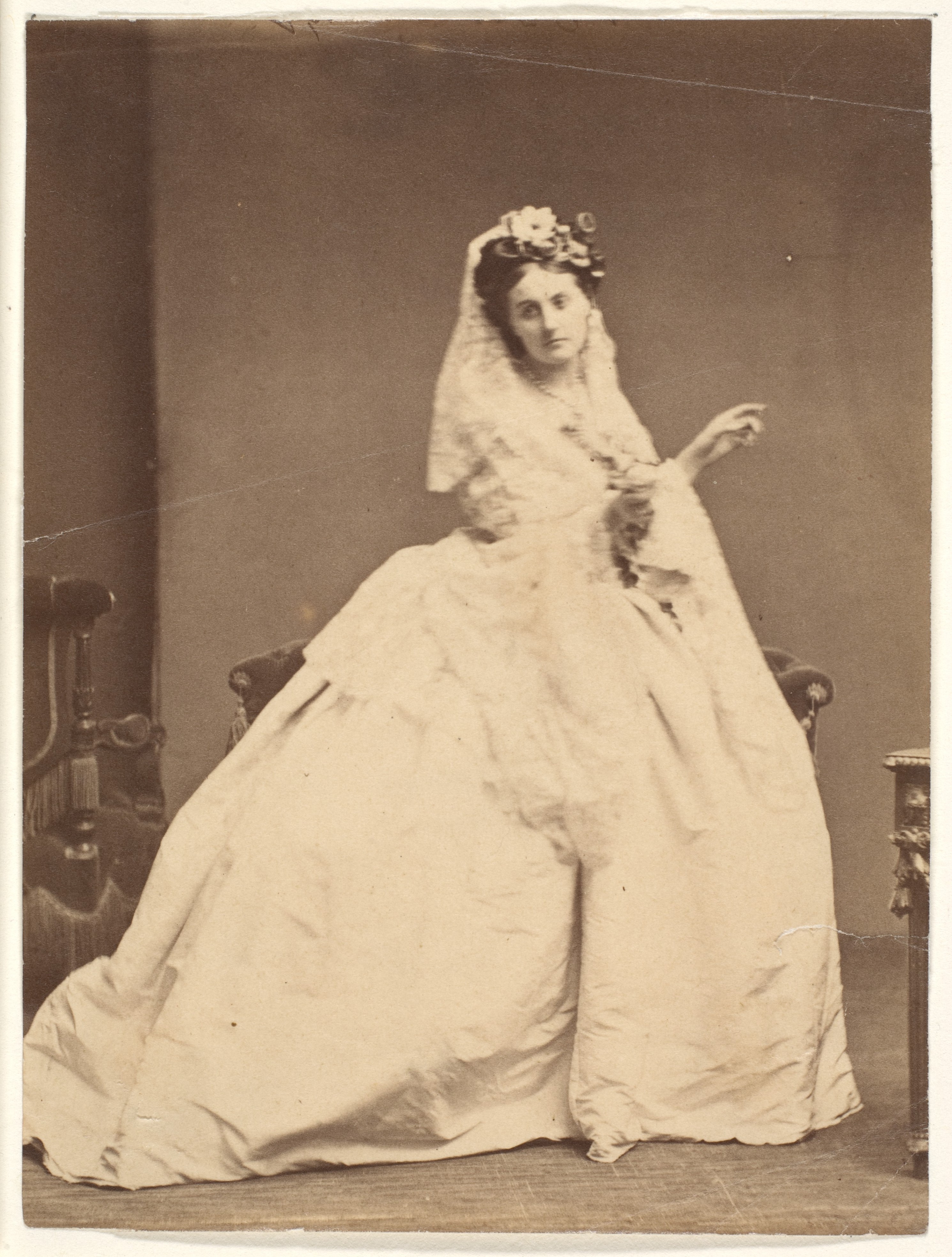
La Robe Bouffante: A Material Reading of Volume, Memory, and the Photographic Surface
The robe bouffante—the billowing, inflated gown whose silhouette dominated Western couture at recurrent intervals across the nineteenth and twentieth centuries—presents a paradox that fashion scholarship has never fully resolved. It is an object defined by excess, yet its historical record frequently survives in the most fragile and chemically unstable of media. The present study examines a single albumen silver print from a glass negative depicting such a garment, treating the photograph not as documentary evidence subordinate to the dress but as a coequal material artefact. In doing so, the analysis situates the robe bouffante within a global heritage framework, arguing that its volume is simultaneously an engineering problem, a social statement, and a photographic condition.
The Garment as Structural Proposition
To speak of the robe bouffante is to speak of air held in suspension. The term, loosely translated as "puffed" or "swelling" dress, describes a family of silhouettes rather than a single cut: the crinoline's hemispheric cage, the bustle's posterior architecture, the balloon hem of the 1950s, and the sculptural volumes of postwar couture all participate in the same logic. What unites them is a deliberate manipulation of negative space—the void between body and fabric becomes the primary expressive material. The couturier does not merely clothe the wearer; he or she constructs a habitable interior, an architecture worn rather than entered.
This structural ambition depended on global material exchange. The stiffened petticoats of the 1850s relied on horsehair and whalebone; the crinoline's steel cage demanded the industrial output of Sheffield and Birmingham; the silk taffeta that gave the bouffante its characteristic rustle travelled from Chinese and Japanese sericulture through Lyon's weaving houses. A single gown, read carefully, is a ledger of nineteenth-century trade routes. Its global heritage is therefore not a vague claim to universality but a specific accounting of fibres, metals, and labour crossing oceans under imperial and mercantile pressure.
The Albumen Print as Interpretive Lens
The albumen silver print, dominant from roughly 1850 to 1895, is a fitting medium for this subject because it shares the garment's defining characteristic: surface tension. A thin layer of albumen—egg white—binds light-sensitive silver salts to the paper support, producing a glossy, slightly warm-toned image with exceptional tonal range. The process is delicate, prone to yellowing, cracking, and silvering out. Like the bouffante itself, it is an object that performs magnificently in its prime and deteriorates conspicuously thereafter.
When a robe bouffante is captured on an albumen print from a glass negative, several registers of meaning converge. The glass negative offers extraordinary resolution, rendering the weave of fabric, the sheen of ribbon, and the crisp edges of a flounce with a precision that modern digital capture rarely equals. Yet the albumen surface simultaneously softens and unifies these details, bathing the garment in a lustrous haze that flatters volume. The photograph does not simply record the dress; it idealises it, converting a heavy, physically demanding garment into a weightless apparition. This is the central irony of the bouffante's photographic afterlife: a silhouette built from steel and horsehair is remembered as air.
Reading the Standalone Study
Because this image exists as a standalone study—divorced from a sitter's identity, a studio's commercial context, or a dated commission—it resists biographical interpretation and invites formal analysis. The viewer confronts the gown without the distraction of a face, a name, or a social occasion. What remains is pure form: the arc of the skirt, the compression at the waist, the cascading fabric that seems to defy gravity. This isolation is analytically productive. It foregrounds the garment as an autonomous aesthetic object, comparable to a sculpture or an architectural model, and it exposes the photographer's own authorial choices—the lighting angle that dramatises folds, the framing that crops the figure to emphasise silhouette over person.
The standalone study also raises questions of provenance and circulation. Such images were frequently produced as reference material for couture houses, as teaching aids for dressmakers, or as specimens for photographic societies. Their survival in archives constitutes a form of intangible heritage, preserving not only the appearance of a garment but the technical knowledge embedded in its construction. To study the print is to study a chain of transmission: the pattern-cutter's skill, the model's posture, the photographer's chemistry, the archivist's care.
Volume, Memory, and the Politics of Space
Finally, the robe bouffante must be read politically. A garment that occupies three times the wearer's natural volume makes a claim on public space. It asserts that the body within is not labouring, not hurrying, not confined to narrow passages. Historically, this claim was available only to the wealthy, and its global heritage is inseparable from the extraction that funded it. Yet the silhouette has been repeatedly reclaimed—by postwar couturiers celebrating abundance after austerity, by contemporary designers interrogating femininity and excess, by diasporic makers reworking Victorian forms through non-Western textile traditions.
The albumen print, in its fragility, becomes an apt metaphor for this contested inheritance. It is beautiful, unstable, and incomplete. It preserves a garment that no longer exists in three dimensions, and in preserving it, it transforms it. La robe bouffante, seen through the glass negative and fixed in egg white and silver, is not a dress but an argument about space, labour, and the enduring human desire to be larger than circumstance allows.