Deconstructing Opulence: The Snuffbox as a Microcosm of Power and Craft
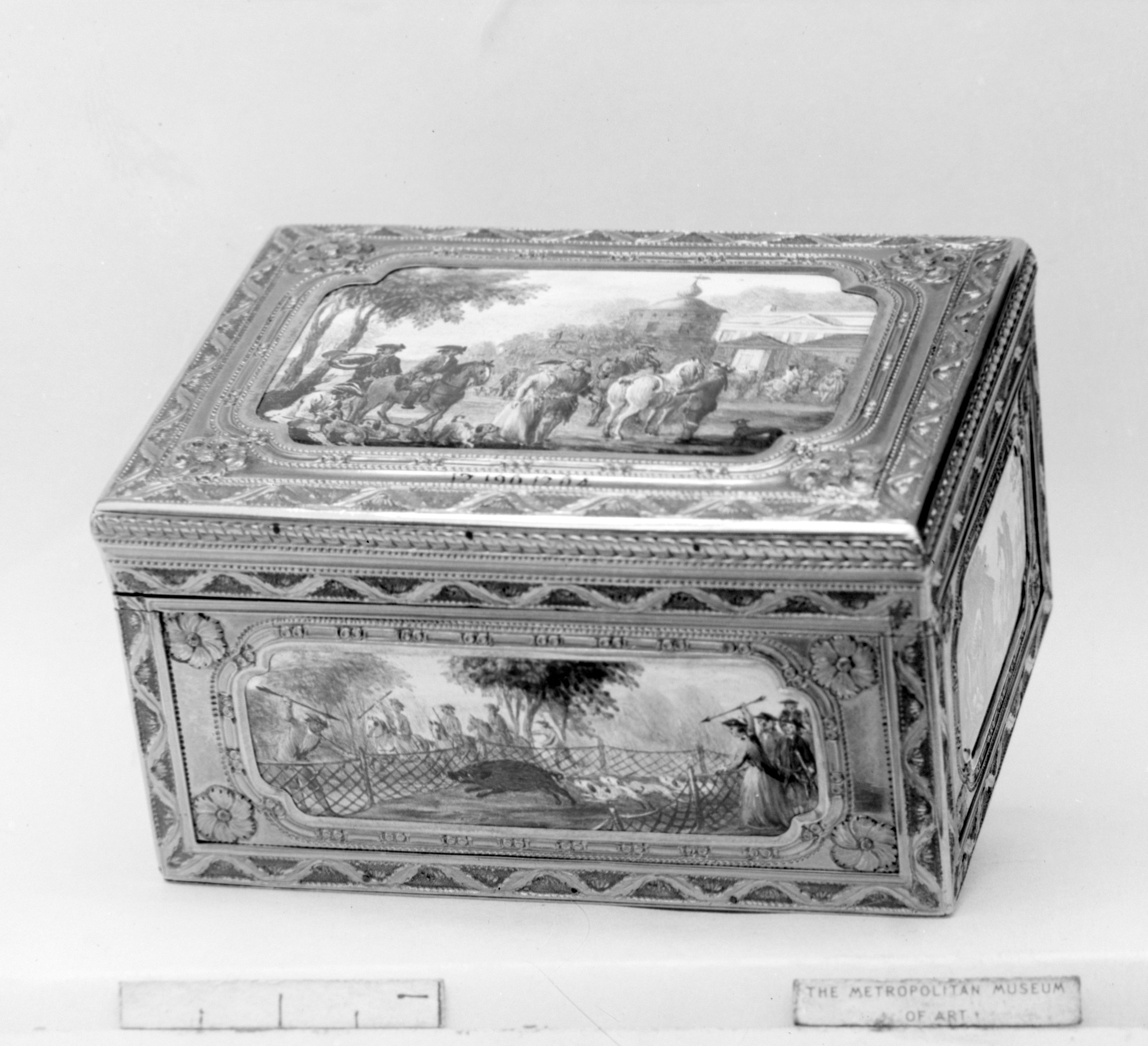
Within the hallowed ateliers of haute couture, the most profound inspirations are often drawn not from the runway’s immediate past, but from objects of historical luxury that encapsulate an entire worldview. For Katherine Fashion Lab, the analysis of this 18th-century snuffbox—crafted in gold and enamel, depicting a refined hunting scene—is not a mere archival exercise. It is a standalone study in the semiotics of luxury, a masterclass in narrative miniaturization, and a provocative lens through which to examine contemporary codes of elegance, sport, and social performance. This object, a portable treasure from the Global Heritage, serves as a perfect case study for the Lab’s philosophy: that true innovation in fashion is born from a deep, analytical dialogue with the craftsmanship and cultural constructs of the past.
The Dialectic of Surface: Enamel as Haute Textile
The materiality of the snuffbox presents our first point of sartorial translation. The combination of gold and enamel establishes a fundamental dialectic between foundation and surface, structure and color—a relationship directly analogous to the relationship between a garment’s silhouette and its textile. The gold substrate is the architectural equivalent of a perfectly tailored foundational garment: a corseted bodice, a precisely structured jacket, or a bias-cut slip. It provides the unwavering support, the value, and the permanence.
The enamel, however, is where the narrative unfolds. Its application is a haute technique paralleling the most meticulous couture savoir-faire: hand-embroidery, featherwork, or microscopic beadwork. The vibrant, painted scene is not merely decoration; it is a fused narrative skin. For the Lab, this prompts a design interrogation: How can a garment’s surface tell a complete, pictorial story while remaining integral to the structure? Imagine a evening coat where the jacquard weave does not simply repeat a pattern, but unfolds a continuous, enamel-like panorama across the body. The challenge lies in achieving that seamless, glossy fusion where image and object are indivisible, where the "fabric" is the story.
The Hunt as Social Theater: Couture as Performance
The subject matter—the hunting scene—is the core of the object’s social programming. In the 18th century, the hunt was not merely a sport; it was a highly codified ritual of aristocracy, a performative theater demonstrating control over nature, land, and social hierarchy. The snuffbox, carried in the pocket, was a token of participation in this elite spectacle. It signaled membership, wealth, and a particular type of masculine, pastoral authority, even when its owner was in an urban salon.
This translates powerfully to modern couture’s function. Today, the red carpet, the gala, the exclusive resort are our equivalent social hunts. The attire worn is not just clothing; it is a portable emblem of belonging to a specific world. Katherine Fashion Lab interprets the hunting scene not literally, but as a metaphor for the pursuit of status, beauty, and exclusivity. A gown, then, becomes a landscape upon which a narrative of power is enacted. The "prey" might be attention, influence, or legacy. The design task is to encode these themes into cut, texture, and movement—creating a garment that performs as much as it covers, turning the wearer into both hunter and curated spectacle.
Miniaturization of Grandeur: The Philosophy of the Detail
Perhaps the most compelling lesson from the snuffbox is its scale. It condenses a vast, active landscape—with figures, animals, and topography—into a palm-sized object of intimate consumption. This miniaturization of grandeur is a quintessential couture principle. The true value of a haute couture garment often resides not in its overall sweep from a distance, but in the breathtaking detail discovered upon intimate inspection: the singular, perfectly placed stitch, the hidden embroidery inside a cuff, the construction of a button.
For the Lab, this object mandates a design discipline where the closer one looks, the more one finds. It champions the idea of a garment that reveals its narrative in layers. The macro-view offers silhouette and color; the micro-view reveals a universe of craftsmanship that speaks to the wearer’s discernment. This philosophy rejects the overt and embraces the whispered secret of quality. It is the difference between a loud logo and a perfectly finished interior seam—the latter being the true marker of luxury, understood only by the initiated.
Global Heritage as a Non-Linear Archive
The designation of "Global Heritage" is crucial. This snuffbox, while likely European in origin, exists now as part of a universal archive of human artistry. For Katherine Fashion Lab, this liberates the object from a strict, parochial history and places it into a non-linear dialogue with global techniques and motifs. The enamel work might converse with Chinese cloisonné or Mughal miniature painting. The goldsmithing could resonate with Ashanti gold weights or pre-Columbian metallurgy.
This contextual fluidity is essential for a modern couture house operating in a globalized world. It allows for the creation of pieces that feel both timeless and unplaceable, weaving together threads of global craftsmanship into a new, coherent language. A single collection could conceptually link the portable intimacy of the snuffbox, the narrative density of a tapestry, and the ceremonial weight of heirloom jewelry, synthesizing them into a wearable form that speaks to a contemporary, cosmopolitan sensibility.
Conclusion: The Standalone Study as Creative Catalyst
This standalone study of the snuffbox exemplifies the Katherine Fashion Lab methodology. By dissecting an object of applied art, we extract core principles—the fusion of structure and narrative, the performance of social codes, the majesty of the miniature, and the richness of a global archive. The resulting fashion is not a costume replicating the past, but a sophisticated evolution of its embedded ideas. The hunting scene is abstracted into a motif of pursuit; the enamel becomes a philosophy of surface; the gold foundation is the unwavering standard of quality. In this way, a centuries-old container for powdered tobacco transforms into a potent vessel for 21st-century couture innovation, proving that the most forward-looking designs are often rooted in the deepest, most analytical appreciation of the luxury objects that preceded them.