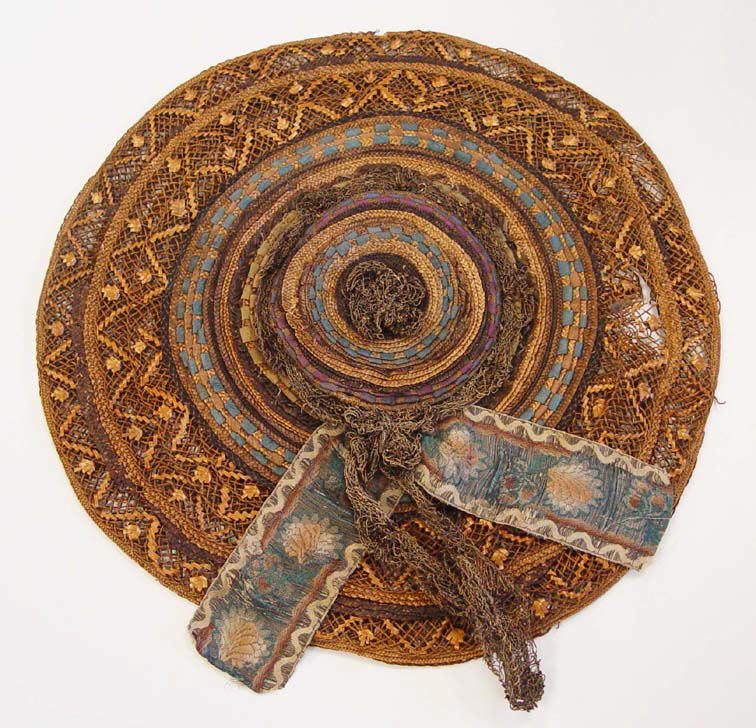
The Straw Hat as Sculptural Object: A Standalone Study in Material, Form, and Cultural Memory
The straw hat occupies a curiously liminal position within the hierarchy of dress. It is at once utilitarian and ceremonial, humble and exalted, ephemeral and enduring. Within the broader narrative of headwear, the straw hat resists easy categorization: it belongs neither exclusively to the field nor to the salon, yet it has been claimed by both. This standalone study examines the straw hat as a discrete object of couture inquiry, tracing its material logic, its formal evolution, and its persistent capacity to signify across registers of class, season, and identity. While its precise origins remain contested—most evidence points toward a British inflection in its modern ceremonial codification—the straw hat's story is ultimately one of transformation, in which a vegetable by-product becomes a vehicle for structural ambition.
Material Logic: The Paradox of Straw
Straw is, in essence, agricultural residue. It is the dried stalk of cereal crops—wheat, rye, barley, oats—harvested for grain and otherwise discarded. Its ascension into the vocabulary of millinery is therefore a story of alchemy: the conversion of waste into worth. This material humility is central to the straw hat's enduring appeal. Unlike felt, which requires the deliberate matting and felting of animal fur, or silk, which demands the cultivation of the mulberry and the labors of the silkworm, straw arrives almost as a gift. It requires only drying, splitting, and plaiting to become a serviceable fabric.
Yet this apparent simplicity belies a sophisticated material intelligence. The quality of a straw hat is determined by the fineness of its plait, the evenness of its tension, and the suppleness of the fiber. The finest straws—such as the legendary Leghorn, woven from a specific variety of wheat grown in Tuscany—were historically prized for their ability to be plaited into braids so fine they resembled thread. The Panama hat, despite its name, is similarly woven from the toquilla palm in Ecuador, its misnomer a testament to the global trade routes that have long carried straw goods across oceans. In Britain, the straw hat found its own vernacular: the boater, with its flat crown and rigid brim, woven from sennit straw and bound with grosgrain ribbon, became a fixture of Edwardian leisure and collegiate uniform.
The material's porosity is also its point. Straw breathes. It admits air while deflecting direct sun, making it functionally superior to felt in warm weather. This physiological logic explains its persistence in climates of heat and labor, from the rice paddies of Asia to the vineyards of France. But couture is never merely functional. The straw hat's texture—its slight roughness, its irregular surface, its refusal of high gloss—offers a counterpoint to the smooth, finished surfaces of urban dress. It introduces a note of the pastoral into the metropolitan, a whisper of the field into the drawing room.
Form and Structure: The Architecture of the Brim
If straw is the material, form is the argument. The straw hat is above all a study in the geometry of the brim and the crown. The boater is perhaps the most architecturally disciplined of the family: its crown is a shallow cylinder, its brim a perfect circle, its silhouette a horizontal line that cuts across the face with almost geometric severity. It is a hat of rules and regulations, adopted by schools, rowing clubs, and military bands. Its rigidity is its meaning: it signifies order, conformity, and the controlled body.
By contrast, the wide-brimmed straw sun hat—often associated with the garden, the seaside, and the colonial outpost—is a study in softness and asymmetry. Its brim may undulate, dip, or flare; its crown may be pinched, dented, or left round. It offers shade as a form of luxury, a private microclimate carried on the head. In the hands of couture milliners, this form has been pushed toward the sculptural: brims so vast they require internal wire armatures, crowns so tall they echo the hennin of the fifteenth century. The straw hat becomes a wearable architecture, a temporary shelter that is also a statement of presence.
The turban and the cloche represent a third trajectory: the compression of straw into close-fitting, head-hugging forms. Here the material is often blocked over wooden forms, steamed and pressed into curves that follow the skull. The cloche, popularized in the 1920s, is the straw hat's most intimate iteration—a helmet of woven fiber that frames the face and demands a particular posture, chin lifted, gaze forward. It is a hat of the modern woman, mobile and unencumbered, yet still bound by the material's inherent texture.
Cultural Signification: From Field to Fashion
The straw hat's cultural meanings are as layered as its plait. In the British context, it is inseparable from the idea of leisure. The boater belongs to the punting party on the Cherwell, the spectator at Henley, the schoolgirl in a summer uniform. It is a marker of class and season, worn only between certain dates and discarded with the first chill. Yet the same object, transported to other contexts, becomes a sign of labor: the straw hat of the agricultural worker, the fisherman, the builder. This duality—leisure and labor, privilege and necessity—is the straw hat's most potent ambiguity.
In the twentieth century, couture reclaimed the straw hat as a site of irony. Designers such as Elsa Schiaparelli and, later, Philip Treacy treated straw not as a humble material but as a sculptural medium, combining it with wire, silk, and even plastics. The straw hat became a quotation of itself: a reference to a pastoral past deployed within an urban present. It is this self-consciousness that makes the straw hat so enduring. It can be sincere or parodic, rustic or refined, conservative or transgressive. It is never merely a hat.
Conclusion: The Persistent Weave
The straw hat endures because it is a contradiction made wearable. It is ancient and modern, humble and haughty, functional and decorative. Its material origins in the harvested field are never fully obscured, even when it is trimmed with velvet ribbon and sold in a Bond Street atelier. This trace of the organic—the stalk, the sun, the hand of the plaiter—gives the straw hat its peculiar warmth. In an age of synthetic fibers and digital reproduction, the straw hat remains stubbornly analog. It is a reminder that couture does not always begin with rarity or expense; sometimes it begins with a handful of dried grass and the decision to make something beautiful of it. For the contemporary wearer, the straw hat offers not only shade but a lineage: a connection to centuries of agricultural labor, artisanal skill, and the simple, radical act of covering the head with grace.