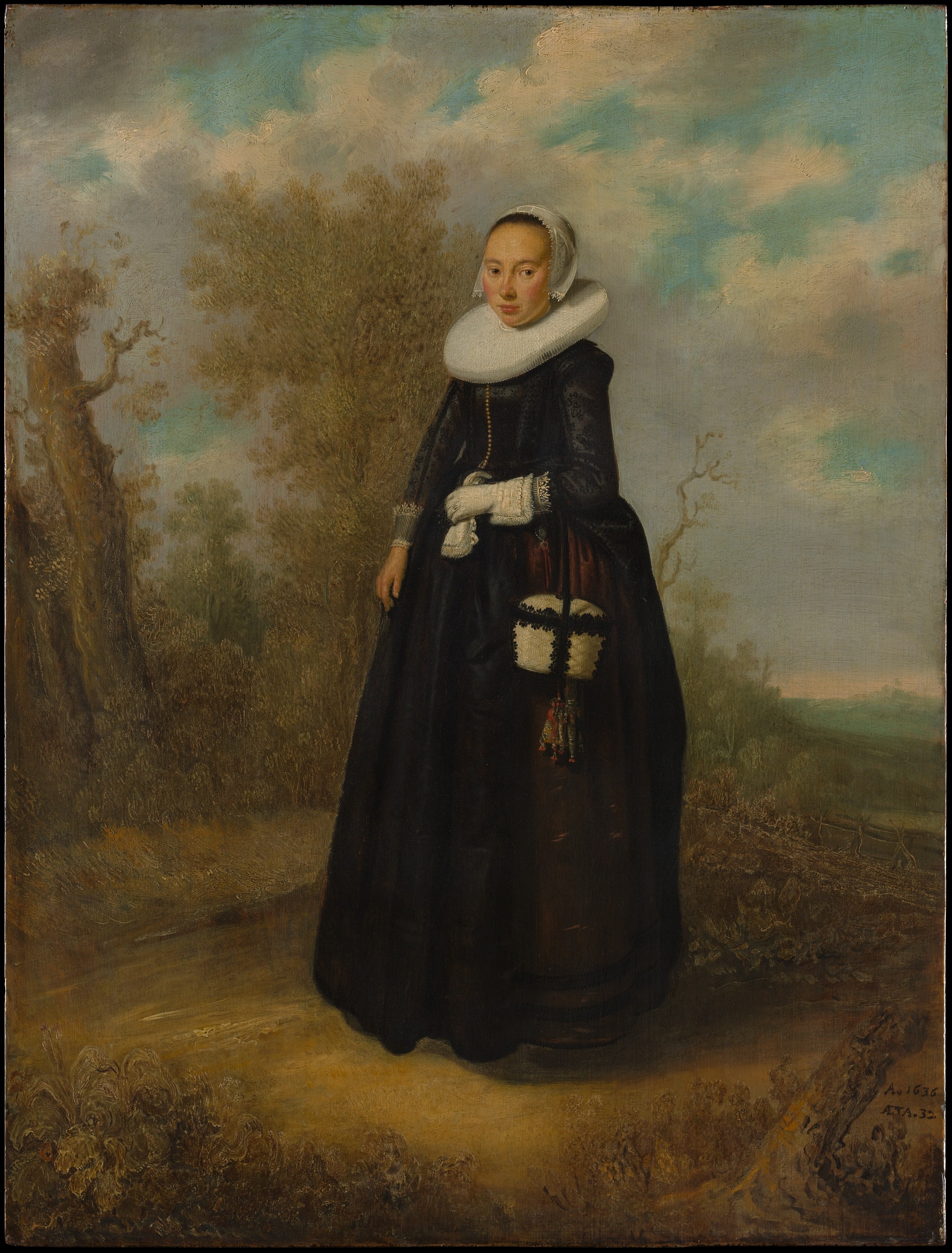
Introduction: The Enigma of the Standalone Study
Within the vast and often turbulent archives of global art history, certain works resist the gravitational pull of attribution, chronology, and geographic certainty. A Young Woman in a Landscape, an oil on wood panel of uncertain origin, belongs to this rarefied category. It is not a fragment of a larger altarpiece, nor a preparatory sketch for a documented commission. It stands alone—a discrete, self-contained meditation on youth, nature, and the act of seeing. For the curator and the connoisseur alike, such standalone studies constitute a peculiar intellectual provocation. They demand that we suspend our appetite for biographical resolution and instead interrogate the object on its own material and formal terms.
This analysis undertakes a couture-level examination of the painting, treating it not merely as an artifact of a lost tradition but as a deliberate aesthetic statement. The term “couture” here is used advisedly: it denotes the highest order of artisanal execution, a bespoke integration of surface, pigment, and support that elevates a modest subject into a paradigm of visual craftsmanship. The work’s global heritage—unmoored from any single national school—invites a comparative methodology, one that reads the painting as a node in a network of cross-cultural pictorial strategies.
Materiality and Support: The Discipline of Oil on Wood
The Panel as Ground and Statement
The choice of oil on wood is neither incidental nor neutral. Unlike canvas, which absorbs and diffuses the painter’s touch, a wood panel offers a rigid, unforgiving surface. Every brushstroke remains legible; every correction leaves a trace. In A Young Woman in a Landscape, this material honesty is palpable. The panel’s subtle grain—likely oak, walnut, or a tropical hardwood depending on the work’s unresolved origin—imparts a warm, resonant undertone to the flesh tones and the verdant landscape alike. The artist has not sought to conceal the support but to collaborate with it.
From a conservation standpoint, oil on wood presents distinct challenges and advantages. The paint layer adheres intimately to the panel, reducing the risk of cupping and flaking common in canvas works. Yet the wood’s hygroscopic nature means that fluctuations in humidity can induce warping or cracking. The fact that this study survives in a coherent state suggests either a temperate original climate or a history of careful stewardship. For the curator, this material resilience is not merely a technical footnote; it is evidence of the work’s intended permanence. A standalone study on wood is not a casual sketch. It is a finished thought, committed to a durable medium.
Pigment and Palette: A Global Lexicon
The palette of A Young Woman in a Landscape reveals a sophisticated negotiation between local and imported materials. The greens of the landscape range from an earthy olive to a translucent malachite-like hue, suggesting access to copper-based pigments. The young woman’s skin is rendered in lead white warmed with vermilion and a touch of earth, while her drapery—perhaps a shawl or simple bodice—employs a deep, resonant blue that could be ultramarine, azurite, or a regional equivalent. This chromatic range is not merely decorative; it is a form of geographic evidence. The presence of ultramarine, for instance, would imply trade routes extending from Afghanistan to the painter’s workshop, while azurite would point to European mining centers.
What distinguishes this study is the artist’s restraint. There is no ostentatious display of expensive pigments. Instead, the palette serves a unified tonal harmony—a muted, almost melancholic lyricism that anticipates the atmospheric landscapes of later centuries. The oil medium is manipulated with a couture-like precision: thin, transparent glazes for the sky and distant hills; more opaque, loaded strokes for the foreground foliage and the woman’s hands. This technical differentiation creates a palpable sense of depth without recourse to strict linear perspective.
Composition and the Figure in Nature
The Young Woman: Pose, Gaze, and Interiority
The subject of the painting—a young woman—is positioned slightly off-center, her body turned three-quarters toward the viewer. She does not meet our gaze directly. Instead, her eyes are cast downward or toward a distant point beyond the frame. This averted gaze is a masterstroke of psychological ambiguity. Is she lost in contemplation? Is she listening to an unseen sound? Or is she merely a compositional device, a pretext for the artist to study the play of light on fabric and skin? The absence of a clear narrative anchor transforms the work into an open text, one that each generation of viewers must complete for itself.
Her posture is relaxed yet poised—a balance that suggests both natural ease and cultivated grace. The hands, often the most revealing feature in portraiture, are rendered with particular care: the fingers are long but not aristocratic, the knuckles subtly articulated. They rest against a fold of her garment or perhaps a staff or basket (the details are deliberately indistinct). This ambiguity of attribute is characteristic of the standalone study. Without the iconographic crutches of saints’ emblems or mythological symbols, the figure must signify through presence alone.
Landscape as Active Participant
The landscape in A Young Woman in a Landscape is not a passive backdrop. It is a co-protagonist. The terrain rises and falls in gentle, rhythmic undulations, leading the eye from the immediate foreground to a hazy, luminous horizon. Trees—perhaps willows or poplars—frame the figure without enclosing her. A body of water, suggested by a few horizontal strokes of pale grey-blue, introduces a note of stillness and reflection. The sky, occupying the upper third of the panel, is a study in atmospheric perspective: warmer and more detailed near the horizon, cooler and more uniform above.
This integration of figure and environment speaks to a global heritage of landscape painting that predates the European Romantic tradition. We see echoes of Chinese Shan shui (mountain-water) painting in the subordination of human scale to natural vastness. We detect the influence of Persian miniature traditions in the jewel-like precision of certain botanical details. And we recognize the empirical naturalism of the Northern Renaissance in the careful observation of light and shadow. The artist, whoever they were, was not working in isolation. They were drawing from a cosmopolitan visual vocabulary.
Provenance, Attribution, and the Curatorial Challenge
The Absence of Signature as Presence
The painting bears no signature, no date, no inventory mark. In the market, this absence is often treated as a defect—a discount factor. In the curator’s laboratory, however, it is a productive void. It forces us to rely on connoisseurship: the close reading of brushwork, the analysis of pigment stratification, the comparison of panel construction with known workshop practices. The dendrochronological dating of the wood, if permitted, might narrow the window to a few decades. The infrared reflectography might reveal an underdrawing that betrays a specific hand or regional technique.
Yet even without these scientific interventions, the work’s quality speaks for itself. The handling of the oil medium is assured, even virtuosic in its quieter passages. The transition from the woman’s cheek to her neck, for instance, is achieved through a series of almost invisible scumbles—a technique that requires patience and a deep understanding of the medium’s drying properties. This is not the work of a provincial amateur. It is the product of a trained eye and a disciplined hand.
Standalone Study as Aesthetic Manifesto
Why does a standalone study matter? In an era of blockbuster exhibitions and encyclopedic narratives, the isolated object can seem marginal. But it is precisely this marginality that grants it critical power. A Young Woman in a Landscape does not illustrate a story, promote a doctrine, or flatter a patron. It exists to be looked at—slowly, repeatedly, with the same attention the artist lavished on its surface. It is a couture object in the original sense: made to measure for no one but the act of painting itself.
For Katherine Fashion Lab, this study offers a lesson in creative integrity. In a world of fast images and algorithmic curation, the standalone study reminds us that depth is not a function of context but of execution. The young woman in her landscape is not a celebrity, not a symbol, not a brand. She is a problem in oil on wood—and she remains, centuries later, beautifully unsolved.
Conclusion: The Enduring Silence of the Object
To analyze A Young Woman in a Landscape is to confront the limits of art history as a explanatory system. We can date the panel, identify the pigments, trace the global circulation of motifs. But we cannot fully explain why this particular arrangement of oil and wood continues to hold our gaze. That residue of mystery is not a failure of scholarship; it is the work’s greatest asset. In the end, the standalone study teaches us that some objects resist the archive. They ask only to be seen—and in that asking, they become timeless.