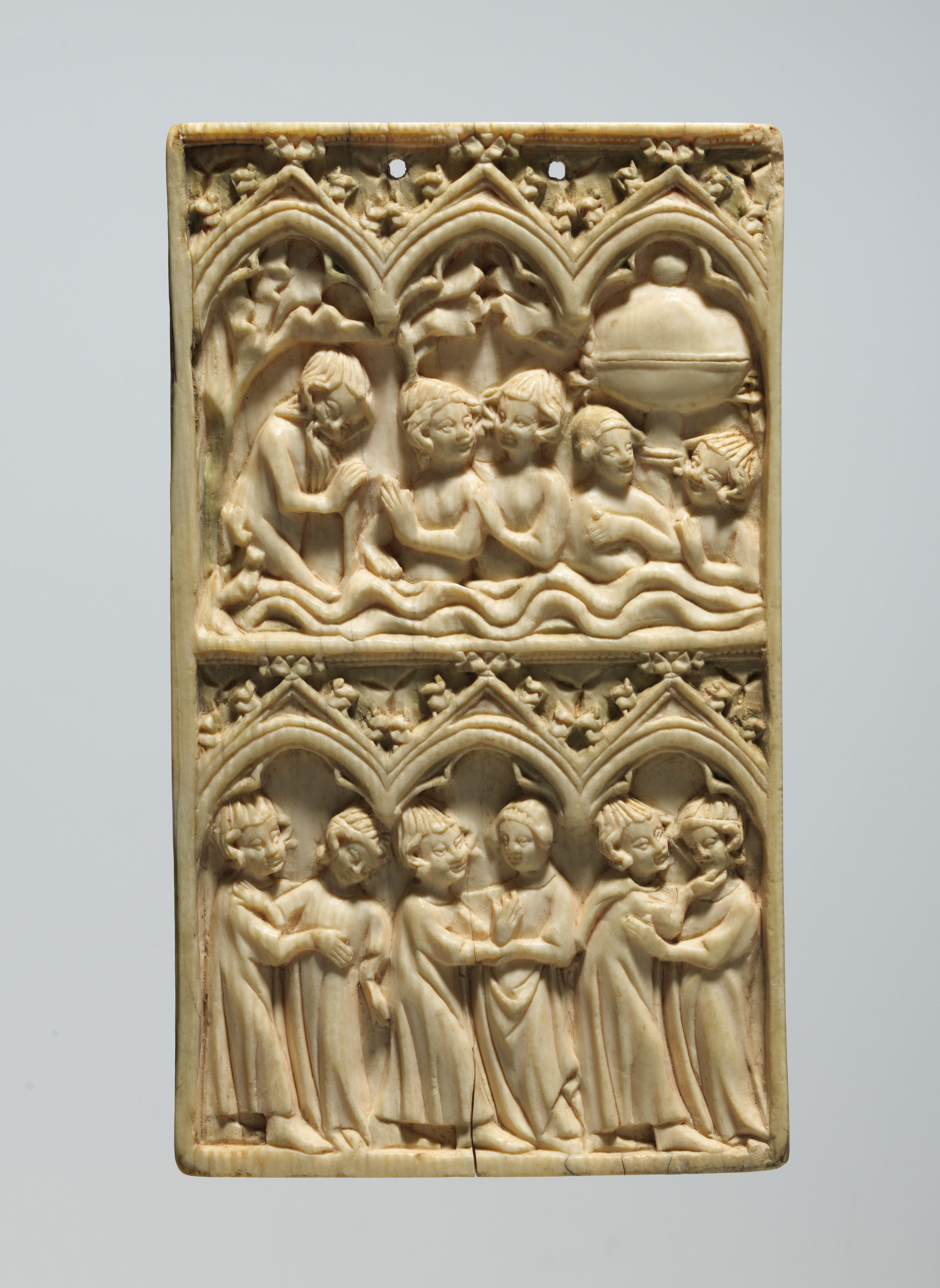
Heritage Asset Analysis: Plaque with the Fountain of Youth
Object Identification and Material Context
The Plaque with the Fountain of Youth is a carved French elephant ivory relief, a museum-grade artifact whose formal vocabulary situates it within the late medieval to early Renaissance tradition of devotional and allegorical ivories. Executed in elephant ivory, the plaque exploits the material's characteristic translucency, warm tonality, and capacity for microscopic undercutting—qualities that made ivory the prestige medium of choice for European court and ecclesiastical commissions. Ivory was not merely a support; it was a statement of access. Its supply chains reached from African and Asian trade networks through Mediterranean ports into the workshops of Paris, the Low Countries, and the Rhineland, embedding the object within the earliest forms of global luxury commerce.
The Fountain of Youth: Iconography and Symbolic Power
The Fountain of Youth motif, rooted in classical and medieval legend, depicts a restorative spring capable of reversing age and decay. In French visual culture, the theme gained particular traction as an allegory of spiritual renewal, dynastic longevity, and the promise of transcendence over mortality. On a carved ivory plaque, the iconography operates on multiple registers simultaneously.
First, the fountain functions as a symbol of regeneration. Figures entering the waters emerge transformed—youthful, healed, restored. This narrative of reversal carries obvious resonance for a culture preoccupied with salvation, lineage, and the fragility of the body. Second, the plaque participates in the medieval tradition of moralized mythology, wherein pagan legend is recast as Christian allegory. The fountain becomes a type of baptismal font or the Fountain of Life, and the promise of physical youth is sublimated into the promise of eternal life.
Third, ivory itself reinforces the message. Its smooth, luminous surface suggests purity and incorruptibility, while its organic origin—drawn from a living creature—adds a subtle meditation on mortality and preservation. The medium and the message converge: a material that endures, carved with a myth about enduring.
Historical Adornment and Elite Consumption
Ivory plaques of this type were rarely utilitarian in the ordinary sense. They functioned as objects of adornment in the most elevated sense: mounted in precious metal, set into reliquaries, or displayed within cabinets of curiosity and princely treasuries. Ownership signified participation in a transregional elite culture that valued rarity, craftsmanship, and symbolic density. The plaque was a portable monument—small enough for private contemplation, significant enough for diplomatic gift exchange.
In the French context, ivory carving flourished in centers such as Paris and later Dieppe, where guild structures regulated production and protected the prestige of the medium. The plaque's existence presupposes a sophisticated patron: someone with the literacy to read its allegory, the wealth to commission it, and the social position to display it. It is, in effect, an early instance of the luxury object as identity signal—a premodern precursor to the branded artifact.
Spiritual Meaning and Contemplative Function
The spiritual dimension of the plaque cannot be separated from its material and iconographic program. In an era when imagery served as the "Bible of the illiterate" and as a focus for learned meditation, the Fountain of Youth plaque offered a layered devotional experience. The viewer was invited to move from the literal (a fountain restoring the aged) to the allegorical (the soul restored by grace) to the anagogical (the promise of resurrection).
This threefold reading was standard in medieval exegesis, and objects like this plaque were designed to support it. The carved surface, catching candlelight and casting soft shadows, animated the scene and encouraged sustained looking. The ivory's warmth under the hand—if the plaque was ever touched—added a tactile dimension to contemplation. The object was thus both art and instrument, a medium of spiritual practice as much as a work of art.
Strategic Relevance for 2026 High-End Luxury
For Katherine Fashion Lab, the Plaque with the Fountain of Youth offers a strategic heritage asset with direct application to 2026 luxury positioning. Three vectors are particularly relevant.
1. Narrative Depth as Differentiation. The contemporary luxury market is saturated with surface-level heritage references. The Fountain of Youth plaque, by contrast, carries a dense symbolic load—regeneration, mortality, spiritual renewal, material prestige—that can anchor a collection narrative with genuine intellectual weight. In an environment where consumers increasingly seek meaning alongside aesthetics, this object provides a defensible story architecture.
2. Material and Craft Continuity. Ivory is ethically constrained in modern production, but the plaque's underlying logic—rare material, virtuoso carving, small-scale monumentality—translates directly into contemporary categories: limited-edition hard accessories, carved resin or bio-ivory alternatives, and micro-architectural jewelry. The heritage reference legitimizes material experimentation while preserving the aura of the original.
3. Allegorical Marketing and the Wellness Economy. The Fountain of Youth is the ur-text of the modern wellness, longevity, and regenerative beauty industries. A luxury house that can claim a genuine historical engagement with this motif—rather than a superficial appropriation—occupies a distinctive position at the intersection of heritage, spirituality, and self-care. For 2026, this supports product lines, campaign imagery, and client experiences built around renewal, restoration, and timelessness.
Recommendation
Katherine Fashion Lab should treat the Plaque with the Fountain of Youth as a strategic standalone heritage asset: a source of iconographic motifs, material philosophy, and narrative authority. Recommended actions include commissioning high-resolution documentation and scholarly provenance research, developing a capsule collection or high-jewelry series inspired by its allegorical program, and positioning the object within a broader brand narrative about regeneration and enduring value. The plaque is not merely an artifact to be cited; it is a conceptual platform for luxury storytelling in a market that rewards depth over decoration.