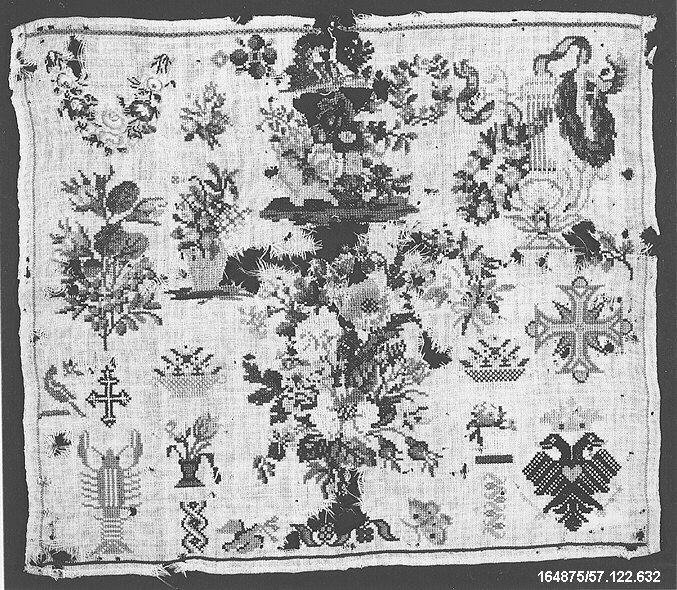
Sampler: A Couture Analysis of Silk on Wool Canvas
Introduction: The Sampler as a Disciplined Art Form
The sampler occupies a paradoxical position within the global heritage of textile arts. Traditionally dismissed as a domestic pedagogical exercise—a young woman's demonstration of needlework proficiency—the sampler has nonetheless functioned as a sophisticated vehicle for cultural transmission, technical innovation, and aesthetic expression across centuries and continents. This analysis examines a standalone study executed in silk on wool canvas, positioning the work within the broader discourse of couture craftsmanship. By interrogating its material composition, structural logic, and cross-cultural lineage, we may reposition the sampler not as a quaint artifact of domesticity but as a legitimate progenitor of haute couture's most rigorous technical and artistic traditions.
Materiality and Technique: Silk on Wool Canvas
The choice of silk thread on wool canvas constitutes a deliberate negotiation between two distinct material vocabularies. Wool canvas, with its open, grid-like weave, provides a structural armature—a substrate that demands precision while simultaneously permitting the embroiderer to count, measure, and construct motifs with mathematical exactitude. Silk, by contrast, introduces luminosity, tensile strength, and a chromatic range that wool alone cannot achieve. The resulting tension—between the matte, utilitarian ground and the lustrous, decorative surface—creates a visual and tactile dialectic that resonates with couture's own preoccupation with contrasting textures and finishes.
Technically, silk on wool canvas necessitates a high degree of thread control. Silk's smooth filament resists friction and slips easily through the wool's fibers, requiring the embroiderer to maintain consistent tension to avoid distortion of the canvas grid. This demands not merely manual dexterity but a conceptual understanding of how individual stitches aggregate into larger patterns. In this sense, the sampler operates as both a technical exercise and a design laboratory—a space where stitch vocabularies are tested, refined, and ultimately codified for future application in garment construction.
Global Heritage: Cross-Cultural Lineages of the Sampler
While the sampler is often associated with European and Anglo-American traditions, its origins are decidedly global. Precedents can be traced to ancient Egypt, where linen fragments embroidered with geometric and figurative motifs served both decorative and instructional purposes. In the Islamic world, particularly in Ottoman and Persian contexts, samplers functioned as repositories of stitch patterns and color combinations, often executed in silk on cotton or wool grounds. These works were not merely domestic exercises but professional reference tools, passed between workshops and guilds.
In East Asia, the Japanese sashiko tradition and Chinese silk embroidery samplers served analogous functions, preserving regional stitch techniques and motif repertoires. The transmission of these practices along trade routes—from the Silk Road to maritime colonial networks—demonstrates that the sampler has always been a cosmopolitan form, absorbing and synthesizing influences from multiple cultures. The present study, executed in silk on wool canvas, participates in this global heritage by drawing on a shared vocabulary of counted-thread embroidery that transcends national boundaries.
Structural Analysis: Composition and Design Logic
Formally, the sampler under consideration exhibits a hierarchical organization typical of the genre. A central field of geometric or floral motifs is flanked by borders of repeating patterns, with alphabetic or numeric sequences often anchoring the composition. This structure reflects a pedagogical logic: the embroiderer progresses from simple to complex stitches, from isolated motifs to integrated designs. Yet the sampler also functions aesthetically, with the grid of the wool canvas providing a rhythmic understructure that unifies disparate elements.
From a couture perspective, this structural discipline is directly transferable to garment design. The sampler's emphasis on modular units—a single flower, a border repeat, a letterform—anticipates the couturier's approach to embellishment, where individual embroidered elements are composed into a cohesive whole. The silk-on-wool combination, moreover, prefigures the layered materiality of couture garments, where delicate surfaces are often applied to more robust foundations.
Technical Vocabulary: Stitches as Couture Infrastructure
The stitches employed in a silk-on-wool sampler constitute a foundational vocabulary for couture embroidery. Cross-stitch, the most common counted-thread technique, teaches precision and uniformity. Running stitch and backstitch provide linear definition. French knots and satin stitch introduce texture and volume. Eyelet holes and drawn-thread work manipulate the canvas itself, creating openwork effects that anticipate the broderie anglaise and cutwork traditions later adopted by couture houses.
Each of these techniques requires the embroiderer to internalize the relationship between thread, needle, and ground. In the context of couture, this internalization is essential: the petites mains of ateliers such as Lesage and Montex must possess an intuitive command of stitch behavior before they can execute the complex, often improvisational embroidery demanded by designers. The sampler, therefore, is not merely a historical curiosity but a training ground for the technical mastery that couture requires.
Conclusion: The Sampler as Couture Progenitor
The sampler in silk on wool canvas is a deceptively modest object. Yet within its grid-bound parameters lies a profound engagement with materiality, technique, and global cultural exchange. By analyzing its material composition, structural logic, and cross-cultural lineage, we recognize the sampler as a legitimate precursor to couture's most sophisticated embroidery practices. It is a standalone study—but one that speaks to the enduring relationship between disciplined craft and artistic expression. For Katherine Fashion Lab, the sampler serves as both historical touchstone and living methodology: a reminder that couture's most spectacular creations are built upon the humble, rigorous, and globally resonant foundation of the counted stitch.