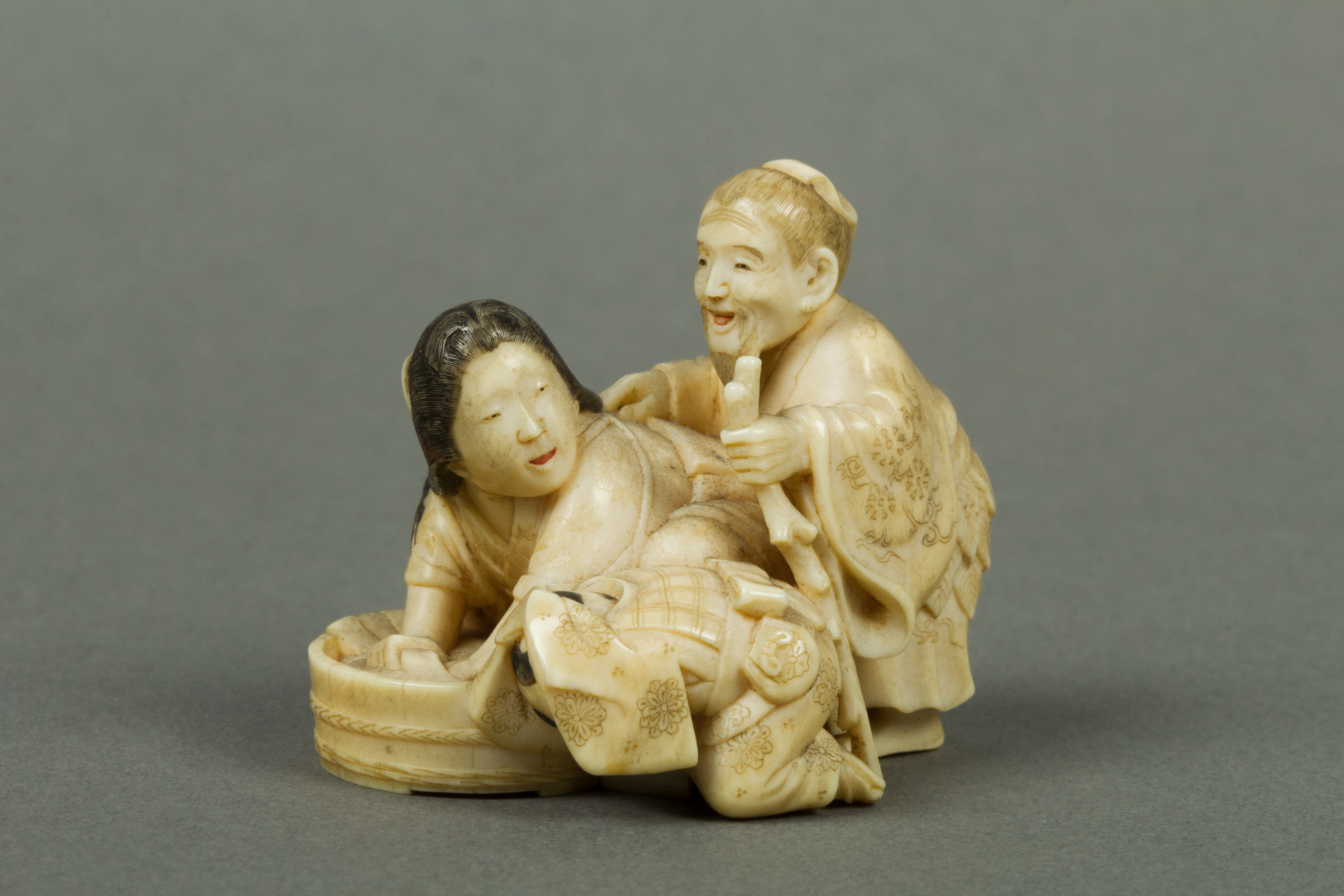
Netsuke: Micro-Sculptural Sovereignty and the Japanese Art of Functional Adornment
Introduction: The Strategic Object
Within the pantheon of heritage artifacts that inform contemporary luxury strategy, few objects embody the tension between utility and transcendence as precisely as the Japanese netsuke. These miniature sculpted toggles, carved predominantly from ivory and boxwood during the Edo period (1615–1868), served a strictly practical function: they anchored the inrō (medicine case) or kinchaku (pouch) to the sash of a kimono, which lacked pockets. Yet within this functional constraint, netsuke carvers achieved a density of symbolic meaning, narrative sophistication, and material mastery that continues to challenge modern notions of scale, value, and adornment. For Katherine Fashion Lab, the netsuke offers a strategic case study in how miniature objects can carry maximal cultural authority—a principle directly applicable to 2026 luxury positioning.
Historical Adornment: The Discipline of the Sash
The netsuke emerged not from decorative ambition but from sumptuary law and architectural necessity. The kimono, with its clean lines and absence of fasteners, demanded an external suspension system for personal effects. The obidome (sash clip) and netsuke evolved as the two poles of this system—one anchoring the cord at the top, the other preventing it from slipping through the sash. This functional origin is critical to understanding netsuke's symbolic power: it was worn, touched, and displayed in motion. Unlike a painting or a ceramic vessel, the netsuke was a tactile companion, rotated in the hand, admired by peers, and exchanged as a gift of consequence.
By the mid-Edo period, netsuke had become a marker of taste and intellectual affiliation. Carvers such as Yoshimura Shūzan and the Osaka school elevated the form to high art, while regional styles—Nagoya, Kyoto, Edo—developed distinct visual dialects. The material hierarchy was equally codified: ivory, imported from Southeast Asia and Africa, signaled wealth and purity; boxwood offered finer detail; lacquer and horn provided exotic alternatives. For the wearer, the netsuke was not merely an accessory but a portable gallery—a statement of connoisseurship in a society where overt displays of wealth were legally constrained.
Symbolic Power: The Carved Cosmology
The symbolic vocabulary of netsuke is remarkably expansive, drawing from Buddhist iconography, Shinto folklore, Chinese legend, and vernacular humor. Each motif operated on multiple levels: the shishi (lion-dog) offered protection; the kitsune (fox) signaled cunning and liminality; the sennin (immortal) conveyed detachment from worldly suffering. The karako (Chinese child) embodied filial piety and prosperity, while erotic shunga netsuke served as talismans against fire or as private amulets of fertility. This polysemy was intentional—a single object could satisfy aesthetic, spiritual, and social functions simultaneously.
Critically, the netsuke's small scale demanded close looking. Its meaning was not broadcast but revealed through intimacy. The wearer chose which narrative to carry against the body, making the object a form of silent autobiography. In a rigidly hierarchical society, this micro-sculptural sovereignty allowed for subtle self-expression within prescribed boundaries—a strategic lesson for luxury brands navigating similar tensions between conformity and individuality in 2026.
Spiritual Meaning: The Amulet and the Anchor
Beyond decoration, many netsuke functioned as omamori (protective charms). The act of suspending a carved deity or auspicious animal from the sash was apotropaic—it warded off evil, ensured safe travel, or invoked good fortune. The physical weight of the netsuke against the hip served as a constant, grounding reminder of one's spiritual commitments. In Zen-inflected Edo culture, this mundane object could also evoke wabi-sabi—the beauty of wear, patina, and imperfection accumulated through daily use.
The ivory medium itself carried spiritual connotations. Its coolness, density, and ability to take a high polish were associated with purity and endurance. Yet ivory's provenance—often imported through Nagasaki—also connected the netsuke to global trade networks, making it a node of cultural exchange long before the term "globalization" existed. This dual identity, local meaning and foreign material, positions the netsuke as an early example of heritage hybridity.
2026 Luxury Strategy: Miniature Authority and Tactile Heritage
For Katherine Fashion Lab, the netsuke offers four actionable strategic pillars for 2026:
1. Scale as Scarcity. The netsuke demonstrates that value is not proportional to size but to density of meaning and craft. A 4-centimeter object can command the same cultural capital as a monumental sculpture. In an era of digital saturation, miniature physical objects offer a counter-narrative of intimacy and focus. Katherine Fashion Lab can apply this by developing "micro-heirlooms"—small, exquisitely crafted accessories that serve as anchors for personal narrative.
2. Functional Adornment. The netsuke was never purely decorative; it solved a problem. Luxury in 2026 must similarly justify its existence through utility, however subtle. A clasp, a charm, a toggle—each can become a site of symbolic investment if designed with narrative depth and tactile reward.
3. Material Ethics and Provenance. Ivory is now a contested material, and responsible luxury must address this directly. The strategic move is not to replicate ivory but to translate its sensory qualities—coolness, weight, polish—into ethical alternatives such as tagua nut, recycled resin, or sustainably harvested hardwoods. The heritage narrative becomes a bridge to innovation, not a barrier.
4. Narrative Layering. The netsuke's power lies in its layered symbolism—animal, deity, humor, protection—all readable in the hand. Katherine Fashion Lab should design objects that reward repeated viewing, embedding multiple cultural references that unfold over time. This creates a relationship of discovery between wearer and object, deepening brand loyalty.
Conclusion: The Strategic Miniature
The netsuke is not a relic of a closed chapter in Japanese history. It is a strategic template for how luxury objects can operate: small enough to be intimate, dense enough to be meaningful, functional enough to be necessary, and symbolic enough to be spiritual. For Katherine Fashion Lab, the lesson is clear. In 2026, authority will not come from size or volume but from the precision of cultural translation and the integrity of tactile experience. The netsuke, carved for a world without pockets, offers a pocket-sized philosophy for a world without attention. To wear one—or to design in its spirit—is to carry a cosmology against the body.