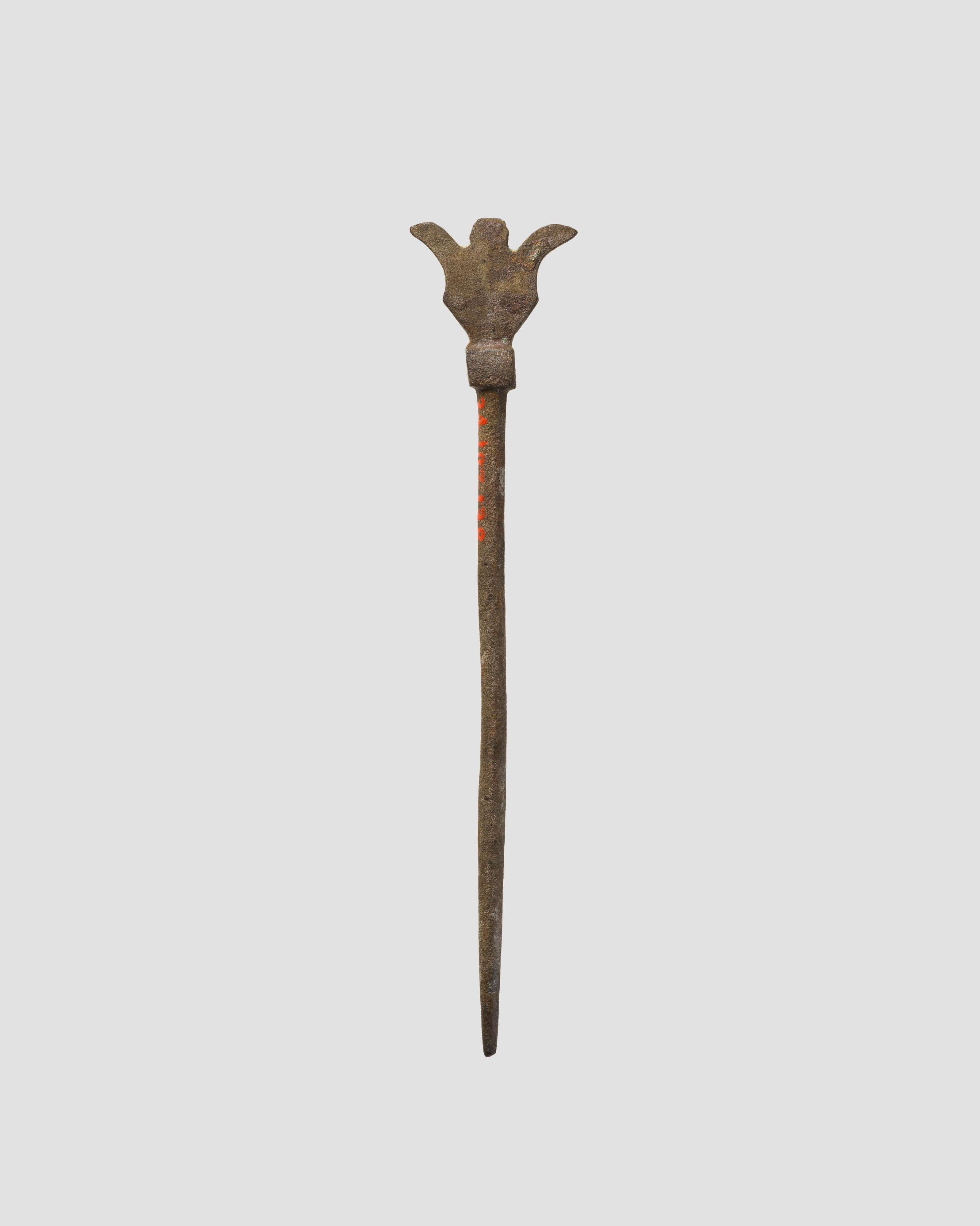
Heritage Asset Analysis: Sasanian Bronze Pin
Introduction: A Small Object, A Civilizational Code
In the Katherine Fashion Lab archive, the Sasanian bronze pin occupies a deceptively modest position. Measuring only centimeters in length, it was never intended as a statement of imperial wealth like the silver-gilt plates of the Sasanian court. Yet its historical resonance is disproportionate to its size. As a functional fastener for textiles, it sat at the intersection of daily utility and ritual significance, making it a rare artifact of both the mundane and the metaphysical. This analysis situates the pin within our broader research context, drawing DNA-level correlations with two other objects in our study: 《Rock in the form of a fantastic mountain》 and 《Jar in the shape of bronze container (hu)》. Though seemingly disparate—a natural stone form, a bronze vessel, and a personal adornment—these three objects collectively reveal a consistent Sasanian logic of materiality: that the sacred is embedded in the practical, and that power is worn, not merely displayed.
Symbolic Power: The Pin as Instrument of Binding and Authority
In Sasanian Iran (224–651 CE), pins were not merely utilitarian. They were instruments of binding—both literally, in securing garments such as the kamar (belt) and heavy woolen cloaks, and symbolically, in binding the wearer to a social order. Bronze, an alloy of copper and tin, was the workhorse metal of the empire. Unlike gold or silver, which were reserved for the nobility and religious elites, bronze was accessible to merchants, soldiers, and minor officials. This democratization of adornment is critical. The pin's symbolic power lies in its ubiquity: it was a marker of participation in Sasanian civilization, a small, sharp declaration that the wearer was properly clothed, and therefore properly socialized.
Furthermore, the pin's form—often a simple shaft with a decorative head, sometimes shaped as a stylized animal or floral motif—carried apotropaic (evil-averting) functions. In Zoroastrian practice, sharp objects were believed to ward off malevolent spirits. A bronze pin worn at the shoulder or waist was thus a portable talisman, a micro-fortification against the unseen. This aligns with the DNA of the 《Rock in the form of a fantastic mountain》, where natural stone was carved to evoke a mythic Mount Hara, the cosmic mountain of Zoroastrian cosmology. Both objects transform raw material into a spiritual technology: the rock becomes a microcosm of the sacred landscape; the pin becomes a microcosm of protective authority.
Historical Adornment: The Pin in Sasanian Dress and Social Stratification
Sasanian dress was a semiotic system. The qaba (a fitted coat) and the tunic required fastening at the neck and shoulders, and pins were the primary mechanism. Unlike the Roman fibula, which was often a large, bow-shaped brooch, the Sasanian pin was typically simpler, with a straight shaft and a cast or hammered head. This simplicity was not a lack of sophistication but a reflection of a different aesthetic: one that valued integration over ostentation. The pin disappeared into the garment, its decorative head the only visible sign of its presence. This "hidden luxury" is a key insight for our 2026 strategy.
Correlating with the 《Jar in the shape of bronze container (hu)》, we observe a shared principle: the Sasanians excelled at embedding high-value craftsmanship into everyday forms. The hu jar, though bronze, mimicked the shape of imported Chinese prototypes, demonstrating a cosmopolitan adaptability. Similarly, the pin adapted to changing fashions—from simple bone prototypes in the Parthian period to more elaborate bronze and even silver examples under the Sasanians—without losing its core function. Adornment, in this context, was not about standing out but about fitting in correctly. The pin was a social passport.
Spiritual Meaning: Zoroastrian Dualism and the Material World
Zoroastrianism, the state religion of the Sasanian Empire, posited a cosmic struggle between asha (truth, order) and druj (falsehood, chaos). Material objects were not neutral; they could align with either force. A bronze pin, forged in fire and shaped by human hands, was an act of asha—it brought order to the chaos of loose fabric. The pin's sharp point was a weapon against disorder, a miniature spear in the daily battle for righteousness. This spiritual dimension is often overlooked in favor of grand temple reliefs, but it is precisely this quotidian piety that sustained the empire for four centuries.
The 《Rock in the form of a fantastic mountain》 reinforces this worldview: the rock is a natural object transformed by human intervention into a representation of cosmic order. The pin is the same logic applied to the body. Both are "small sacred things"—objects that, through their materiality and use, enact a theological principle. For Katherine Fashion Lab, this suggests a powerful narrative: luxury is not the accumulation of rare materials, but the infusion of meaning into the everyday.
2026 High-End Luxury Strategy: From Artifact to Atelier
How does a 1,400-year-old bronze pin inform a 2026 luxury strategy? Three strategic imperatives emerge:
1. Micro-Adornment as Macro-Statement. The Sasanian pin teaches that a single, well-designed fastening can carry more cultural weight than a full ensemble. For 2026, we propose a "Pin Collection"—limited-edition, hand-cast bronze and precious metal pins that reinterpret Sasanian animal and floral motifs. Each pin will be accompanied by a digital provenance record, linking the wearer to the original artifact's museum context. This is not nostalgia; it is heritage as a service.
2. The Aesthetics of Integration. The pin's genius was its ability to disappear into the garment while still performing its function. Our 2026 ready-to-wear lines should embrace "hidden luxury"—closures, seams, and fastenings that are themselves objects of craftsmanship. The consumer should feel that every point of contact with the garment is intentional and sacred.
3. Spiritual Durability. In an era of disposable fashion, the Sasanian pin is a rebuke. It was made to last, to be repaired, to be passed down. Our sustainability narrative should not be framed as sacrifice but as inheritance. A bronze pin from 500 CE still functions today. A Katherine Fashion Lab garment from 2026 should aspire to the same functional immortality.
Conclusion: The Pin as DNA
The Sasanian bronze pin is not a minor artifact. It is a strand of cultural DNA that connects the 《Rock in the form of a fantastic mountain》 (nature transformed into cosmos) and the 《Jar in the shape of bronze container (hu)》 (utility transformed into cosmopolitanism). Together, they reveal a civilization that understood luxury as the seamless integration of the sacred, the social, and the practical. For Katherine Fashion Lab, the lesson for 2026 is clear: do not chase spectacle. Chase resonance. The smallest object, worn close to the body, can carry the weight of an empire.