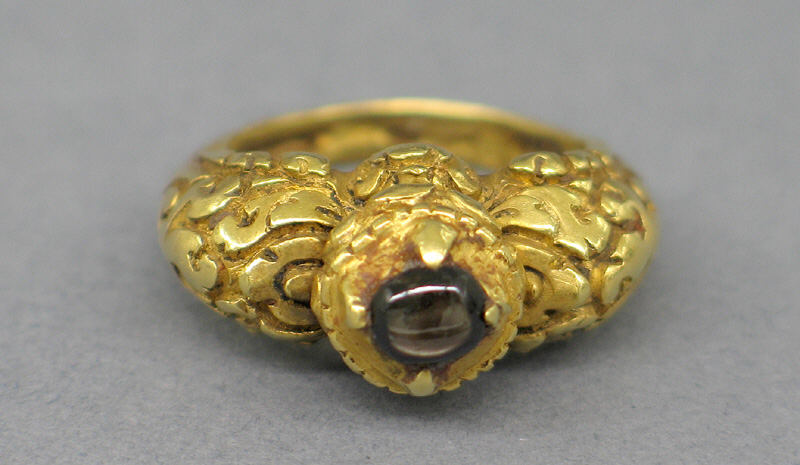
Stirrup-Shaped Ring with Stone and Foliate Designs: A Heritage Analysis for Katherine Fashion Lab
Object Overview and Materiality
The stirrup-shaped ring under examination—gold set with a stone and embellished with foliate motifs—originates from Java, Indonesia, and represents a sophisticated convergence of metallurgical mastery, botanical symbolism, and spiritual cosmology. The stirrup archetype, characterized by a broad, arched band that rises into a raised bezel, is a form that appears across Islamic, Indian, and Southeast Asian goldsmithing traditions. In the Javanese context, however, the form acquires distinct local meaning, shaped by the island's Hindu-Buddhist heritage, its later Islamic courts, and its enduring animist substrate.
The medium is gold, a material the Javanese have worked since at least the first millennium CE. Gold was not merely decorative; it was understood as a physical manifestation of spiritual radiance, associated with royalty, ancestral veneration, and divine favor. The stone—likely a semi-precious gem such as a ruby, sapphire, or locally sourced chalcedony—anchors the ring's talismanic function. Foliate designs, rendered in relief or filigree, frame the stone and extend along the shoulders of the band, transforming the ring from a simple ornament into a miniature cosmological statement.
Symbolic Power and Historical Adornment
In Javanese court culture, rings were instruments of political and spiritual authority. The stirrup shape, with its elevated profile, was designed to be seen—an object of display that communicated status during diplomatic audiences, ceremonial processions, and ritual exchanges. Unlike the flat signet rings of later European tradition, the Javanese stirrup ring prioritized verticality, allowing the stone to catch light and draw the eye upward, a gesture toward the heavens and the unseen.
Historical records from the Majapahit era (13th–16th centuries) and subsequent Islamic sultanates of Mataram and Yogyakarta describe gold rings as gifts between rulers, as heirlooms passed through female lines, and as components of bridal dowries. The foliate motif—often stylized as tendrils, leaves, or the lotus—was not incidental decoration. In Hindu-Buddhist iconography, the lotus symbolizes purity and enlightenment; in Islamic Javanese contexts, vegetal arabesque served as a non-figurative meditation on paradise and divine infinity. The ring thus carried layered meanings: a public emblem of rank, a private talisman, and a portable shrine.
Spiritual Meaning and Talismanic Function
Javanese spiritual traditions, particularly the kejawen synthesis of animism, Hinduism, Buddhism, and Islam, attribute to gold and gemstones a capacity to channel spiritual energy. The stone in this ring would have been selected not only for beauty but for its reputed metaphysical properties—protection against illness, enhancement of charisma, or alignment with planetary forces. The stirrup shape itself may evoke the stirrup of a horse, symbolizing mobility, mastery, and the ability to navigate both physical and spiritual realms.
Foliate designs in Javanese goldwork often incorporate hidden symmetries and repeating patterns that mirror the concept of tata—cosmic order. To wear such a ring was to participate in that order, to carry a microcosm of the universe on one's hand. This talismanic dimension explains why rings were frequently buried with the deceased, offered at temple foundations, or placed in rice granaries to ensure fertility and prosperity.
2026 High-End Luxury Strategy: Positioning and Narrative
For Katherine Fashion Lab, this object offers a strategic opportunity to enter the 2026 luxury market with a narrative that is both deeply rooted and globally resonant. The high-end consumer of 2026 is not merely purchasing a product; they are acquiring provenance, meaning, and ethical authenticity. The stirrup-shaped ring from Java provides all three.
Strategic Pillars for Brand Integration
1. Provenance as Product: The ring's Javanese origin allows Katherine Fashion Lab to position itself within the growing market for Southeast Asian heritage luxury. Unlike generic "ethnic" collections, this object demands specificity—Majapahit goldsmithing, kejawen spirituality, and the trade routes that brought Indian gemstones to Indonesian courts. The brand should commission scholarly authentication and publish a heritage dossier with each piece, transforming the ring into a collectible artifact.
2. Symbolic Power for Modern Wear: The foliate motif can be adapted into a contemporary design language—subtle, architectural, and gender-neutral. The stirrup shape, with its vertical emphasis, suits the 2026 preference for rings that are visible in digital and physical spaces alike. Marketing should emphasize the ring as a "talisman for the modern navigator," linking the Javanese concept of mobility to the global professional's lifestyle.
3. Spiritual Meaning without Appropriation: Katherine Fashion Lab must engage with Javanese spiritual meaning respectfully. This means partnering with Javanese artisans, crediting specific communities, and avoiding reductionist language. The brand can position the ring as a "meditation object"—a piece that invites the wearer to reflect on order, protection, and interconnectedness, values that transcend culture.
4. Material Integrity and Sustainability: Gold and gemstones must be sourced ethically, with traceability from mine to market. The 2026 luxury consumer will penalize brands that ignore environmental and social impact. Katherine Fashion Lab can lead by using recycled gold and supporting Javanese artisanal cooperatives, turning supply chain transparency into a brand differentiator.
Conclusion
The stirrup-shaped ring with stone and foliate designs is not a relic to be admired from a distance. It is a strategic asset. Its symbolic power, historical depth, and spiritual resonance align precisely with the 2026 luxury landscape's demand for meaning, provenance, and ethical beauty. For Katherine Fashion Lab, the task is to translate this Javanese masterpiece into a contemporary icon—one that honors its origins while speaking to a global audience. The ring's journey from the courts of Java to the wrists of the world's most discerning consumers is not a departure from heritage; it is a continuation of its story.