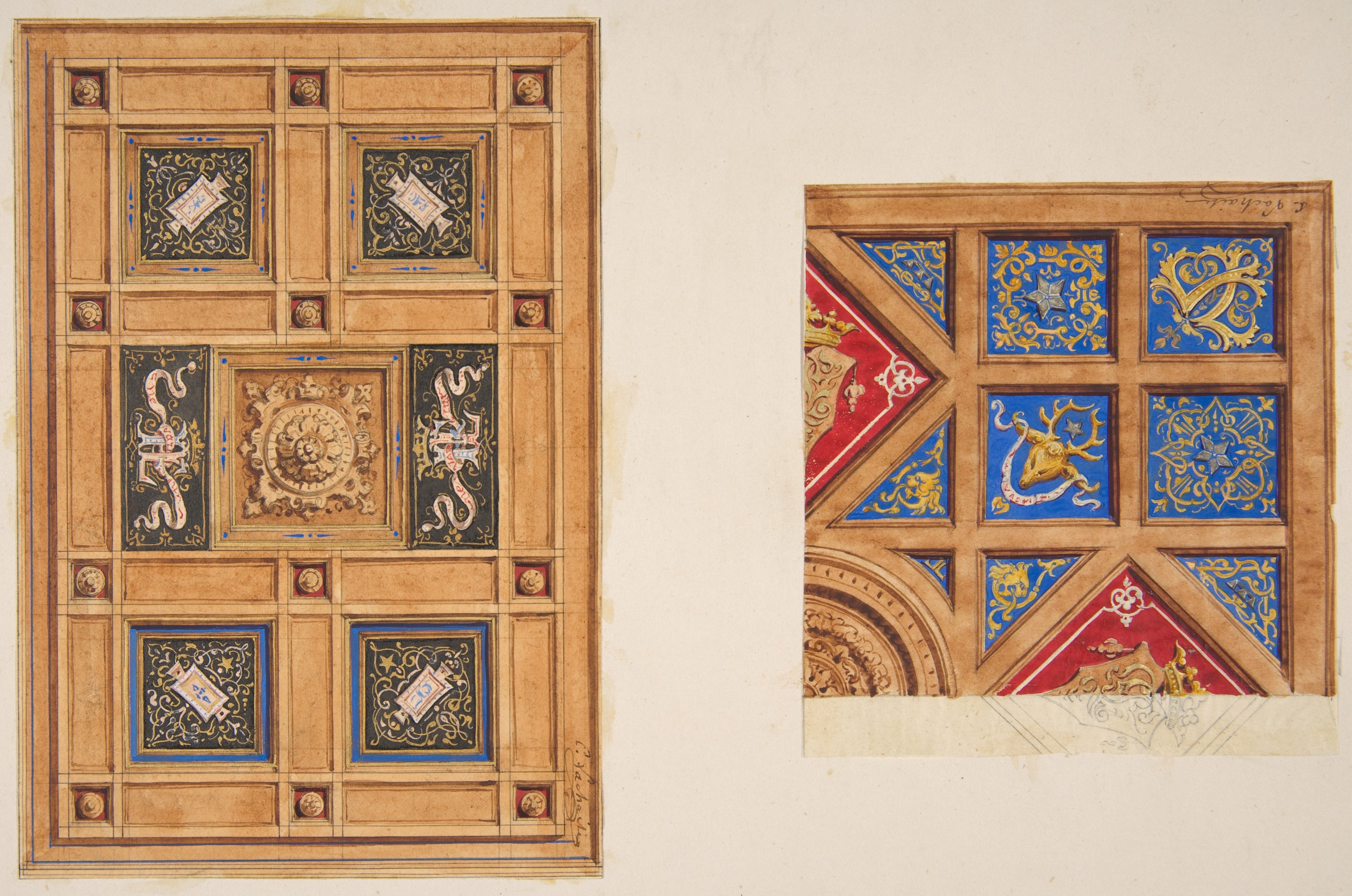
Heritage Analysis: Two Designs for a Paneled Ceiling with Painted Decoration
Object Overview and Materiality
The subject of this analysis comprises two preparatory designs for a paneled ceiling with painted decoration, executed in pen and ink, watercolor, and gold paint across two sheets of tracing paper, subsequently mounted on wove paper. The work belongs to the visual tradition of an ancient civilization whose architectural and decorative grammar continues to inform luxury codes today. The choice of tracing paper is itself significant: it signals a working document, a stage in the design process rather than a finished commission. For Katherine Fashion Lab, this distinction matters. It positions the object not as a static artifact but as evidence of intellectual labor—the moment when symbolic intent is translated into structural ornament.
The medium is layered and deliberate. Pen and ink establish the architectural armature: coffers, borders, and geometric divisions. Watercolor introduces chromatic modulation, suggesting how pigment would interact with plaster, stone, or wood under natural and artificial light. Gold paint, applied selectively, marks the hierarchy of the composition. Gold is never neutral in pre-modern visual culture; it denotes divinity, sovereignty, and the transmission of authority. The combination of these three media on translucent paper reveals a designer thinking simultaneously as engineer, painter, and courtier.
Symbolic Power and Historical Adornment
Paneled ceilings in ancient civilizations were not merely structural solutions. They were cosmograms. The grid of coffers could represent the ordered heavens, the four cardinal directions, or the administrative divisions of an empire. Each panel offered a discrete field for emblematic content: floral rosettes, geometric stars, mythological figures, or dynastic insignia. The repetition of these motifs across a ceiling transformed a private or ceremonial space into a legible statement of power. To stand beneath such a ceiling was to be enclosed within a worldview.
The gold paint in these designs likely functioned as more than decoration. In many ancient traditions, gold was understood as a material analogue of solar light and incorruptibility. Its application to specific panels—rather than uniform gilding—would have created a rhythm of revelation and concealment. The eye would travel across the ceiling, drawn to gilded nodes of meaning. This is an early form of what luxury brands now call “visual hierarchy”: the strategic deployment of preciousness to guide attention and encode value.
Spiritual Meaning and Spatial Experience
Ceilings occupy a unique position in sacred and palatial architecture. They are the boundary between the human and the celestial, the interior and the infinite. Painted decoration on a ceiling is therefore never purely ornamental; it is theological. The two designs under consideration suggest a concern with ascent. The paneled structure creates a grid that can be read as a ladder or a map, while the painted motifs provide the content of that ascent—deities, ancestors, or abstract principles of order.
Watercolor washes in these sheets indicate how light was expected to behave. A ceiling is lit from below, often by flickering oil lamps or filtered daylight. The designer had to anticipate how pigment and gold would shift under those conditions. This is an early instance of experiential design: the object is not complete until it is inhabited. For Katherine Fashion Lab, this principle translates directly into retail and runway environments, where lighting, material, and sequence determine whether a heritage reference feels alive or archival.
Material Intelligence and Craft Hierarchy
The use of tracing paper reveals a culture of iteration. The designer could overlay, revise, and transfer motifs without destroying the original. This is a pre-digital form of layering that anticipates contemporary design software. The mounted wove paper support suggests that the sheets were later preserved as a set, perhaps for a patron’s archive or a workshop’s reference collection. The object thus carries two histories: the history of its making and the history of its keeping.
Gold paint on tracing paper is a technically demanding combination. The paper is thin and absorbent; the gold must be applied with precision to avoid bleeding or flaking. The survival of these sheets indicates a high level of workshop skill. For a luxury house, this is a reminder that heritage is not only about motifs but about process. The hand that applies gold to a ceiling panel and the hand that applies gold to a couture embroidery share a discipline of control and intention.
2026 Luxury Strategy: From Ceiling to Collection
For Katherine Fashion Lab, the strategic value of this object lies in its dual identity as architectural proposal and symbolic system. In 2026, high-end luxury is moving away from literal logo repetition toward what can be called “coded heritage.” The consumer is invited to recognize a reference without being told its name. The paneled ceiling offers exactly this kind of code: a grid that can be translated into quilting, lace, or leather marquetry; a gold node that can become a clasp, a heel, or a button.
The first strategic direction is architectural tailoring. The coffer grid can inform the construction of outerwear and accessories, creating garments that feel built rather than sewn. The second is ritual lighting. The interplay of watercolor and gold suggests a palette and a finish strategy for eveningwear and fine jewelry, where matte and metallic surfaces alternate to simulate the experience of looking up. The third is archival transparency. The tracing paper itself—translucent, provisional, layered—can inspire packaging, campaign imagery, and in-store displays that reveal the design process rather than hiding it.
Finally, the spiritual dimension of the ceiling should not be neutralized. Contemporary luxury consumers are increasingly drawn to objects that carry a sense of protection, order, and transcendence. A collection that references a painted ceiling is not selling nostalgia; it is selling a structure of meaning. The panel is a promise: that chaos can be ordered, that light can be placed, that gold can mark what matters.
Conclusion
These two designs for a paneled ceiling are more than preparatory drawings. They are a compact statement of how ancient civilizations used adornment to organize power, spirit, and space. For Katherine Fashion Lab, the object provides a rigorous template for 2026: translate the grid, respect the gold, and design for the moment when the wearer looks up.