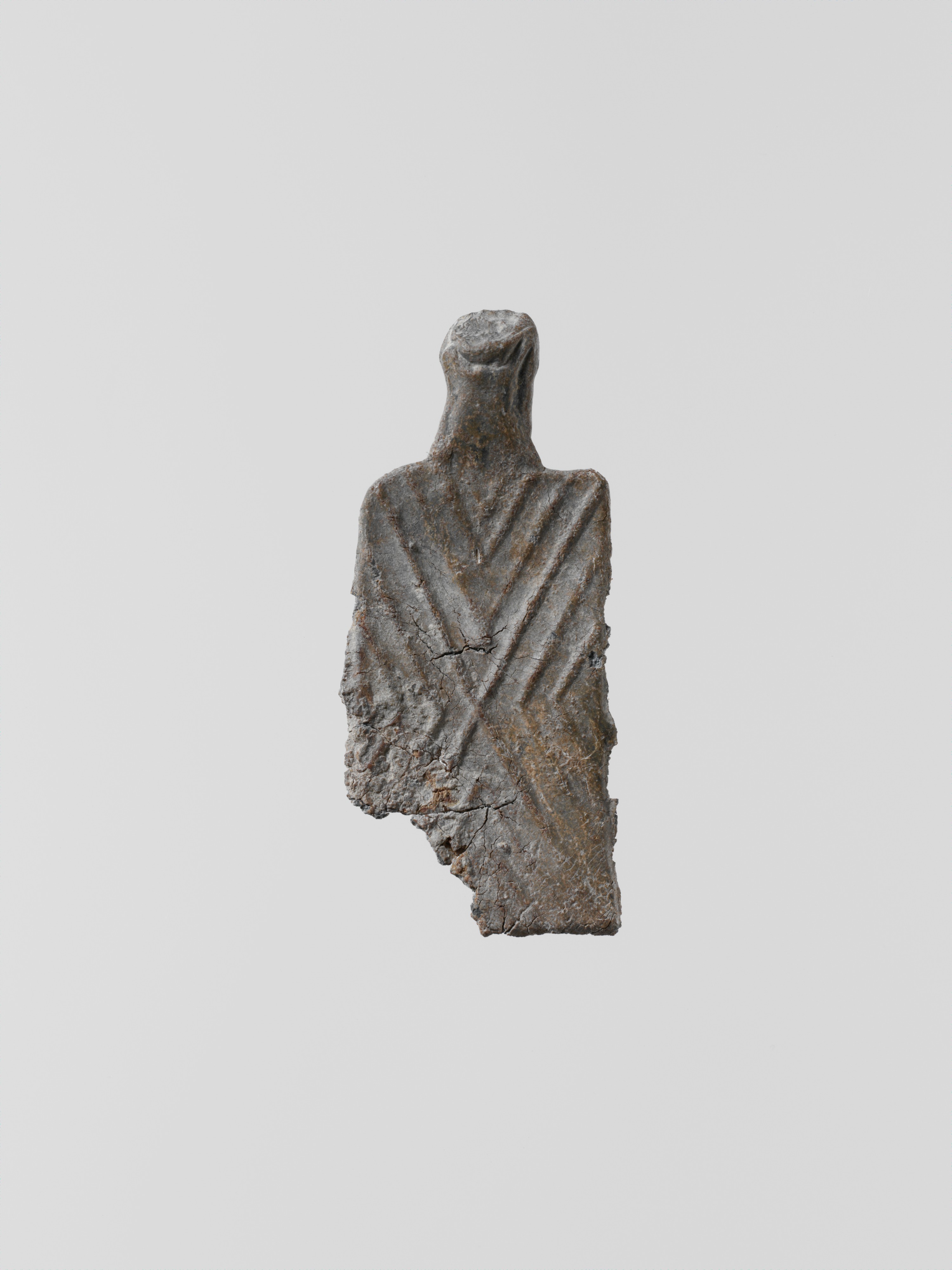
Lead Ornament, Laconian Greek: Symbolic Power and Strategic Luxury Implications for 2026
Object Overview and Material Paradox
The artifact under examination is a lead ornament of Laconian Greek origin, tentatively dated to the Archaic through Classical periods (circa 700–400 BCE). Despite its base material, the object exhibits formal characteristics—perforations, incised linear motifs, and symmetrical profiling—that closely imitate contemporary gold, silver, and bronze jewelry. This deliberate mimicry of precious adornment in a base metal constitutes the central analytical tension of the piece. For Katherine Fashion Lab, this object serves as a strategic case study in how material hierarchy, symbolic substitution, and ritual function intersect with modern luxury positioning.
Historical Context: Laconian Material Culture
Laconia, the region of the southeastern Peloponnese dominated by Sparta, maintained a distinctive material culture that diverged sharply from Athenian luxury traditions. Spartan society enforced sumptuary norms that discouraged ostentatious display among citizens, yet archaeological evidence from sanctuaries such as the Menelaion, the Amyklaion, and Artemis Orthia reveals abundant votive deposits. Lead was locally available and easily cast, making it an accessible medium for mass-produced votive offerings. These objects were not merely cheap substitutes; they operated within a ritual economy where the act of dedication, not the intrinsic value of the material, conferred spiritual efficacy.
The Laconian lead ornaments frequently imitate imported luxury goods from Corinth, Ionia, and the Near East. This imitation was not necessarily a mark of poverty but rather a deliberate translation of elite visual language into a democratized ritual vocabulary. The ornament therefore functioned as a symbolic conduit: it allowed a broader segment of the population to participate in adornment practices otherwise reserved for the aristocratic elite.
Symbolic Power and Spiritual Meaning
In ancient Greek ritual contexts, lead possessed ambivalent symbolic properties. Its dullness, weight, and susceptibility to corrosion associated it with chthonic forces, binding spells (katadesmoi), and the realm of the dead. Yet lead was also malleable and could be cast into intricate forms, making it ideal for votive figurines and ornaments dedicated to deities associated with transition, protection, and fertility. A Laconian lead ornament imitating jewelry thus occupied a liminal space: it was simultaneously an adornment for the living and an offering for the divine.
The perforations and suspension loops on such ornaments suggest they were sewn onto garments or strung as pendants. In a ritual context, the wearer or dedicant may have sought protection, status within a cult community, or the favor of a deity such as Artemis Orthia, whose sanctuary yielded thousands of lead votives. The spiritual meaning resided not in the metal's market value but in the act of consecration and the object's capacity to mediate between human and divine.
Adornment as Social Technology
From a sociological perspective, the Laconian lead ornament functioned as a social technology. It enabled the performance of adornment without violating Spartan egalitarian norms. The imitation of jewelry signaled aspiration while the base material signaled restraint. This duality is directly relevant to contemporary luxury strategy, where consumers increasingly seek objects that convey sophistication without overt excess. The lead ornament anticipates the modern concept of "stealth wealth" and the growing demand for heritage narratives that prioritize meaning over material cost.
Strategic Implications for 2026 High-End Luxury
Katherine Fashion Lab operates at the intersection of heritage research and luxury brand strategy. The Laconian lead ornament offers three actionable strategic pillars for 2026 collections and communications.
First, the valorization of base materials through narrative. Luxury consumers in 2026 are expected to prioritize provenance, ritual, and emotional resonance over traditional preciousness. A lead ornament that imitates gold challenges the industry's material hierarchy. Brands can leverage this by developing capsule collections that use non-traditional materials—recycled metals, base alloys, or composite ceramics—and frame them within rigorous historical narratives of symbolic substitution and ritual function.
Second, the ritual economy as a branding model. The Laconian votive economy was participatory and accessible. Luxury brands can adapt this logic by creating "dedication" product lines where a portion of proceeds supports cultural heritage preservation, or by designing objects intended for personal ritual—daily wear that carries meditative or protective associations. The object's spiritual meaning becomes a brand asset.
Third, the aesthetics of restraint. The ornament's formal language—simple profiles, incised lines, and functional perforations—aligns with the minimalist, tactile, and anti-bling aesthetic gaining traction in high-end markets. For 2026, Katherine Fashion Lab should consider a Laconian-inspired line that emphasizes negative space, matte finishes, and modular wearability. The lead ornament's imitation of jewelry becomes a design principle: luxury that whispers rather than shouts.
Conclusion
The Laconian lead ornament is not a marginal artifact but a sophisticated cultural document. It demonstrates how symbolic power can override material value, how spiritual meaning can be embedded in humble media, and how adornment can serve social cohesion rather than mere display. For Katherine Fashion Lab, this object provides a strategic blueprint for 2026 luxury: heritage-driven, materially conscious, ritually resonant, and aesthetically restrained. The lead ornament teaches that the most enduring luxury is not the most expensive material, but the most meaningful narrative.