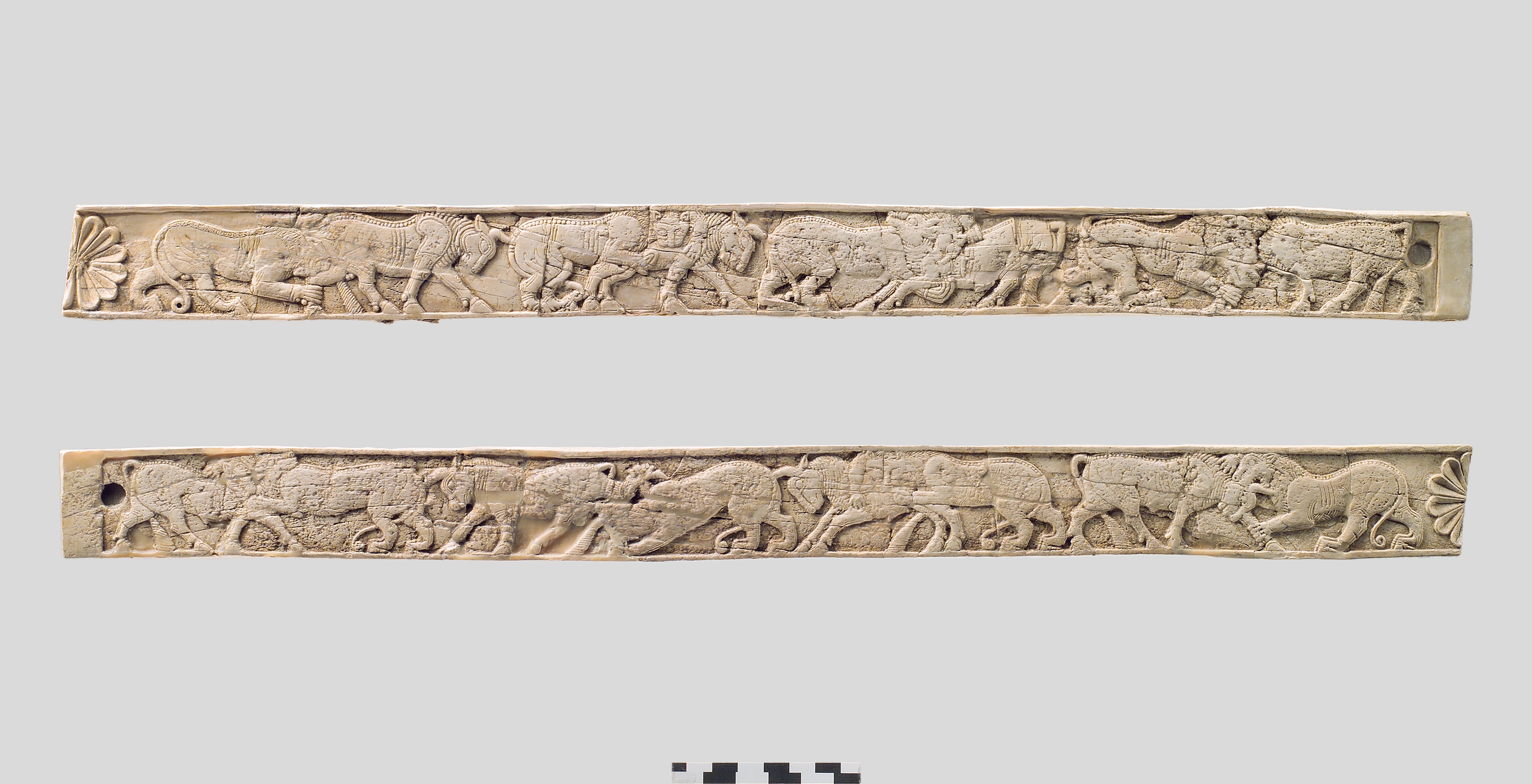
Heritage Analysis: Assyrian Ivory Furniture Plaques with Animal Combat Relief
Introduction: The Object as Strategic Archive
Within the material record of the ancient Near East, few categories of luxury object carry as much concentrated symbolic capital as the carved ivory furniture plaques of the Assyrian tradition. Produced primarily between the ninth and seventh centuries BCE, and recovered in significant quantities from the royal storehouses of Nimrud, these small relief-carved panels—typically measuring between five and fifteen centimetres—were originally inlaid into wooden furniture, thrones, beds, and ceremonial stands. Their medium, elephant or hippopotamus ivory, was itself a statement of reach: a material that travelled across imperial frontiers and spoke to the Assyrian court's command of distant trade networks. For Katherine Fashion Lab, these plaques are not merely archaeological curiosities but a compressed grammar of power, adornment, and spiritual protection that remains legible to a contemporary luxury audience.
Symbolic Power: The Iconography of Controlled Violence
The dominant motif of these plaques is animal combat: a lion or lioness bringing down a bull, a stag, or an ibex; a griffin with raised talons seizing its prey; a hero figure—often identified as the mythological Master of Animals—grasping two beasts in symmetrical tension. This is not decorative naturalism. It is a carefully engineered visual argument. In Assyrian royal ideology, the king was the shepherd who subdued chaos, and the animal combat motif externalised that claim onto the furniture of the palace. Every banquet couch and every throne became a stage on which the empire's foundational myth—order triumphing over wild disorder—was re-enacted at the scale of the hand.
The compositional symmetry is equally deliberate. The mirrored struggle creates a closed, self-contained field of tension, a visual containment that parallels the political containment of conquered peoples. For a modern luxury strategist, the lesson is precise: narrative tension, when formalised into a repeatable visual system, becomes brand equity. The Assyrians did not invent a new image for every commission; they iterated a core motif across hundreds of plaques, achieving recognition through disciplined repetition rather than novelty.
Historical Adornment: Ivory as Tactile Luxury
Ivory occupies a singular position in the history of adornment. Its fine grain permitted carving of extraordinary detail—the sinews of a lion's foreleg, the incised feathers of a griffin's wing—while its warm, pale surface offered a chromatic counterpoint to the gilded and painted woods into which it was set. The plaques were not flat pictures; they were components of a multi-material surface, combined with gold foil, lapis lazuli, and coloured glass to produce an object that rewarded close inspection and reflected lamplight in a palace interior.
This is the historical antecedent of what the contemporary luxury sector calls material storytelling. The value of the plaque was not reducible to its raw ivory weight; it derived from the convergence of rare material, skilled handwork, and a meaning system that only an educated elite could fully decode. The Assyrian court understood that adornment functions as a form of social sorting: those who recognise the code belong; those who do not are spectators.
Spiritual Meaning: Apotropaic Function and the Protective Surface
Beyond political messaging, the plaques carried an apotropaic charge. In Mesopotamian belief, dangerous forces—demons, disease, misfortune—moved through the world and could be intercepted at thresholds and surfaces. The carved beast in combat was not only a symbol of royal victory but a functional guardian, its aggression redirected outward to ward off harm from the person who used the furniture. The presence of protective figures on beds is particularly telling: sleep and vulnerability were states requiring supernatural insurance.
This fusion of the ornamental and the talismanic is a critical insight for heritage-led luxury strategy. The object was never purely aesthetic; it performed a service. It promised safety, continuity, and favour. A contemporary luxury brand that can articulate an equivalent promise—protection, belonging, endurance—inherits a far deeper emotional architecture than one that trades solely on surface beauty.
Strategic Implications for 2026 High-End Luxury
Three strategic directions emerge from this heritage analysis for Katherine Fashion Lab's 2026 positioning.
First, codified iconography over seasonal novelty. The Assyrian plaque system demonstrates that a recognisable motif, rigorously maintained, accumulates authority across decades. A signature emblem—whether a combatant pair, a guardian figure, or an abstracted knot—should be treated as a proprietary asset, deployed with consistency across leather goods, hardware, and print.
Second, multi-material craftsmanship as provenance. The integration of ivory with gold and pigment anticipates the contemporary appetite for objects that reveal layered making. For 2026, collections should foreground visible joinery and material contrast, allowing clients to perceive the hand of the maker and the logic of assembly.
Third, the protective narrative. The apotropaic dimension offers a differentiated emotional territory. Positioning a product line around guardianship—crafted objects that accompany the wearer through risk and transition—aligns ancient spiritual function with contemporary consumer desire for resilience and meaning.
Conclusion
The Assyrian ivory furniture plaques are a reminder that luxury has always been a technology of meaning. They converted a rare material into a system of power, protection, and identity, and they did so with a formal discipline that modern brands would do well to study. For Katherine Fashion Lab, the strategic opportunity is not to reproduce antiquity but to inherit its operating principles: repeat the emblem, layer the material, and promise the wearer something older and more durable than fashion—safety, status, and the quiet confidence of belonging to a civilisation that knows how to hold its ground.