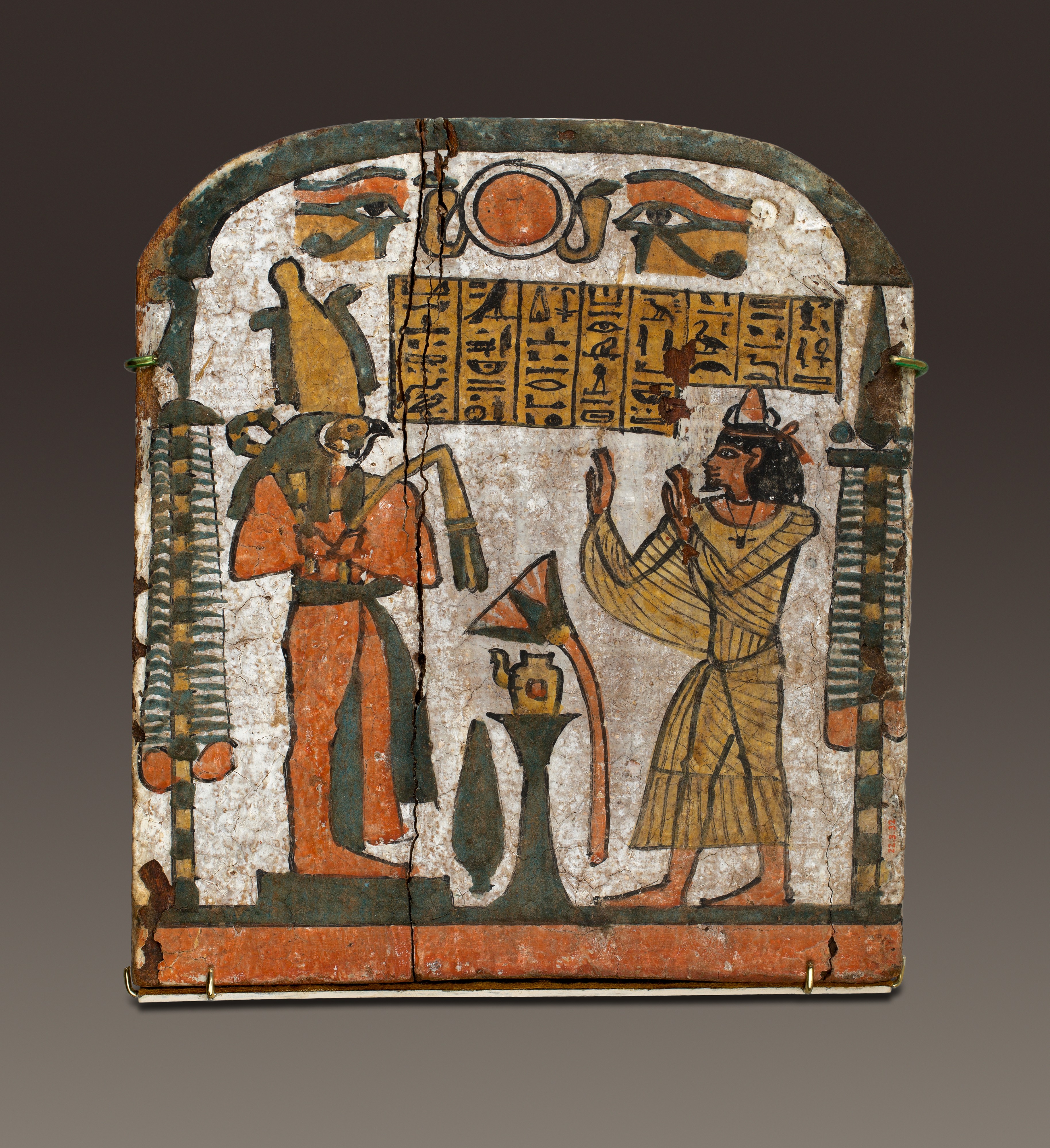
The Stela of Inamennayefnebu: A Material Meditation on Memory and Craft
Within the rarefied discourse of couture analysis, certain objects resist the conventional taxonomies of fashion history. The Stela of Inamennayefnebu, a funerary artifact rendered in wood, paste, and paint, belongs to this exceptional category. While it originates from the ritual traditions of ancient Egypt, its significance for contemporary couture scholarship extends far beyond archaeological curiosity. This standalone study examines the stela as a paradigm of material intelligence—a crafted object whose layered construction, symbolic density, and formal restraint offer profound lessons for designers navigating the intersection of heritage, narrative, and technical execution.
For the modern atelier, the stela functions as a mnemonic device—not merely commemorating a life but encoding the very principles of adornment, surface transformation, and structural integrity that define haute couture at its most rigorous.
Materiality as Narrative Architecture
The stela’s tripartite material composition—wood, paste, and paint—reveals a sophisticated understanding of layering that anticipates contemporary couture’s obsession with mixed-media surfaces. The wooden substrate provides structural integrity, a humble yet resilient foundation analogous to the hand-shaped corsetry or structured underlayers that support a couture gown’s silhouette. Upon this armature, the artisan applied paste—likely a gypsum or calcareous preparation—to create a smooth, receptive ground. This intermediate layer is critical: it mediates between the organic irregularity of wood and the chromatic ambitions of the painted surface.
In couture terms, this is the preparation of the toile, the unglamorous yet indispensable stage where the designer establishes the canvas for embellishment. The paste layer speaks to the importance of grounding—a technical and philosophical principle that resonates with the work of houses like Lesage or Lemarié, where embroidery and featherwork demand a meticulously prepared base to achieve their effects. The stela teaches that ornament without preparation is chaos; preparation without ornament is mute potential.
The final painted layer transforms the object into a vehicle of signification. Pigments—likely mineral-based, given the period—were applied with a precision that suggests both ritual function and aesthetic intentionality. The palette, though faded by millennia, retains traces of ochre, carbon black, and possibly Egyptian blue or green. These colors were not decorative choices alone; they were semiotic instruments, each hue carrying cosmological weight. For the couturier, this reminds us that color is never neutral. Every dye lot, every thread choice, every surface treatment participates in a system of meaning that extends far beyond the visual.
Formal Restraint and the Discipline of the Frame
Stelae are, by definition, framed objects. The Stela of Inamennayefnebu likely features a rounded or rectangular top, a defined border, and a carefully ordered interior field of text and image. This formal discipline is instructive. In an era of maximalist couture—where more is often mistaken for more—the stela demonstrates the power of containment. The frame does not merely enclose; it concentrates. It creates a world within a world, a bounded space where every element must justify its presence.
This principle finds direct expression in the work of designers like Cristóbal Balenciaga, whose sculptural silhouettes operated within strict architectural limits, or Yohji Yamamoto, whose monochromatic palettes and generous volumes achieve impact through restraint rather than accumulation. The stela’s internal organization—typically hierarchical, with the deceased or deity occupying a central position, surrounded by offering formulas and protective symbols—mirrors the hierarchical composition of a couture ensemble: the focal point (a hand-embroidered bodice, a dramatic shoulder), the supporting elements (a bias-cut skirt, a restrained sleeve), and the framing details (a collar, a hemline) that anchor the whole.
Moreover, the stela’s function as a standalone study—removed from its original architectural context—invites us to consider the object as a self-sufficient statement. In couture, the standalone piece—a single gown presented on a runway, photographed in isolation, archived without its accessories—must carry its own weight. It must be legible, resonant, and complete. The Stela of Inamennayefnebu, even stripped of its tomb, retains its power. This is the mark of intrinsic design integrity.
Heritage, Authenticity, and the Ethics of Appropriation
As a global heritage object, the stela also raises urgent questions for the contemporary fashion industry. Couture has long drawn inspiration from ancient cultures—Egyptian motifs appeared in the 1920s with the discovery of Tutankhamun’s tomb, in the 1960s with Cleopatra-inspired collections, and continue to surface in modern runway narratives. Yet the stela demands more than visual quotation. It demands material and contextual literacy.
To engage with such an object responsibly, the designer must understand not only its formal qualities but its biography: the wood’s origin, the paste’s composition, the paint’s chemistry, the ritual’s meaning. This is the difference between appropriation and critical homage. The stela is not a mood board image; it is a complex technological and spiritual artifact. Its study encourages a slower, more ethical approach to heritage—one that prioritizes research, collaboration, and attribution over extraction and pastiche.
Conclusion: The Stela as Couture Manifesto
In the end, the Stela of Inamennayefnebu is not a garment. It is not a dress, a coat, or a gown. But it is couture in the deepest sense: a handcrafted object of profound intention, where material, form, and meaning are inseparable. It teaches that surface is never superficial, that structure enables expression, and that restraint is a form of power. For the designers, curators, and scholars of Katherine Fashion Lab, the stela stands as a silent manifesto—a reminder that the most enduring creations are those that honor their materials, respect their contexts, and speak across millennia with clarity and grace.