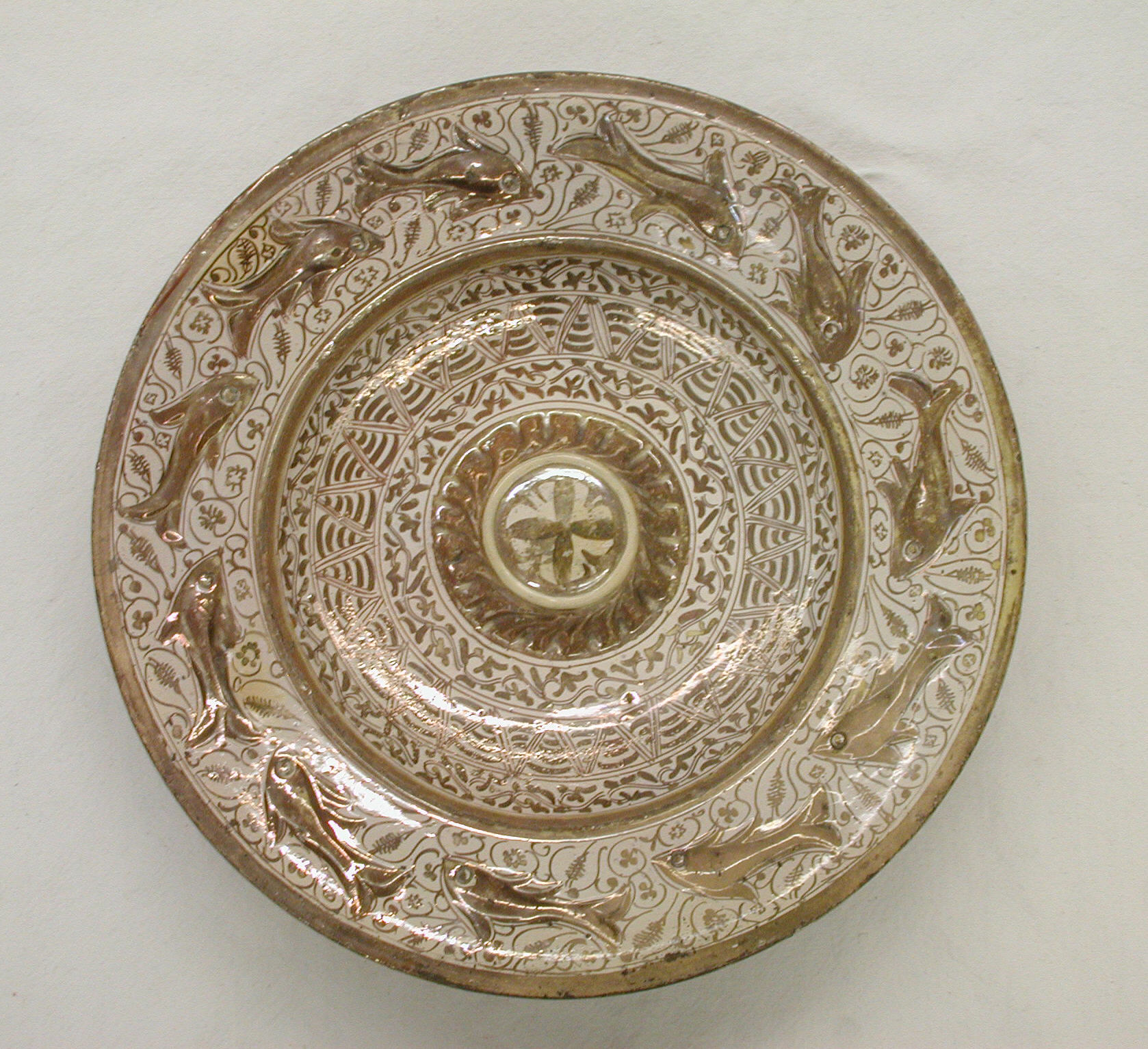
The Dish as Autonomous Artifact: A Couture Reading of Tin-Glazed Lusterware
Within the curatorial framework of Katherine Fashion Lab, the standalone study occupies a privileged position. It is an object liberated from the narrative obligations of the ensemble, the chronology of the collection, and the didacticism of the retrospective. The dish under present consideration—a tin-glazed, luster-painted earthenware form of global heritage—constitutes precisely such an autonomous artifact. To examine it is to confront a paradox central to the discipline of couture analysis: that the most humble domestic object may encode the most sophisticated systems of material intelligence, cross-cultural exchange, and aesthetic philosophy. This analysis treats the dish not as tableware but as a thesis in ceramic form, a surface upon which civilizations have written their aspirations in metallic pigment and vitreous glaze.
Material Provenance and the Alchemy of Surface
The technical identity of this dish is inseparable from its geography. Tin-glazed earthenware—known variously as majolica in Italy, faience in France and Germany, delftware in the Netherlands and England—represents one of the earliest and most consequential instances of global material transfer. The opacity of tin oxide, suspended in a lead glaze, provided potters with a white ground that mimicked the coveted porcelain of Chinese export wares while remaining achievable with locally available clays. This was, in effect, an early modern exercise in luxury substitution: the democratization of whiteness.
Yet it is the luster that elevates this dish from competent imitation to couture object. Luster painting—the application of metallic oxides, typically copper or silver, followed by a third firing in a reduction atmosphere—produces an iridescent film of extraordinary fragility and depth. The technique originated in the Islamic world, likely in ninth-century Iraq, where potters sought to replicate the sheen of precious metal without its material cost. By the time it reached Hispano-Moresque Spain and later Italian and Persian workshops, luster had become a signature of technical virtuosity. The dish thus carries within its very surface a history of transmission: from Basra to Málaga, from Valencia to Deruta, from Kashan to Iznik. Its glaze is a palimpsest of migration.
Form, Function, and the Rhetoric of the Circle
Consider the morphology of the dish itself. It is a shallow, circular vessel with a wide rim and a central well—a form so ubiquitous as to appear inevitable. But in couture analysis, inevitability is always suspect. The circle is a cosmological statement: the horizon, the sun, the cycle of seasons, the perfection of the infinite. When a luster-painted dish is displayed upright, as in the tradition of Renaissance credenza arrangements or modern museum vitrines, its circularity becomes a framing device. It is no longer a receptacle for food but a window onto a decorated world.
This tension between utility and display is central to the object's couture identity. The dish was made to be used—to hold fruit, to serve a roast, to be washed and stacked. Yet its luster decoration, vulnerable to abrasion and acidic foods, militates against such use. It is a functional object designed for contemplation, a contradiction that aligns it with the highest expressions of fashion: garments whose construction renders them nearly unwearable, yet whose cultural power depends precisely on that impracticality. The dish is couture in ceramic form: an object whose beauty is inseparable from its fragility.
Global Heritage and the Politics of Ornament
The decoration of this dish—presumably geometric, vegetal, or heraldic, given the lusterware tradition—participates in a visual language that traversed continents. Islamic arabesque, Gothic script, Renaissance grotesques, and Chinese lotus motifs coexisted on the surfaces of tin-glazed wares in ways that anticipate the globalized visual culture of the twenty-first century. A single dish might bear a coat of arms commissioned by a Florentine merchant, painted by a craftsman trained in the Moorish tradition, using pigments traded from the Levant, fired in a kiln whose technology originated in Mesopotamia.
This hybridity is not incidental; it is the object's essential character. In the vocabulary of Katherine Fashion Lab, we might describe it as a transcultural artifact of the first order—a material witness to the fact that globalization is not a contemporary phenomenon but a continuous condition of human creativity. The dish does not belong to a single heritage. It belongs to the network of heritages that produced it, each layer of glaze and pigment a negotiation between local identity and foreign influence.
Standalone Study: The Dish as Method
Why isolate the dish for analysis? Because in its autonomy, it reveals what the ensemble obscures. A table setting, a collection, a museum gallery—these contexts distribute meaning across multiple objects, allowing the viewer to synthesize, compare, and categorize. The standalone study denies this comfort. It demands that we confront the object in its singularity, that we read its surface as a complete text rather than a fragment of a larger narrative.
This is the discipline of couture analysis at its most rigorous. The dish, stripped of its table, its companions, its provenance file, must justify its existence through material intelligence alone. And it does. It speaks of tin and silver, of fire and reduction, of the human desire to make the ordinary luminous. It speaks of trade routes and workshops, of apprentices and patrons, of the endless migration of forms. It speaks, finally, of the possibility that a shallow circle of fired clay can hold within its glaze the memory of a world.
In the end, the dish is not a dish. It is a proposition: that beauty may be baked into matter, that heritage may be painted in metallic film, that the most domestic object may be the most cosmopolitan. Katherine Fashion Lab presents this standalone study as an invitation to read the surface—and to find, in its luster, the reflection of a global imagination.