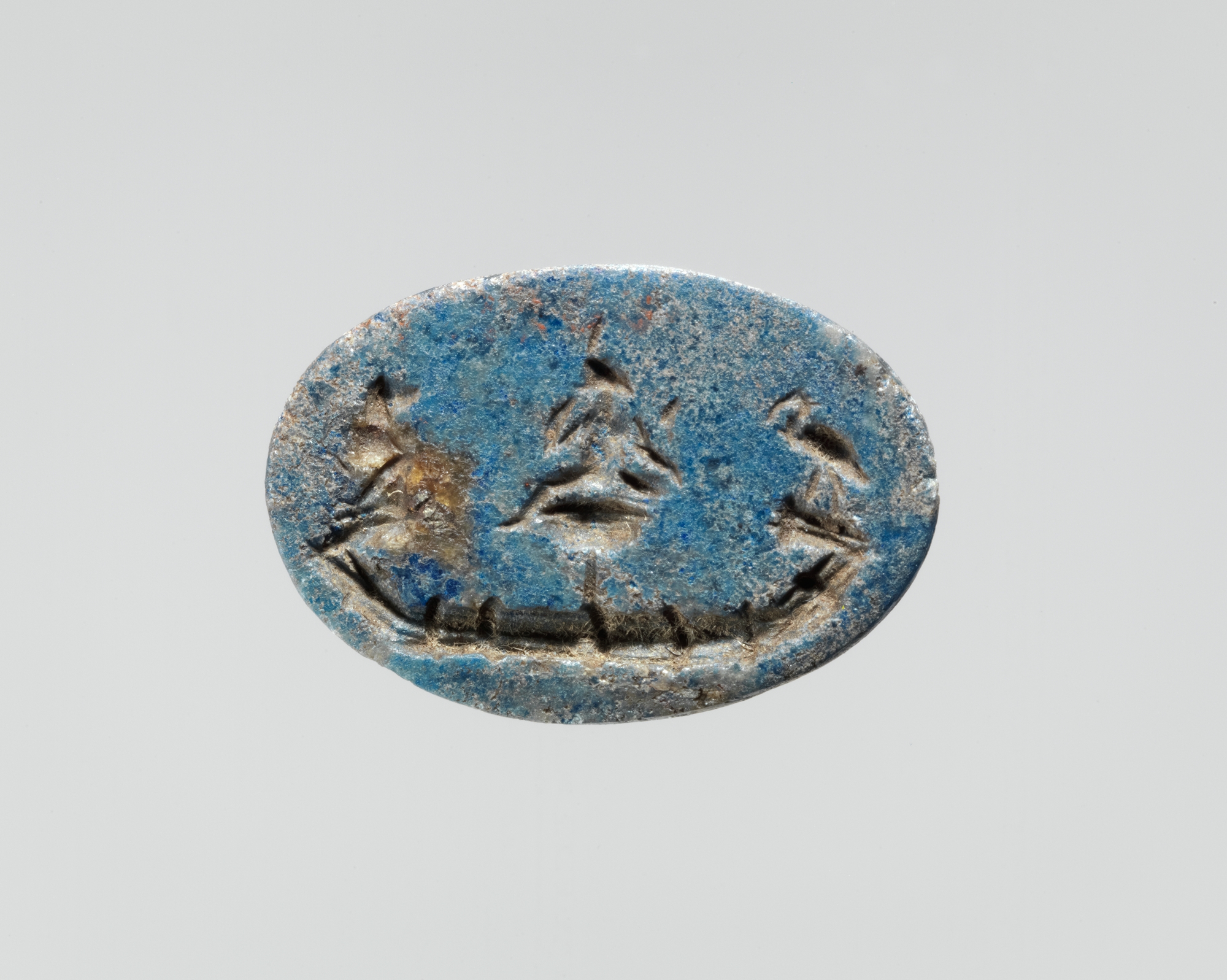
Executive Summary: The Strategic Value of a Roman Lapis Lazuli Intaglio
In the competitive landscape of 2026 luxury, provenance and narrative depth are no longer differentiators—they are prerequisites. The object under examination, a Roman lapis lazuli intaglio depicting Harpocrates in a papyrus boat, represents a convergence of rare material, syncretic spiritual symbolism, and portable antiquity. For Katherine Fashion Lab, this artifact offers a strategic blueprint for a heritage-driven collection that bridges archaeological authenticity with contemporary consumer desire for talismanic luxury. This analysis evaluates the intaglio's symbolic power, historical adornment function, spiritual meaning, and its actionable implications for high-end product strategy.
Materiality and Symbolic Power: Lapis Lazuli as a Luxury Signal
Lapis lazuli in the Roman world was not merely a stone; it was a geopolitical asset. Sourced primarily from the Sar-e-Sang mines in present-day Afghanistan, lapis traveled vast trade networks to reach the Mediterranean, embedding itself in elite consumption. Its deep ultramarine hue, often flecked with golden pyrite, was associated with the heavens, divine favor, and royal authority. In Roman gemstone hierarchies, lapis ranked among the lapides pretiosi—stones reserved for signet rings, amulets, and imperial commissions.
The choice of lapis for an intaglio was deliberate. Intaglios required stones hard enough to carve fine detail yet durable enough for daily wear. Lapis, with a Mohs hardness of 5–6, met both criteria while offering a chromatic intensity that distinguished it from carnelian, sardonyx, or hematite. For Katherine Fashion Lab, this materiality translates into a strategic asset: lapis lazuli communicates rarity, provenance, and celestial symbolism without requiring explanation. In a 2026 market where consumers seek objects of meaning, lapis serves as a visual shorthand for enduring value.
Historical Adornment: The Intaglio as Personal and Political Instrument
Roman intaglios were not passive ornaments. They functioned as seals, amulets, and status markers, worn on rings or embedded in pendants. The engraved image—Harpocrates in a papyrus boat—activated the stone's power through direct contact with the wearer's skin. This intimacy between object and body is a critical insight for luxury strategy: adornment in antiquity was performative and protective, not merely decorative.
Harpocrates, the Hellenized form of the Egyptian child-god Horus, was adopted by Roman elites as a symbol of silence, discretion, and nascent power. His depiction in a papyrus boat evokes the solar barque of Ra, linking the wearer to cycles of rebirth and safe passage. The boat itself, constructed from papyrus—a material associated with Lower Egypt and the goddess Wadjet—reinforces themes of protection and organic renewal. When worn, the intaglio became a portable shrine: a private declaration of affiliation with mystery cults, Isiac devotion, or simply a cosmopolitan appreciation for Egyptian theology.
This historical function offers a direct parallel to contemporary high-end jewelry. Today's luxury consumer seeks pieces that encode identity and belief, not just wealth. The Harpocrates intaglio demonstrates that adornment can be simultaneously esoteric and socially legible—a balance Katherine Fashion Lab can replicate through limited-edition signet rings or talismanic pendants that reference this artifact's iconography.
Spiritual Meaning: Syncretism and the Silent God
The spiritual power of this intaglio lies in its syncretic nature. Roman religion was inherently absorptive, and Harpocrates exemplifies this dynamic. Originally an Egyptian deity representing the newborn sun, Harpocrates was reinterpreted by Greeks and Romans as the god of silence—sigalion—often depicted with a finger to his lips. This gesture, misread in later centuries as a request for quiet, originally symbolized the child-god's role as a keeper of divine secrets.
In a papyrus boat, Harpocrates becomes a psychopomp and a solar traveler. The boat navigates the waters of creation, carrying the silent god through danger and darkness. For the Roman wearer, this image promised protection during transitions—whether journeys, initiations, or the passage of the soul. The lapis medium amplified this promise: its blue evoked the celestial Nile, its golden inclusions the stars guiding the vessel.
For Katherine Fashion Lab, this spiritual dimension is not a historical footnote but a strategic lever. In 2026, luxury consumers increasingly seek objects of contemplation and resilience. A collection inspired by Harpocrates in his papyrus boat can position adornment as a practice of mindfulness—a wearable reminder of silence, safe passage, and inner sovereignty. The narrative writes itself: each piece is a vessel, each wearer a traveler.
2026 High-End Luxury Strategy: From Artifact to Atelier
The commercial translation of this intaglio requires a disciplined approach. Three strategic pillars emerge:
1. Material Authenticity and Ethical Provenance. Lapis lazuli remains a viable luxury material, but 2026 consumers demand transparency. Katherine Fashion Lab should source from certified, conflict-free mines and articulate the stone's journey from Sar-e-Sang to the atelier. This narrative mirrors the Roman trade route, creating a heritage continuity that justifies premium pricing.
2. Iconographic Licensing and Limited Editions. The Harpocrates-in-boat motif should be reproduced through hand-carved intaglios, not mass-printed etchings. Each piece can be numbered, with a certificate detailing its Roman antecedent. Scarcity is enforced by the labor intensity of intaglio carving—a technique that few contemporary artisans master. This positions the collection at the intersection of archaeology and haute joaillerie.
3. Narrative-Led Retail and Digital Provenance. The object's power depends on its story. Katherine Fashion Lab should deploy immersive digital content—3D scans of the original intaglio, scholarly commentary on Harpocrates, and wearer testimonials—to transform a ring or pendant into a collectible narrative asset. In an era of blockchain-backed provenance, each piece can carry a digital twin documenting its symbolic lineage.
Conclusion: The Intaglio as Strategic Compass
The Roman lapis lazuli intaglio of Harpocrates in a papyrus boat is more than an archaeological curiosity. It is a case study in how material, image, and belief converge to create enduring value. For Katherine Fashion Lab, this artifact offers a roadmap for 2026: prioritize symbolic density over surface trend, embed spiritual meaning into wearable objects, and treat provenance as a living narrative rather than a static certificate. The silent god in his boat has traveled two millennia to reach this moment. The strategic question is not whether to listen, but how to carry him forward.