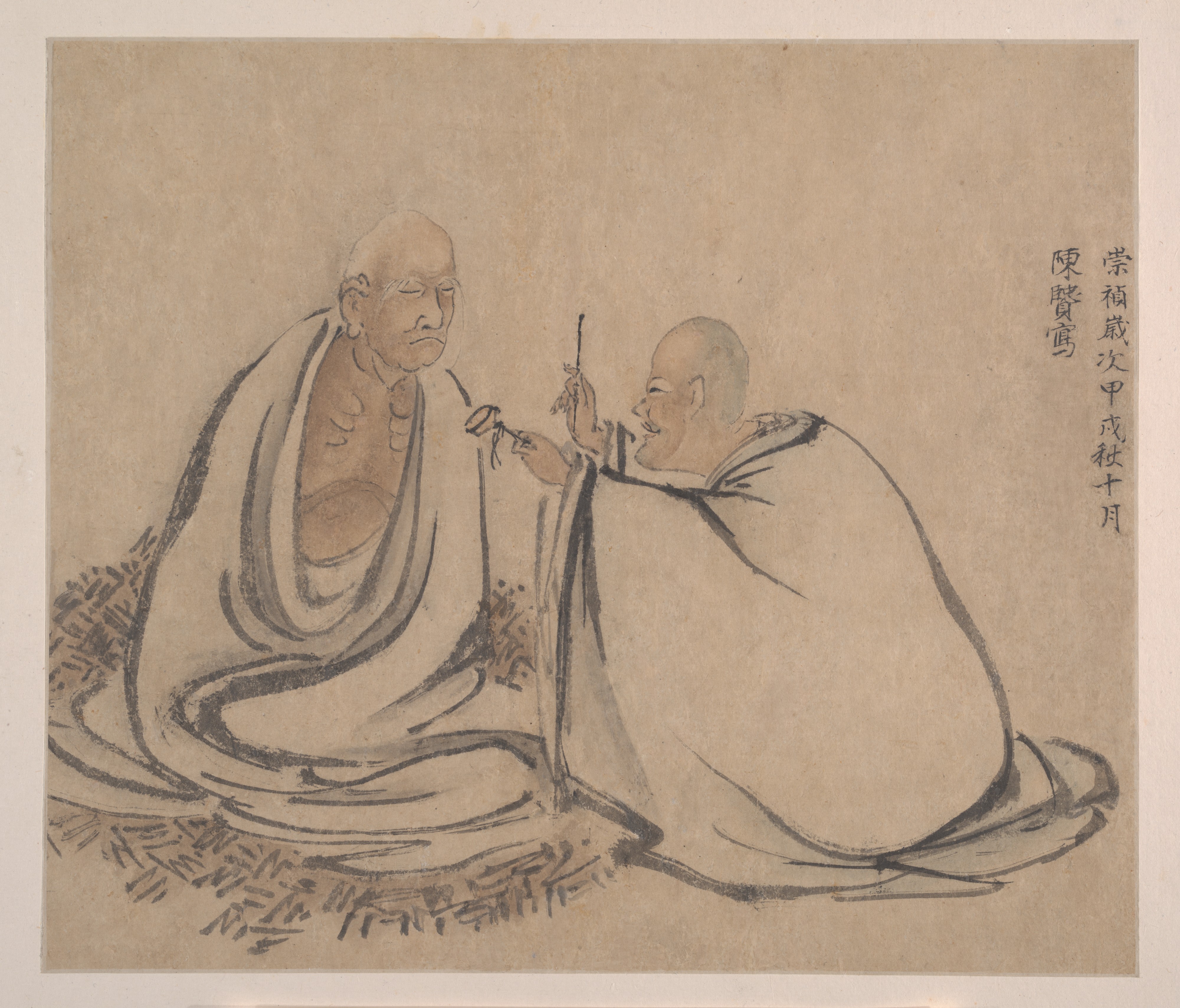
The Sixteen Luohans: A Couture Analysis of Sanctified Form and Line
Within the venerable tradition of East Asian Buddhist art, the depiction of the Sixteen Luohans (or Arhats) represents a profound intersection of spiritual doctrine, cultural narrative, and artistic virtuosity. For Katherine Fashion Lab, this album of sixteen paintings—executed in ink and color on paper—serves not as a mere historical artifact, but as a masterclass in character-driven design, structural integrity, and the eloquent use of negative space. These enlightened disciples of the Buddha, tasked with preserving the Dharma until the coming of the next Buddha, are rendered not as monolithic saints, but as a collection of distinct individuals. This analysis deconstructs the album as a standalone sartorial study, extracting principles of silhouette, texture, and composition that resonate with the highest ideals of avant-garde couture.
Architectural Silhouette and the Doctrine of Drapery
The most immediate and powerful lesson from the Luohan paintings lies in the treatment of the robe. The monastic garment, the kāṣāya, is far more than cloth; it is an architectural shell that defines the posture and spirit of the figure within. The artists employ ink washes and precise, rhythmic lines to depict fabric that is simultaneously heavy with spiritual gravity and animated by an inner vitality. We observe a foundational couture principle: fabric must communicate weight, movement, and attitude.
In some depictions, the robe falls in crisp, angular folds, creating a geometric, almost crystalline structure around the seated figure. This suggests a tailoring approach focused on sharp, intentional construction—think sculptural jackets or gowns with origami-like pleating that creates its own space. In other paintings, the drapery flows in soft, liquid curves, pooling around the Luohan like water. This translates to bias-cut garments where the material cascades organically, following and revealing the body's form in a subtle, reverent manner. The key is the intentionality of each fold and line; nothing is accidental. Every break in the fabric tells a story of the body beneath—a bent knee, a meditative slump, a firm shoulder—making the garment an active participant in narrating the wearer’s posture and poise.
Character as Blueprint: The Individual Within the Uniform
Despite the uniformity of their sacred role and basic attire, each Luohan is meticulously individualized. This is a core tenet of haute couture: the transformation of a uniform code into a personal statement. The artists achieve this through nuanced variations in posture, attribute, and, most instructively, the handling of the robe itself.
One Luohan may have his robe arranged with fastidious precision, every fold orderly, suggesting a personality of rigorous discipline. This inspires a design ethos of minimalist perfection, where seam placement and internal structure are the sole decorative elements. Another may have his robe loosely draped, even slipping from a shoulder, revealing a wizened chest or a powerful arm. This speaks to a more deconstructed, effortless elegance—a garment that appears to be in a state of graceful becoming. The accessory attributes—the dragon, the sutra, the staff, the begging bowl—are the ultimate couture accents. They are not mere props but symbolic extensions of the figure’s identity. In fashion terms, these are the meticulously chosen, conversation-piece accessories: a sculptural handbag, a transformative piece of jewelry, or an heirloom textile incorporated into the design, which completes and personalizes the narrative of the ensemble.
The Palette of Transcendence: Ink, Color, and Negative Space
The medium of ink and light color on paper is decisive. The palette is typically restrained: the profound blacks and grays of sumi ink, punctuated by muted mineral pigments—ochres, rusts, and muted greens—for flesh tones, attributes, or landscape elements. This is a masterclass in restrained color theory, where value and tone are paramount, and color is used as strategic emphasis rather than blanket coverage.
For couture, this translates to a foundational philosophy where the inherent quality of a material—the luster of a silk duchesse, the matte density of a wool crepe—is celebrated. Color is applied with poetic specificity: a lining in burnt sienna, an embroidered motif in verdigris, a thread of gold tracing a seam. The vast, untouched paper ground is the most critical element. This negative space is not empty; it is atmospheric, a field of spiritual and visual resonance. In design, this equates to the essential understanding of the body as the foundational canvas. It mandates the strategic use of bare skin, the breath between garment and body, and the powerful statement of a single, isolated detail against a plain fabric ground. The composition teaches that what is omitted is as vital as what is rendered.
From Spiritual Lineage to Sartorial Legacy: A Modern Translation
For Katherine Fashion Lab, the Sixteen Luohans album provides a rigorous framework for contemporary creation. The translation is not literal but philosophical. Imagine a collection where each look embodies a "Luohan principle."
A silhouette built from layered, asymmetrical folds of stiffened organic silk, creating a personal architecture around the wearer (inspired by the geometric drapery). A gown that utilizes a single, continuous length of fabric, wrapped and tied to form both sleeve and bodice, celebrating the beauty of transformative dressing (inspired by the loose, adaptive robes). The palette would be rooted in the depth of ink-black, shell-white, and clay, with shocking, singular accents of cinnabar or lapis lazuli reserved for a lining or a meticulously embroidered symbol. Tailoring would focus on interior structure that creates iconic, almost exaggerated posture—a powerful shoulder line that evokes meditative solidity, or a back construction that allows fabric to fall into perfect, serene pools.
Ultimately, these paintings are studies in composed individuality. They teach that true luxury and power in dress come from a deep understanding of internal structure (the body, the spirit), expressed through a mastered external form (the garment). The Luohans are eternally relevant muses because their style is born of purpose, character, and profound authenticity—the very pillars upon which enduring couture is built. Their album is not just a set of religious images; it is a timeless manifesto on the art of making an inner life visible through the sanctity of line, form, and considered space.