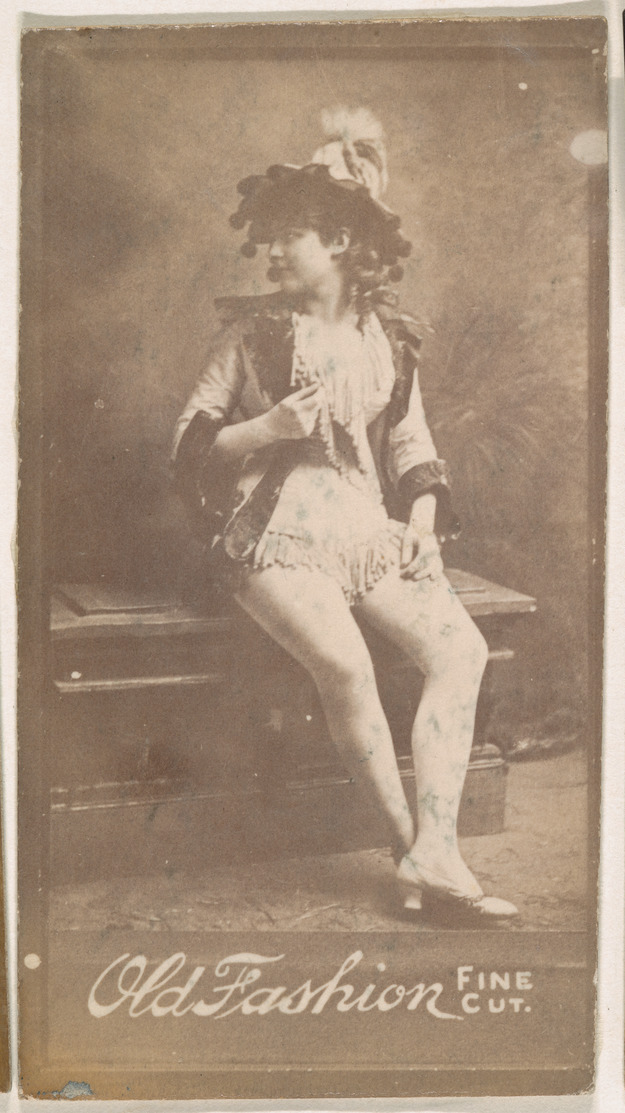
Introduction: The Actress on the Bench as a Site of Cultural Negotiation
The Actresses series (N664), issued to promote Old Fashion Fine Cut Tobacco, occupies a deceptively modest position within the broader landscape of late nineteenth-century photographic ephemera. Among its surviving cards, the present study isolates a single, standalone image: an actress seated on a bench, rendered as an albumen photograph. This card is not merely a collectible; it is a compressed artifact of intersecting economies—commercial, theatrical, and visual. Its subject, a female performer posed in a moment of apparent repose, becomes a locus for examining how global heritage circulates through the most ordinary objects of industrial modernity. The bench, the studio set, and the albumen surface together produce a quiet but insistent argument about gender, spectatorship, and the transnational flow of images in the Gilded Age.
The Material Logic of the Albumen Photograph
To understand the N664 card, one must begin with its physical substrate. Albumen photography, dominant from the 1850s through the 1890s, used paper coated with egg white and sensitized with silver salts. The result was a glossy, warm-toned surface capable of remarkable detail—ideal for the small-scale portraiture that tobacco inserts demanded. Unlike the lithographic trade card, the albumen photograph carried an indexical claim: this actress, or at least a body bearing her likeness, once sat before a lens.
The materiality of the albumen print matters for three reasons. First, its tonal range—from deep sepia shadows to creamy highlights—gave the seated figure a sculptural presence that flattered theatrical subjects accustomed to dramatic lighting. Second, its fragility meant that these cards were handled, traded, and often discarded, making surviving examples rare documents of everyday visual culture. Third, the small format imposed compositional discipline: the bench, the actress’s posture, and the studio backdrop had to communicate instantly and economically. The albumen surface thus functions as both a window onto a performance and a mirror of the commercial pressures that shaped it.
The Bench as Prosthetic and Stage
The bench in this image is not incidental furniture. It is a prosthetic extension of the actress’s body, organizing her limbs into a legible silhouette. In nineteenth-century theatrical portraiture, the seated pose was a standard solution to the problem of representing an entire performance within a single frame. Standing figures tended to appear stiff or monumental; seated figures could suggest intimacy, contemplation, or coquettish ease. The bench here performs a double duty: it grounds the actress in a recognizable domestic or pastoral setting while also elevating her—literally and figuratively—above the mere snapshot.
Critically, the bench also signals class and respectability. Unlike a stool or a chaise longue, a bench implies public space: a park, a railway platform, a garden promenade. By placing the actress on a bench, the photographer aligns her with the emerging figure of the modern mobile woman—visible, unaccompanied, and yet contained within the frame’s decorum. This is a carefully managed transgression, one that the tobacco company could market as both titillating and safe.
Old Fashion Fine Cut Tobacco and the Economy of Collecting
The N664 series belonged to a broader phenomenon: the cigarette card as promotional currency. Tobacco manufacturers discovered that inserting stiffeners into soft packs could double as collectible advertisements. By commissioning photographic portraits of actresses, they tapped into a ready-made fan culture. Theatergoers already collected playbills and engraved portraits; the albumen card simply miniaturized and standardized that desire.
For Old Fashion Fine Cut Tobacco, the actress card served multiple purposes. It advertised the brand’s modernity—photography was still a relatively new commercial medium—while also associating the product with the glamour of the stage. The actress’s seated pose, often with a slight turn toward the viewer, invited the collector to imagine a private audience. This was parasocial intimacy avant la lettre: the smoker could hold in his hand the image of a woman he might never see in person, yet whose performance he could claim to possess.
From a heritage perspective, the series is transnational. Actresses were photographed in studios from New York to London to Paris, and the cards circulated across borders. The bench, the backdrop, and the albumen process were themselves global conventions, adapted locally by each studio. Thus, a single card promoting an American tobacco brand might depict a European actress posed in a manner derived from French theatrical photography, printed on paper manufactured in Germany. The object is a networked artifact, its apparent simplicity masking a dense web of trade, migration, and aesthetic exchange.
Standalone Study: The Actress Without Her Series
To treat this card as a standalone study is to resist the collector’s impulse to complete the set. Instead, we attend to the internal logic of the single image. Isolated from its siblings, the actress on the bench becomes less a specimen and more a portrait in the traditional sense. We notice the fall of her skirt, the angle of her wrist, the slight asymmetry of her shoulders. We notice, too, the bench’s grain and the backdrop’s faint mottling—traces of the studio’s material world.
This isolation also reveals the performative labor behind the pose. The actress is not simply resting; she is composing herself for the camera. Her gaze may be directed slightly off-axis, a convention that suggests reverie rather than direct address. Her hands, often the most restless part of a seated portrait, are stilled—perhaps folded, perhaps resting on the bench’s edge. The result is a tableau vivant in miniature, a frozen excerpt from a play we will never see.
Gender, Spectatorship, and the Politics of the Seated Pose
Feminist art historians have long argued that nineteenth-century portraiture often reduced women to objects of the gaze. The N664 card certainly participates in that economy: the actress is young, conventionally beautiful, and framed for consumption. Yet the seated pose also offers resistance. By sitting, the actress claims space. She is not standing to attention; she is not curtseying. She occupies the bench with a certain sovereignty, however scripted.
Moreover, the bench implies a narrative beyond the frame. Who is she waiting for? What has she just done? The card’s commercial function—to sell tobacco—depends on this ambiguity. The smoker is invited to complete the story, to imagine the conversation, the flirtation, the solitude. In this sense, the actress on the bench is a collaborator in her own commodification, but also a skilled manager of her own image. Many actresses of the period used such cards to build public followings, and some negotiated directly with photographers and tobacco companies for favorable terms.
Global Heritage and the Afterlife of the Card
Today, the N664 card resides in the ambiguous category of global heritage. It is not a masterpiece, nor a monument. It is a minor relic that nonetheless illuminates major historical forces: the rise of mass photography, the globalization of advertising, the professionalization of actresses, and the gendered politics of looking. Its albumen surface, now often faded or foxed, bears witness to the chemical and commercial conditions of its making.
For the contemporary viewer, the card offers a lesson in slow looking. The bench, the pose, the tobacco brand, and the photographic process are all legible if we resist the urge to dismiss the object as mere ephemera. The actress seated on the bench is not a passive subject. She is a node in a network—of studios, printers, distributors, smokers, and collectors—that stretched across the Atlantic and beyond. Her image, fixed in albumen, continues to solicit our attention, asking us to consider what it meant to be seen, and to sell, in the age of the cigarette card.
Conclusion: The Quiet Radicalism of the Seated Actress
The Actresses series (N664) card of an actress seated on a bench is a small thing: a few square inches of albumen paper, a faint image, a line of promotional text. Yet within that smallness lies a cosmopolitan history. The bench becomes a stage, the photograph becomes a commodity, and the actress becomes a global figure—however briefly. To study this card as a standalone object is to recover the material and performative labor that made such images possible. It is also to recognize that heritage is not only in museums and monuments, but in the everyday objects that once circulated through pockets, albums, and tobacco shops. The actress on the bench is still waiting, still posing, still selling—and still, quietly, resisting.