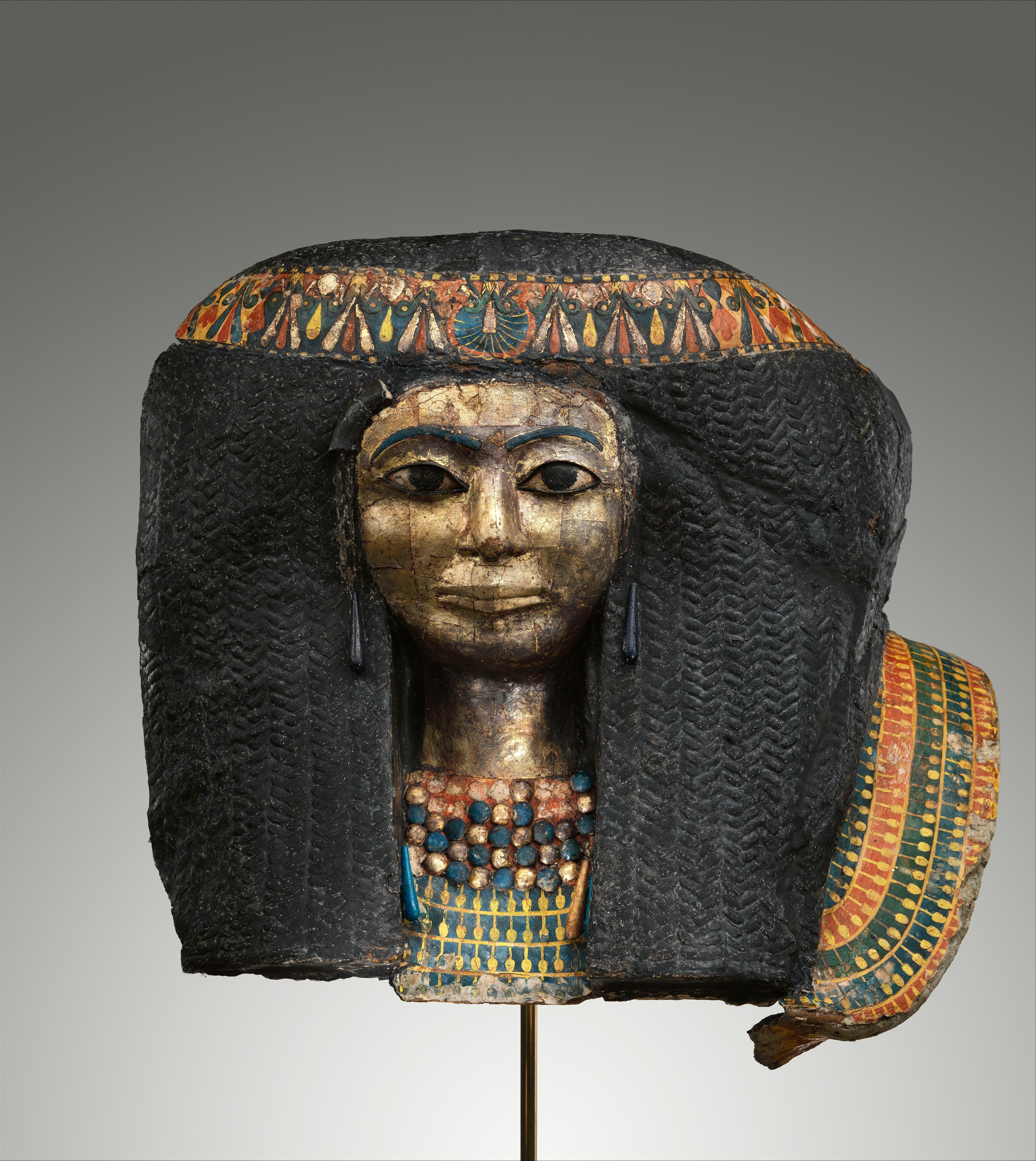
Heritage Analysis: The Funerary Mask of a Woman
Introduction: The Mask as a Strategic Artifact
Within the broader portfolio of ancient material culture, few objects carry the strategic density of the funerary mask. The Funerary Mask of a Woman—executed in cartonnage, gesso, paint, gold, copper alloy, and faience—represents not merely a burial good but a carefully engineered instrument of transformation. For Katherine Fashion Lab, this artifact offers a case study in how adornment functions as a technology of meaning: a system in which materials, iconography, and ritual performance converge to project identity beyond the threshold of death. The mask is, in effect, a luxury object in the original sense—scarce, skill-intensive, spiritually charged, and designed for an elite consumer whose status depended on visible mastery of symbolic capital.
Material Hierarchy and the Logic of Permanence
The mask's composite construction reveals a deliberate hierarchy of materials. Cartonnage—layered linen or papyrus stiffened with gesso—provided the structural substrate, lightweight yet durable enough to preserve the contours of the face. Gesso served as the ground for polychrome paint, enabling the fine detailing of eyebrows, cosmetic lines, and funerary text. Gold, applied as leaf or powder, signaled incorruptibility and solar identification, linking the deceased to the cyclical eternity of the sun god. Copper alloy elements introduced a contrasting metallic register, while faience—a sintered quartz paste with a vitreous blue-green glaze—evoked regeneration, the color of life emerging from the primordial waters.
This material hierarchy is not arbitrary. It reflects an ancient understanding that luxury is a language of differentiated substances, each carrying distinct associations of rarity, origin, and metaphysical efficacy. Gold was not simply beautiful; it was ontologically stable, resistant to tarnish, and therefore a fitting medium for the immortal self. Faience, by contrast, was a manufactured luxury—its production required specialized kilns and controlled recipes, making it a marker of technological sophistication. For a contemporary luxury house, the lesson is precise: material choice is never merely aesthetic. It is a statement about what the brand believes lasts, and why.
Symbolic Power: The Face as Cosmetic and Cosmic Surface
The mask's most immediate function was to idealize the deceased. The painted face typically presented a youthful, serene countenance, with eyes outlined in kohl and lips tinted in red ochre. This was not portraiture in the modern sense but a strategic representation—the deceased as they wished to be seen in the afterlife, assimilated to the gods and freed from the decay of the body. The cosmetic detailing is significant: it transforms the face into a surface of adornment, where every line and color carries apotropaic and regenerative meaning.
For Katherine Fashion Lab, this raises a critical question about the ethics and aesthetics of idealization. The ancient mask did not conceal identity; it elevated it. The woman beneath the mask was not erased but translated into a higher register of being. In luxury strategy, the equivalent is the transformation of the client through the product—not into someone else, but into a more fully realized version of themselves. The mask is therefore a precursor to the modern beauty ritual, the couture gown, the signature scent: an instrument that mediates between the wearer's present self and their aspirational self.
Historical Adornment and the Gendered Body
The Funerary Mask of a Woman also participates in a long history of gendered adornment. In ancient civilizations, women's burial assemblages often emphasized jewelry, cosmetic equipment, and textile wealth. The mask's gold and faience elements would have caught the light in the tomb, creating a theatrical effect that reinforced the deceased's status. This is adornment as performance—a final, permanent act of self-presentation.
Historically, women's adornment has been dismissed as vanity or ornamentation. The mask refutes this reading. It is a document of agency: the woman's family and community invested substantial resources in her posthumous identity. The mask asserts that her face mattered, that her beauty and status were worth preserving in gold and glaze. For a contemporary luxury brand, this historical precedent offers a powerful narrative: adornment is not superficial but existential. It is how cultures mark what they value and how individuals claim their place in the order of things.
Spiritual Meaning: The Mask as Threshold Technology
In its original context, the mask was a functional object in a ritual process. It was believed to protect the face from decay, to provide the deceased with a recognizable form for the soul's return, and to equip the spirit with the means to navigate the afterlife. The gold identified the wearer with the sun god; the faience with Osiris, lord of regeneration; the copper alloy with enduring strength. The mask was thus a composite deity—a wearable pantheon.
This spiritual density is the source of its enduring power. The mask does not merely represent belief; it operationalizes it. It is a technology of transition, designed to manage the most profound boundary crossing of all. For luxury strategy in 2026, this suggests a model of the product as ritual object. The most successful luxury brands are those that provide not just goods but thresholds—moments of transformation that the consumer can inhabit and repeat.
2026 Luxury Strategy: Heritage as Forward-Looking Capital
As Katherine Fashion Lab looks toward 2026, the Funerary Mask of a Woman offers a strategic framework. First, material integrity: the mask's power derives from the disciplined use of precious and semi-precious materials in a coherent hierarchy. Luxury brands must resist the temptation to dilute material meaning for volume; scarcity and specificity remain the engines of desire.
Second, symbolic legibility: the mask communicates its meanings through a shared visual language—gold for eternity, blue for regeneration, the idealized face for transformation. A 2026 luxury strategy must build similarly legible codes, whether through color, silhouette, or ritualized service moments.
Third, spiritual resonance: the mask addresses the human need for continuity and meaning beyond the material. Luxury in the coming decade will increasingly be judged by its ability to provide not just status but significance—objects and experiences that help consumers navigate identity, mortality, and memory.
Finally, gendered heritage: the mask is a woman's object, made for a woman's eternity. Katherine Fashion Lab can draw on this lineage to articulate a luxury proposition that honors women's historical role as custodians of adornment and meaning, without reducing them to decorative subjects.
Conclusion: The Mask as Mirror
The Funerary Mask of a Woman is not a relic of a dead civilization. It is a mirror in which the luxury industry can see its own deepest logic: the transformation of raw materials into carriers of identity, the engineering of permanence from perishable substances, and the belief that adornment is a serious human endeavor. For Katherine Fashion Lab, the strategic imperative is clear. Heritage is not nostalgia; it is a laboratory of meaning. The mask teaches that the most powerful luxury objects are those that help us cross thresholds—and that the face we present to eternity is the ultimate luxury statement.